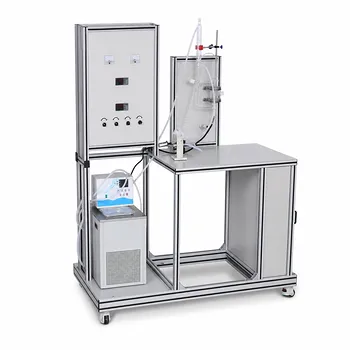
The essential foundation is a validated thermodynamic model matched to the separation: collect the relevant pure-component properties, characterize phase behavior across the pilot plant’s operating range, and select models that represent non-idealities in each phase. For vapor-liquid systems, this usually means a fugacity-based equation of state or a combined activity-coefficient/equation-of-state method; for liquid-liquid systems, it means an activity-coefficient model such as NRTL or UNIQUAC, validated against measured tie-line data.
Reliable pilot-plant design requires more than boiling points and equilibrium curves. The model must predict fugacity, phase stability, mutual solubility, azeotropes, and phase compositions over the actual temperature, pressure, and composition ranges of operation.
Define the Thermodynamic Design Basis
Establish the operating envelope
Specify the expected temperature, pressure, composition, and flow ranges before selecting property methods.
The model must cover normal startup, shutdown, turndown, feed variability, and potential excursions into two-liquid or three-phase regions. A model that is accurate at the nominal condition may be unreliable near an azeotrope, critical point, or liquid-liquid phase boundary.
Identify the required components and phases
Include all major feed components, products, solvents, water, light gases, heavy ends, and likely impurities.
The phase set may include:
- One liquid phase
- Two liquid phases
- One vapor phase
- Vapor plus one liquid phase
- Vapor plus two liquid phases
The last case is VLLE, and it is particularly important when distillation and extraction behavior interact or when heterogeneous azeotropes are possible.
Essential Pure-Component Parameters
Molecular weight and normal boiling point
Molecular weight supports material balances, molar-to-mass conversions, and mixture-property calculations.
The normal boiling point provides an initial indication of volatility differences, but it is not sufficient to predict separation performance in non-ideal mixtures.
Freezing and melting behavior
Normal freezing or melting points help identify the risk of solid formation during cooling, solvent recovery, startup, and shutdown.
This is important for pilot plants because a small amount of solid formation can obstruct valves, sampling lines, reboilers, or heat-transfer surfaces.
Critical properties and acentric factor
Critical temperature, critical pressure, and related parameters are needed by many equations of state, including cubic EOS methods.
They are especially important for high-pressure vapor-liquid calculations, near-critical operation, and estimating fugacity coefficients and phase-splitting behavior.
Phase-transition enthalpies
Include heats of vaporization, fusion, and, where relevant, sublimation.
These properties support energy balances, reboiler and condenser sizing, utility calculations, and prediction of temperature changes during flashing or evaporation.
Heat capacities
Liquid and vapor heat capacities are required for enthalpy calculations over the design temperature range.
They affect condenser duty, reboiler duty, flash temperature prediction, and the energy balance used to interpret pilot-scale performance.
Liquid density and viscosity
Liquid density supports hydraulic calculations, holdup estimates, residence-time calculations, and conversion between mass and volumetric flow.
Viscosity affects mixing, droplet formation, settling, column pressure drop, and mass-transfer performance. These are not phase-equilibrium parameters themselves, but they are essential for converting equilibrium predictions into a workable pilot-plant design.
Apply the Correct Phase-Equilibrium Criteria
Vapor-liquid equilibrium
At VLE, each component must have equal fugacity in the vapor and liquid phases:
[ f_i^V=f_i^L ]
For an ideal or simplified system, this may be approximated with Raoult’s law. For real systems, the calculation generally requires vapor fugacity coefficients, liquid activity coefficients, or both.
Liquid-liquid equilibrium
At LLE, each component must have equal chemical potential, or equivalently equal fugacity, in the two liquid phases:
[ f_i^{L_I}=f_i^{L_{II}} ]
Using an activity-based formulation, this is commonly written as:
[ x_i^{I}\gamma_i^{I}=x_i^{II}\gamma_i^{II} ]
where (x_i) is the mole fraction and (\gamma_i) is the activity coefficient.
Thermal and mechanical equilibrium
Coexisting phases also require equal temperature and pressure:
[ T^I=T^{II} ]
[ P^I=P^{II} ]
These conditions are necessary, but equality of temperature and pressure alone does not establish compositional equilibrium. Chemical-potential equality for every component is the critical condition for predicting phase compositions.
Select Models for Vapor-Liquid Systems
Cubic equations of state
Equations of state such as Peng–Robinson or Soave–Redlich–Kwong are commonly used when vapor-phase non-ideality, elevated pressure, or gas solubility is important.
They calculate fugacity coefficients from pressure, temperature, composition, and pure-component parameters. Their performance depends strongly on appropriate binary interaction parameters and mixing rules.
Activity-coefficient models for the liquid phase
For strongly non-ideal liquid mixtures, use an activity-coefficient model such as NRTL or UNIQUAC.
A practical formulation is often a gamma-phi model:
- The liquid phase is represented with activity coefficients.
- The vapor phase is represented with fugacity coefficients or an equation of state.
- Vapor-liquid equilibrium is solved by equating component fugacities.
This approach is particularly useful for low- to moderate-pressure distillation involving polar, associating, or otherwise non-ideal liquids.
Henry’s law for dilute gases
Henry’s law coefficients are essential when a gas is sparingly soluble in a liquid, such as in absorption, stripping, dissolved-gas removal, or solvent recovery.
Henry’s law can describe the dilute-solute limit, while an equation of state may be more appropriate when gas pressure is high or the gas and liquid phases are both significantly non-ideal.
Select Models for Liquid-Liquid Systems
NRTL and UNIQUAC
NRTL and UNIQUAC are primary models for predicting liquid-phase non-ideality, mutual solubility, distribution coefficients, and tie-line compositions.
They are especially important because LLE is driven by differences in activity coefficients between the two liquid phases. Assuming ideal behavior would incorrectly predict equal compositions in the phases and therefore fail to describe liquid-liquid splitting.
Margules-type models
The Margules equation can be useful for binary systems and for illustrating phase stability, miscibility gaps, and liquid-liquid splitting.
It is generally less flexible than NRTL or UNIQUAC for complex multicomponent pilot-plant feeds, so its use should match the available data and the complexity of the system.
UNIFAC for limited-data systems
UNIFAC can estimate activity coefficients from molecular group contributions when experimental data are limited.
It is useful for preliminary screening, solvent selection, and generating initial parameter estimates. However, LLE predictions can be highly sensitive to parameter quality, so UNIFAC should not replace experimental validation when scale-up decisions depend on accurate distribution coefficients.
Analyze Phase Stability and Separation Boundaries
Stability of a homogeneous liquid
A single liquid phase is stable when the system’s Gibbs energy is locally minimized.
For a binary mixture, the curvature of molar Gibbs energy with respect to composition provides a stability indication. A negative second derivative indicates intrinsic instability of the homogeneous phase and a tendency toward liquid-liquid separation.
Tie lines and the lever rule
For an LLE system, the two equilibrium liquid compositions define the endpoints of a tie line on a ternary phase diagram.
The lever rule estimates the relative amounts of the two phases once the overall composition and equilibrium phase compositions are known. These quantities are directly relevant to extractor sizing, settler capacity, solvent circulation, and phase disengagement.
Residue curve maps
Residue Curve Maps (RCMs) are essential for multicomponent distillation analysis.
They help identify:
- Homogeneous azeotropes
- Heterogeneous azeotropes
- Distillation regions
- Separation boundaries
- Feasible distillate and bottoms compositions
RCMs should be evaluated before scaling a distillation or hybrid extraction-distillation pilot unit because they reveal whether the desired separation is thermodynamically reachable by the proposed sequence.
VLE, LLE, and VLLE diagrams
Generate the phase diagrams that correspond to the intended operation:
- T–x–y or P–x–y diagrams for binary VLE
- Ternary liquid-liquid diagrams for extraction
- VLLE diagrams for systems capable of vapor plus two liquid phases
- Phase envelopes and critical loci for high-pressure systems
These diagrams should cover the actual operating range rather than only atmospheric pressure or a single nominal temperature.
Validate the Model with Pilot-Scale Data
Fit parameters to relevant equilibrium data
NRTL and UNIQUAC parameters should be fitted first to available binary VLE and LLE data, then checked or refined using multicomponent LLE data where possible.
Using only VLE data to predict extraction behavior is unreliable because the model may reproduce volatility while misrepresenting liquid-liquid mutual solubility and distribution coefficients.
Measure phase compositions directly
Pilot runs should include sampling from each equilibrium phase, with reliable analysis of component compositions.
Measure both raffinate and extract compositions for LLE, and liquid and vapor compositions for VLE. Temperature, pressure, flow, and phase ratio should be recorded at the same time so the data can be compared with the model at a defined thermodynamic state.
Separate equilibrium errors from mass-transfer limitations
A pilot plant rarely reaches ideal equilibrium at every stage.
If measured performance differs from equilibrium predictions, determine whether the cause is:
- Incorrect thermodynamic parameters
- Inadequate mixing
- Insufficient residence time
- Poor phase disengagement
- Channeling or maldistribution
- Heat loss or pressure variation
- Sampling or analytical error
This distinction is essential. Correct equilibrium data cannot compensate for poor contacting, and excellent hydraulics cannot overcome an inaccurate phase-equilibrium model.
Understanding the Trade-offs
No single model is best for every system
Cubic equations of state are practical for gases, hydrocarbons, and high-pressure systems, but they may not adequately represent strongly associating or highly polar liquid mixtures without additional corrections.
Activity-coefficient models are often better for non-ideal liquid mixtures, but they require reliable interaction parameters and may be less dependable outside the temperature and composition ranges used for fitting.
Prediction is not the same as validation
UNIFAC and other estimation methods are valuable during early design, but predicted LLE can be especially sensitive to the underlying group interactions.
For critical scale-up decisions, experimental tie-line, distribution, and phase-split data should be treated as necessary validation rather than optional confirmation.
More detailed models require better data
A VLLE model, electrolyte treatment, or high-pressure EOS calculation can represent more physical behavior, but it also increases the need for accurate parameters and careful phase-stability calculations.
A simpler, well-validated model is usually preferable to a sophisticated model used outside its data range.
Equilibrium does not determine equipment performance alone
Thermodynamics predicts the attainable phase compositions and separation limits.
It does not by itself determine mass-transfer coefficients, stage efficiency, droplet size, settling time, flooding, entrainment, pressure drop, or heat-transfer performance. Those require pilot measurements and transport-property data such as density and viscosity.
How to Apply This to Your Project
Select the property package and experiments according to the dominant separation objective:
- If your primary focus is distillation or flashing: Build VLE and, where necessary, VLLE calculations using an appropriate EOS or gamma-phi method, supported by critical properties, vapor-pressure data, enthalpies, and heat capacities.
- If your primary focus is liquid-liquid extraction: Use NRTL or UNIQUAC for liquid-phase non-ideality, generate ternary phase diagrams and tie lines, and validate distribution coefficients with pilot-scale phase-composition measurements.
- If your primary focus is gas absorption or stripping: Include Henry’s law coefficients for dilute gases and use fugacity-based methods when pressure or gas-phase non-ideality is significant.
- If your primary focus is azeotropic or hybrid separation: Construct residue curve maps and VLLE diagrams to identify azeotropes, phase boundaries, and thermodynamically feasible separation regions before selecting the flowsheet.
- If your primary focus is scale-up reliability: Treat model validation, temperature and pressure control, phase sampling, density, viscosity, and phase-disengagement measurements as part of the thermodynamic design basis.
A pilot plant becomes a reliable scale-up tool when its equilibrium model, physical-property data, and measured phase behavior are validated together over the complete operating envelope.
Summary Table:
| Separation focus | Essential models and parameters | Key validation or design outputs |
|---|---|---|
| Distillation and flashing | Peng-Robinson or SRK EOS, gamma-phi methods, vapor pressure, critical properties, enthalpy, and heat capacity | VLE, VLLE, phase envelopes, residue curve maps, and feasible operating regions |
| Liquid-liquid extraction | NRTL or UNIQUAC, mutual solubility, binary interaction parameters, and tie-line data | Ternary phase diagrams, distribution coefficients, phase splits, and solvent requirements |
| Gas absorption and stripping | Henry’s law coefficients, fugacity coefficients, EOS methods, and gas solubility data | Gas-liquid equilibrium, solvent loading, and pressure-dependent phase behavior |
| Pilot-plant scale-up | Density, viscosity, phase ratios, temperature, pressure, flow, residence time, and phase-composition measurements | Reliable mass balances, phase disengagement, hydraulic design, and separation performance |
| Model validation | Measured VLE, LLE, or VLLE data across the complete operating envelope | Reduced uncertainty and a property package suitable for scale-up decisions |
Planning a reliable separation process for your university, research institute, or enterprise? Contact LABPARK to discuss an Educational or Vocational Unit Operations Pilot Plant tailored to your project. LABPARK provides pilot plants for chemical engineering, bioprocess and biotechnology, and environmental and water-treatment applications. Our systems help you validate VLE, LLE, and VLLE models, study real phase behavior, collect pilot-scale equilibrium and process data, and connect thermodynamic predictions with mixing, mass transfer, phase disengagement, and scale-up performance.
Related Products
- Binary System Vapor Liquid Equilibrium Data Determination Educational Unit Operations Pilot Plant
- Comprehensive Liquid-Liquid Extraction Pilot Plant for Engineering Education
- Hot Filtration Educational Unit Operations Pilot Plant Laboratory System
- Gas-Solid Heterogeneous Separation Demonstration Educational Unit Operations Pilot Plant
- Two-Dimensional Fluidization Hydrodynamics Educational Pilot Plant for Unit Operations Training
People Also Ask
- How can pilot plants assist in validating VLE models? Bridge theory and physical reality.
- Why Collect Isothermal vs. Isobaric VLE Data? Key Pilot Unit Advantages
- How Do Equations of State Predict VLE in Pilot Plants? Optimize Your Separation Design
- How do intermolecular forces and molecular kinetic energy govern gas liquefaction and vaporization? Explore VLE pilot plants
- For VLE Experiments: Fugacity vs. Activity Coefficient Method Selection Criteria