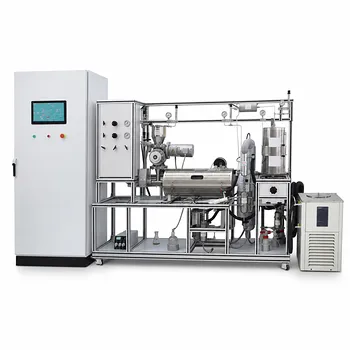
Selective ammonia oxidation is a masterclass in kinetic control. To demonstrate this reaction in a chemical engineering unit operations pilot plant, the reactor must be engineered to outrun thermodynamics. You need a platinum-rhodium (Pt-Rh) catalyst gauze, exceptionally short gas residence times in the range of 10⁻⁴ to 10⁻³ seconds, high-temperature operation (typically 800–950°C), and ultraprecise flow and temperature regulation. These elements, paired with rigorous safety systems for handling explosive ammonia-air mixtures, create a platform where students and researchers can directly observe how rapid kinetics guide product selectivity toward nitric oxide (NO) rather than the thermodynamically favored nitrogen (N₂).
The defining challenge of ammonia oxidation is that formation of N₂ is thermodynamically far more favorable than NO. A successful pilot-plant reactor overcomes this by leveraging a Pt-Rh gauze, sub-millisecond contact times, and high temperatures to make kinetics the dominant force—backed by explosion-proof design and tight feed-ratio control that keep the process both educational and inherently safe.
The Kinetic vs. Thermodynamic Battle in Ammonia Oxidation
Designing a reactor for selective NO production requires first understanding why N₂ would win by default and how reaction engineering rewrites the rules.
Why Thermodynamics Favors Nitrogen
The overall oxidation of ammonia can follow two competing paths. The path to N₂ releases more free energy and is therefore thermodynamically downhill, while NO formation is less favored. If the system is allowed to approach equilibrium, nitrogen becomes the primary product, and the goal of nitric acid production is lost.
How Kinetics Can Be Engineered to Win
Kinetic control is achieved by exploiting the enormous difference in reaction rates on a selective catalyst. The Pt-Rh gauze accelerates the NO-forming reaction so dramatically that, at very short contact times, the nitrogen pathway never has a chance to develop. The pilot plant’s primary mission is to make this kinetic supremacy tangible, allowing operators to manipulate residence time and temperature and immediately see the impact on NO selectivity.
Core Reactor Design Principles for Selective NO Production
To transform the kinetic concept into a working pilot unit, several design principles must be integrated from the start. These elements work together to create the narrow window of conditions where NO dominates.
Catalyst Choice: Platinum-Rhodium Gauzes
A solid Pt-Rh gauze is non-negotiable. This catalyst provides the necessary activity and selectivity to push the reaction toward NO at commercially relevant rates. The pilot reactor must hold the gauze pack securely in the gas stream, often as a series of fine mesh layers, so that the entire ammonia-air mixture passes through with minimal bypassing.
Residence Time: The Sub-Millisecond Window
Contact times of 10⁻⁴ to 10⁻³ seconds are critical. At these brief intervals, the reaction is limited to the most kinetically facile pathway—NO formation—while the slower N₂-forming side reaction is practically frozen out. The pilot plant must therefore feature high-speed flow control and a reactor geometry that guarantees a short, uniform transit through the catalyst zone. Any stagnation or backmixing broadens the residence time distribution and erodes selectivity.
Temperature: The Need for Precision Heat
The gauze must operate in the 800–950°C range to achieve high conversion and sustain autothermal operation. The pilot reactor design incorporates multi-point thermocouples and precise heating or cooling adjustments to maintain this temperature window. Even modest deviations can cause catalyst sintering, a drop in NO yield, or shift selectivity undesirably.
Feed Composition Control: Walking the Explosion Limit Tightrope
Ammonia forms explosive mixtures with air over a range of roughly 15–28% NH₃, but the industrial process typically operates near 9–11% to stay safely outside the flammable envelope while maintaining productivity. The pilot plant must integrate high-accuracy mass flow controllers for both ammonia and air, plus online gas analysis, to hold the mixture at the target setpoint without drifting into hazardous territory.
Integrating Safety as a Design Principle
Because the reaction is highly exothermic and the feed mixture is potentially explosive, safety considerations are not add-ons—they are fundamental reactor design requirements.
Explosion Mitigation: Rupture Disks and Blast Vents
The reactor vessel must be fitted with explosion-proof disks (rupture disks), safety relief valves, and blast vents. These features protect operators and equipment by providing a controlled release path if a pressure spike or thermal runaway occurs.
Interlocks and Inert Gas Purging
Automated emergency shutdown (ESD) valves, lab gas detection alarms, and online analyzers trigger immediate inert gas purging—usually with nitrogen—when a leak, off-ratio mixture, or unsafe temperature is detected. This integrated system ensures that the reactor transitions to a safe state without manual intervention.
Thermal Stability: Multizone Temperature Monitoring
High-precision, multipoint thermocouples placed around the gauze and reactor body feed data to a control system that can adjust cooling or heating media, shut off reactant flow, or initiate purging. This prevents thermal runaway, which not only destroys the catalyst but can escalate into an explosion hazard.
Reactor Configuration and Flow Pattern
How the gas flows through the catalyst bed dramatically affects selectivity, especially when side reactions are possible.
Minimizing Backmixing to Suppress Side Reactions
In reactions where the desired product can further react to form unwanted byproducts—such as NO oxidizing further to NO₂ or N₂ being formed through a secondary path—backmixing is the enemy. A plug-flow-like regime ensures that each gas element spends exactly the same short time in contact with the catalyst, preventing NO from lingering and degrading.
Gauze Reactor as a Plug-Flow Analog
A thin, closely packed Pt-Rh gauze stack inherently provides a narrow residence time distribution with minimal stagnant zones. In educational pilot plants, this configuration also allows visual demonstration of the glowing gauze, making the high-temperature catalytic phenomenon tangible. Reactors with larger liquid holdup or bubble columns would be entirely inappropriate for this demonstration.
Understanding the Trade-offs and Practical Pitfalls
No design choice comes without compromises. Acknowledging them builds the trust needed to run the pilot plant safely and interpret data correctly.
- Residence Time vs. Conversion: Extremely short contact times maximize NO selectivity but can limit per-pass conversion. The pilot plant may need to simulate a multi-stage industrial system where unreacted ammonia is recycled or a secondary bed is used, requiring additional reactor modules.
- Temperature vs. Catalyst Life: Operating at the higher end of the temperature range boosts kinetics but accelerates precious metal loss from the gauze through volatilization and embrittlement. The pilot plant must allow easy inspection and replacement of gauze packs so students can study deactivation.
- Safety vs. Operational Flexibility: Explosion-proof interlocks and rigid feed ratio limits are essential, but they restrict how far operators can explore off-design conditions. The control system should provide a safe sandbox for parameter variation without overriding critical safety boundaries.
- Materials of Construction: High temperatures and the corrosive nature of NOₓ downstream demand reactor materials that resist scaling and embrittlement. While hydrogen embrittlement is a concern in ammonia synthesis, for oxidation the focus shifts to high‑temperature stainless steels or nickel alloys that can withstand long-term cycling.
Making the Right Choice for Your Pilot Plant Goals
Every design parameter should serve the specific educational or research objectives of the unit operations laboratory.
- If your primary focus is demonstrating kinetic vs. thermodynamic control: Prioritize flexible, high-precision mass flow controllers and a variable-speed feed system that can rapidly change residence time, coupled with a real‑time NO/NOₓ analyzer at the reactor exit.
- If your primary focus is industrial relevance and process safety training: Integrate a fully instrumented explosion‑protection system, automated ESD valves, and inert gas purging to replicate the safety logic of a commercial nitric acid plant.
- If your primary focus is studying catalyst deactivation and gauze life: Design the reactor housing for quick, tool‑less gauze removal and incorporate a sampling port for surface analysis, so operators can correlate operating conditions with precious metal loss.
- If your primary focus is heat integration studies: Configure the pilot plant with downstream heat exchangers or a waste‑heat boiler module, allowing students to explore how the exothermic heat of the NO reaction can be recovered for downstream absorption processes.
A well-designed ammonia oxidation pilot reactor transforms an abstract textbook trade‑off into a visible, controllable experiment. By embedding these principles, the unit becomes a safe, powerful tool for teaching how reaction engineering dictates what comes out of the reactor—and why.
Summary Table:
| Design Parameter | Target Specification | Role in Reactor Design |
|---|---|---|
| Catalyst Selection | Pt-Rh Gauze Pack | Maximizes reaction rate and selectivity toward NO |
| Residence Time | $10^{-4}$ to $10^{-3}$ seconds | Suppresses the thermodynamically favored $N_2$ pathway |
| Operating Temp. | 800–950°C | Sustains autothermal operation and high conversion |
| Feed Composition | 9–11% $NH_3$ in air | Keeps reactants safely below the 15% lower explosive limit |
| Flow Regime | Minimal backmixing (Plug-Flow) | Prevents product degradation and secondary reactions |
| Safety Measures | Rupture disks, ESD, $N_2$ purge | Mitigates explosion hazards and thermal runaway risks |
Bring Advanced Reaction Engineering to Your Lab
To demonstrate complex kinetic controls like selective ammonia oxidation safely and effectively, you need a pilot plant engineered to industrial safety and performance standards.
LABPARK provides state-of-the-art Educational and Vocational Unit Operations Pilot Plants in chemical engineering, bioprocess & biotech, and environmental & water treatment. Designed specifically for universities, research institutes, and enterprises, our systems offer students and researchers a hands-on, inherently safe environment to study transport phenomena and reaction kinetics.
Ready to elevate your training and research capabilities? Contact LABPARK today to customize your pilot plant solutions!
Related Products
- Multi-Reactor Educational Pilot Plant for Reaction Engineering Unit Operations
- Multi-Modal Distillation Unit Operations Training Pilot Plant
- Multi-Functional Special Distillation Educational Pilot Plant
- Fixed-Bed Chemical Reaction and Gas Dust Tar Removal Unit Operations Pilot Plant
- Natural Product Extraction Unit Operations Training Pilot Plant
People Also Ask
- What role do educational pilot plants play in scaling green chemistry? Bridging the Lab-to-Industry Gap
- How do educational unit operations pilot plants address safety and waste management when scaling up?
- How do educational unit operations pilot plants bridge theory and design? Bridge the Engineering Gap
- Why Compare Predicted and Experimental Excess Enthalpy? Key to Accurate Pilot Plant Scale-up
- Why Use PTFE & Hastelloy in Chemical Pilot Plants? Prevent Corrosion & Ensure Safety