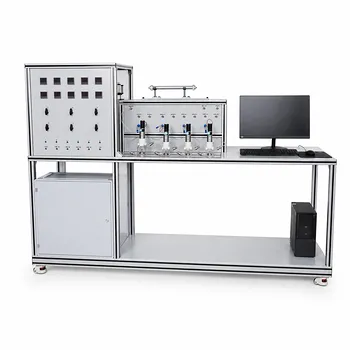
Finding the sweet spot for pilot plant operation comes down to juggling two numbers: how much of your fuel you use (utilization) and the ratio of your equipment cost to fuel cost. For fuel cells and electrochemical reactors, the primary levers are cell potential (voltage), current density, and reactant flow rates. The economic optimum is reached by adjusting these so that the combined cost of wasted fuel and the capital tied up in the reactor is minimized—a balance that shifts dramatically depending on whether your spent reactants have any resale value.
Operating a pilot plant economically isn't about maximizing efficiency or power density in isolation; it's about driving the system to the exact point where the sum of fuel losses and capital charges hits its lowest possible value. This exact point is determined by your fuel's recovery value, your equipment's amortized cost, and the thermodynamic behavior of your cell.
The Central Economic Dial: Fuel Utilization vs. Capital Cost
Why “Using All the Fuel” Is Rarely the Economic Answer
The instinct is to push fuel utilization to 100%—to squeeze every electron from every mole of reactant. But a higher utilization always demands a larger, more expensive stack, because you're pushing the reaction further towards completion where driving forces (voltage) drop and more electrode area is required for the same production rate.
The primary reference frame is the capital-to-fuel cost ratio. If your reactor is relatively cheap and fuel is astronomically expensive, you can justify very high utilizations. But if your amortized pilot plant cost is high and fuel is cheap, wasting some fuel to shrink the reactor is economically rational. The pilot plant job is to experimentally verify this ratio, not assume it.
The Pivot Point: Recovery Factor of the Depleted Stream
The waste stream's value is the hidden variable that flips the entire optimization logic.
When the depleted fuel has zero recovery value (e.g., anode-off gas is just flared or vented with no credit), the math pushes you toward higher utilization. There’s no penalty for consuming the fuel nearly completely except the capital cost, so the optimum creeps upward.
When the spent fuel can be recovered and sold at cost, the economics invert. Now, undepleted reactant is an asset leaving the stack, not a loss. It becomes profitable to run with the richest possible fuel and air streams and to operate at a lower utilization, deliberately leaving unreacted material that can be sold downstream. The pilot plant must quantify this recovery factor precisely; small errors here can make the optimization completely wrong.
The Thermodynamic Foundation: Voltage, Current, and the Nernst Effect
Balancing Cell Potential Against Production Rate
Electrochemical economics are married to thermodynamics through the cell potential and current density. The cell potential represents the energy cost per electron, and the current density sets how many electrons you're pushing through a given electrode area. Together, they define the power cost per unit of product.
In a pilot plant, you're hunting for the optimum current density–potential pair that minimizes the overall cost. A higher current density means more product from a given stack (lower capital), but it drives up the cell potential due to activation and ohmic overpotentials (higher energy/operational cost). A lower current density reduces voltage losses but demands more electrode area (higher capital). The pilot plant maps this curve experimentally because theoretical models can't capture all real-world inefficiencies.
Concentration Changes and the Nernst Equation During Operation
As fuel flows through the reactor, reactant concentrations drop along the channel. The Nernst equation dictates that cell potential changes with reactant and product activities. This isn't a static number—it evolves continuously from inlet to outlet. That's why inlet and outlet flow rates are non-negotiable parameters to monitor and control.
For example, in a fuel cell consuming hydrogen, a falling hydrogen partial pressure at the outlet depresses the reversible cell voltage. To maintain a target current density, you might need to adjust the flow rate to keep outlet concentrations above a threshold, or accept a lower potential. The pilot plant reveals the real-time Nernst-driven voltage profile, which directly feeds back into the economic optimization: the steeper the voltage drop at the end of the channel, the more painful high utilization becomes.
Oxidation State Tracking for Mass and Charge Balances
In more complex electrochemical synthesis (like permanganate reduction to MnO2 or Mn²⁺), the oxidation state change determines the stoichiometric electron demand. Getting the material balance wrong means you either starve the reactor or flood it with excess reactant, destroying efficiency. Pilot plant operation must track these state changes precisely, using inlet/outlet analysis to refine the charge transfer calculations that underpin both the sizing model and the economic forecast.
Operational Parameters That Turn Theory into Profit
The Trio You Must Control in Real Time
Three field-level parameters are the direct handles on the economic-thermodynamic dance:
- Cell potential (voltage setpoint or measured value): Your immediate energy cost signal.
- Current density: The production rate lever, tied to stack area and capex.
- Inlet and outlet flow rates of reactants: The knobs that set fuel utilization and concentration profiles.
These are not independent. Twist one, and the others react. For instance, increasing fuel flow at a fixed current density lowers utilization but flattens the concentration gradient, raising the average cell voltage. The pilot plant's purpose is to find the combination where the cost per unit of energy or product bottoms out.
The “Rich Feed, Low Utilization” Regime
When the recovery factor is high, the optimal strategy from the primary reference is clear: run with the richest fuel and airstreams, and keep utilization low. In a pilot plant, this means setting reactant feeds well above the stoichiometric minimum and pulling only a modest conversion per pass. The cell potential stays high, the stack size shrinks, and the revenue from the valuable exhaust more than compensates. Operators must analyze both the stack’s electrical output and the exhaust stream’s composition to confirm this balance.
Understanding the Trade-offs
The High-Utilization Trap
Chasing a utilization fraction in the high 90s can send capital costs spiraling. The voltage penalty near complete depletion (especially with sluggish mass transport) can be so severe that the energy cost overshadows any fuel saving. Pilot plant data will often reveal that the last 2-3% of fuel carries a disproportionate economic burden, making 96% utilization more profitable than 99%.
Model Pitfalls When Ignoring Multicomponent Behavior
While highly relevant for liquid-liquid extraction (LLE) pilot plants, the warning also applies indirectly to electrochemical systems: relying on simplistic equilibrium assumptions or fitting data without proper parameter foundation leads to wrong setpoints. If you're using activity coefficient models to predict electrolyte behavior or concentration overpotentials, you need validation against actual multicomponent pilot plant measurements. The Nernst equation with ideal assumptions fails under high concentrations, and only experimental optimization with real feeds corrects the error.
When Heat Integration Changes the Game
Though not explicitly in the primary reference, many pilot plants must balance exothermic and endothermic reactions to manage thermal gradients. In electrochemical reactors, joule heating and overpotential losses generate heat that can accelerate degradation or, cleverly managed, reduce external heating loads. Any thermodynamic optimization must factor in these heat effects, or the economic model will underestimate cooling or auxiliary power costs.
Making the Right Choice for Your Pilot Plant Goal
Your specific objective determines which parameter you prioritize in the experimental matrix.
- If your primary focus is minimizing operating expenditure (OPEX) during scale-up: Emphasize finding the minimum power cost per unit of energy by sweeping current density and cell potential while factoring in the actual fuel cost. Use the data to identify the precise point where the sum of energy cost and fuel waste bottoms out.
- If your primary focus is reducing capital expenditure (CAPEX) and you have a valuable exhaust stream: Test the low-utilization, rich-feed regime. Experiment with higher flow rates to keep outlet concentrations high and voltage losses low, then validate that the revenue from the recovered fuel offsets the lower per-pass conversion.
- If your primary focus is model validation for accurate scale-up: Don’t just log voltage and current; collect dense data on inlet/outlet concentrations and track oxidation state distributions. Use this to refine your Nernst-based models and charge balance calculations, ensuring your digital twin actually mirrors the pilot plant’s thermodynamic reality.
The pilot plant isn’t just a small version of a commercial unit—it’s your economic optimization laboratory, and only by deliberately tuning these parameters against the true cost inputs will you uncover the operational formula that turns an elegant reaction into a profitable process.
Summary Table:
| Parameter | Operational Role | Economic/Thermodynamic Impact |
|---|---|---|
| Cell Potential | Measures energy cost per electron | Dictates operational energy costs (OPEX) |
| Current Density | Determines production rate per electrode area | Influences reactor stack size and capital costs (CAPEX) |
| Reactant Flow Rates | Controls fuel utilization and concentration | Affects Nernst-driven voltage profiles and conversion |
| Fuel Utilization | Measures fraction of reactant consumed | High utilization reduces fuel waste but increases equipment size |
Scale Up Your Research with LABPARK Pilot Plants
Ready to optimize your electrochemical and chemical processes? LABPARK provides state-of-the-art Educational and Vocational Unit Operations Pilot Plants in chemical engineering, bioprocess & biotech, and environmental & water treatment. Tailored for universities, research institutes, and enterprises, our systems enable precise parameter control to bridge the gap between theory and profitable production.
Contact LABPARK today to find the perfect pilot plant solution for your lab!
Related Products
- Methane Cracking Educational Unit Operations Pilot Plant
- Fixed-Bed Chemical Reaction and Gas Dust Tar Removal Unit Operations Pilot Plant
- Electrochemical Water Treatment Educational Unit Operations Pilot Plant
- Carbon Dioxide Hydrogenation Methanol Synthesis Educational Unit Operations Pilot Plant
- Multi-Reactor Educational Pilot Plant for Reaction Engineering Unit Operations
People Also Ask
- How do ethane vs naphtha cracking influence teaching pilot plant analytical configurations? Key Design Guide
- How can flow-NMR be integrated with pilot plant reactors to monitor kinetics? A Complete Guide
- How do cracking temperature and residence time affect olefin yield? Pilot Plant Guide
- How are utility consumption rates integrated into chemical pilot plant economic evaluations?
- How should OSBL investments be estimated? Key Steps to Avoid Budget Overruns in Pilot Plant Projects