Higher cracking temperatures accelerate the primary reactions that produce ethylene and propylene, but they also speed up secondary degradation. To preserve the olefins you just created, you must reduce residence time as temperature increases. In a pilot plant, this means running hotter (e.g., shifting an outlet temperature from 1050 K to 1200 K) while simultaneously cutting the gas’s contact time inside the tube—typically from 0.7 seconds down to 0.4 seconds or even into the millisecond range. When you get that balance right, yield and selectivity rise; when you don’t, your desired products are consumed by coking and side reactions before they ever leave the reactor.
The core interaction is a kinetic trade‑off: temperature drives the rate of both olefin formation and olefin destruction, while residence time decides how much of that destruction is allowed to occur. In a pilot‑scale cracking reactor, raising temperature without shortening residence time invariably eats into your yield. The job of the engineer is to find the pairing that maximizes primary cracking while quenching secondary reactions the moment the target olefin concentration peaks.
The Kinetic Balancing Act Behind Olefin Yield
Primary vs. Secondary Reactions: A Race Against Time
Thermal cracking unfolds in two competing stages. Primary reactions break heavy hydrocarbon chains into valuable short‑chain olefins—ethylene, propylene, and butadiene. These are what you want. Secondary reactions start as soon as those products form: the same olefins can further crack into methane, dehydrogenate, polymerize into heavy aromatics, or condense into coke.
In a pilot reactor, secondary reactions are the enemy. They consume valuable product, foul the tube walls, and create heat‑transfer resistance. The only way to stop them is to arrest the reaction at precisely the right moment—after enough primary cracking has occurred, but before secondary pathways hijack the mixture.
Temperature: The Accelerator of Both Desired and Undesired Paths
Cracking is endothermic and highly temperature‑sensitive. Raising the coil outlet temperature from, say, 1050 K to 1150 K dramatically increases the rate of primary hydrocarbon scission. This is good: you get faster conversion and a higher instantaneous yield of ethylene.
But the activation energy for secondary cracking is often comparable. So the same temperature jump also fires up coking, methane formation, and olefin oligomerization. Without countermeasures, you’ll simply trade a spike in ethylene at the reactor midpoint for a flood of methane and coke at the outlet. In a pilot plant, you’d see the ethane or naphtha conversion rise, but the ethylene selectivity plummet—a classic sign of runaway secondary reactions.
Residence Time: The Control Knob for Quenching Secondary Reactions
Residence time determines how long the cracked gases spend in the high‑temperature zone. A long residence time (0.6–0.7 seconds) gives primary reactions plenty of opportunity, but it also gives secondary reactions enough runway to destroy the olefins you just made.
Shortening residence time is the primary countermeasure. When you push the outlet temperature higher, you simultaneously tighten the gas’s contact time—for example, from 0.4 seconds to 0.2 seconds, or in millisecond‑cracking designs down to 0.05 seconds. This lets you harvest the faster primary products before secondary reactions can reach their destructive peak. In thermal cracking pilot plants, operators achieve this by reducing tube volume, lowering the steam‑to‑oil ratio at the expense of partial pressure control, or using split‑coil configurations that accelerate velocity through the final hot section.
How Pilot Plants Make This Interaction Visible
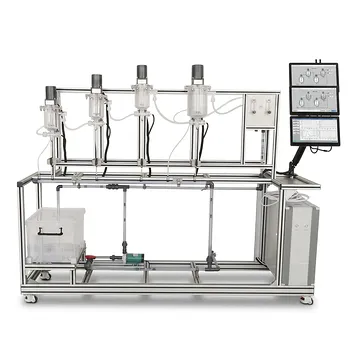
A unit‑operations pilot plant typically uses a micro‑tubular reactor with precise temperature and flow controllers. Researchers can independently adjust the feed rate, dilution steam, and furnace zone temperatures while sampling the cracked gas at multiple points. This setup exposes the interaction directly:
- At a fixed residence time, raising the temperature increases ethylene concentration initially, then triggers a sharp decline as secondary coking takes over.
- At a fixed temperature, shortening the residence time boosts ethylene selectivity by suppressing secondary paths, but if you cut it too much, conversion drops because primary cracking becomes incomplete.
By mapping dozens of temperature‑residence‑time pairings, students and researchers can identify the “peak‑yield ridge” —the operating envelope where primary cracking is fast but secondary destruction is minimal. Tube configurations (branch designs like 2‑1 or 4‑4‑2‑1, and variable‑diameter profiles that transition from narrow inlets to wider outlets) are used in educational pilot plants to further demonstrate how heat‑transfer acceleration and pressure‑drop reduction allow hotter cracking without extending residence time.
Understanding the Trade‑offs
The temperature‑residence‑time interaction isn’t free. Pushing for ever‑shorter residence times brings its own challenges.
Hydraulic limits. To cut residence time drastically, you must increase feed velocity, which raises the pressure drop across the coil. Higher pressure drop promotes secondary condensation reactions because it increases hydrocarbon partial pressure—partly undoing the benefit of the shorter contact time. Pilot plants teach this by showing how yield‑gain curves flatten when you approach millisecond regimes.
Coke management. Even with optimal pairing, some coke forms. Running hot and short merely shifts the coke deposition to a later section of the tube. If you can’t decoke the pilot reactor frequently, you’ll see a gradual loss of heat transfer and a drift in measured yields—a practical lesson in operability.
Feedstock sensitivity. Ethane cracking demands more severe conditions (higher temperature and slightly longer residence time) to reach acceptable conversion, and it delivers over 70 wt% ethylene. Naphtha, by contrast, cracks more easily and produces a broader product slate; if you misjudge the time‑temperature pair for naphtha, methane and propylene yields balloon while ethylene selectivity drops sharply. Pilot plants with variable temperature profiling allow you to simulate both worlds and observe how the optimal setpoint shifts.
Steam dilution interdependence. Dilution steam lowers hydrocarbon partial pressure, directly suppressing secondary reactions. When you shorten residence time, you can often reduce the steam‑to‑oil ratio without losing selectivity, which saves energy and simplifies downstream separation. The pilot plant environment makes this three‑way interaction (temperature‑time‑dilution) tangible, because you can hold two variables constant and vary the third while measuring olefin output.
Making the Right Choice for Your Pilot Plant Study
Your goal dictates how you navigate the temperature‑residence‑time interaction in your unit‑operations pilot plant.
- If your primary focus is maximizing ethylene yield: Operate at the highest outlet temperature your tube metallurgy and coking tolerance allow (1050–1200 K), then shorten residence time until secondary reactions are just suppressed. Monitor the ethylene‑to‑methane ratio as your optimization signal—when it peaks, you’ve found your window.
- If your primary focus is studying kinetic fundamentals: Vary temperature and residence time systematically while keeping steam dilution constant. Map the full yield profile and clearly demarcate the transition from primary‑dominated to secondary‑dominated regimes. Use this to calculate apparent activation energies for cracking and coking.
- If your primary focus is feedstock flexibility: Start with a moderate temperature and residence time, then test each feedstock (ethane, naphtha, or gas oil) at the same conditions to highlight selectivity differences. Next, adjust time and temperature until each feedstock gives its own optimal product distribution—this teaches how industrial crackers are tailored.
- If your primary focus is demonstrating industrial relevance: Shift pilot‑plant residence times from conventional 0.4 s down to millisecond (0.05–0.1 s) levels while raising outlet temperature, and show the incremental ethylene gain of 1–2 wt% discussed in commercial millisecond furnaces. This connects academic pilot‑scale data to real‑world design.
Mastering the interplay between cracking temperature and residence time transforms your pilot plant from a simple demonstration rig into a powerful kinetic probe. By deliberately moving along the temperature‑residence‑time ridge, you unlock both higher olefin yields and deeper insights into the fundamental chemistry of pyrolysis.
Summary Table:
| Parameter Change | Impact on Olefin Yield | Primary Process Risk |
|---|---|---|
| Higher Temperature | Accelerates primary cracking and initial olefin yield | Speeds up coking and secondary degradation |
| Shorter Residence Time | Preserves olefins by quenching secondary reactions | Risks incomplete conversion if too short |
| Longer Residence Time | Allows high conversion at lower temperatures | Promotes olefin destruction and tube fouling |
Optimize Your Chemical Engineering Labs with LABPARK
Ready to bring advanced kinetic and thermal cracking concepts to life? LABPARK provides premium Educational and Vocational Unit Operations Pilot Plants across chemical engineering, bioprocess & biotech, and environmental & water treatment.
Designed specifically for universities, research institutes, and enterprises, our pilot plants feature precise temperature, flow, and residence time controls. This enables students and researchers to safely hands-on simulate commercial cracking, map kinetic reactions, and optimize yields.
Get the tools to bridge the gap between academic theory and industrial practice. Contact LABPARK today to customize your pilot plant setup!
Related Products
- Methane Cracking Educational Unit Operations Pilot Plant
- Multi-Reactor Educational Pilot Plant for Reaction Engineering Unit Operations
- Fluidized Bed Gas Solid Catalytic Reaction Educational Pilot Plant
- Fixed-Bed Chemical Reaction and Gas Dust Tar Removal Unit Operations Pilot Plant
- Internal Circulation Gradient Free Catalytic Reaction Educational Pilot Plant
People Also Ask
- How do ethane vs naphtha cracking influence teaching pilot plant analytical configurations? Key Design Guide
- How can flow-NMR be integrated with pilot plant reactors to monitor kinetics? A Complete Guide
- How are utility consumption rates integrated into chemical pilot plant economic evaluations?
- How should OSBL investments be estimated? Key Steps to Avoid Budget Overruns in Pilot Plant Projects
- Why use split-plot designs in pilot plants instead of CRD? Optimize process parameters effectively.