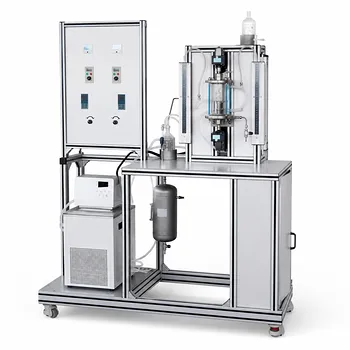
The most direct and widely applicable technique is the non-reactive gas uptake method—often called the pressure-decay or depressurization test. You thoroughly degas your solvent, pressurize the headspace with the gas of interest, then record the drop in pressure as the gas dissolves into the liquid under controlled agitation. The slope of the resulting pressure-time curve directly yields the volumetric mass transfer coefficient (k_La) for your specific reactor geometry and operating conditions.
The pressure-decay method transforms a simple pressure transducer into a high-precision mass transfer probe. By tracking how fast the headspace pressure falls toward equilibrium, you capture the true gas-liquid transfer rate in your pilot reactor without invasive sensors or chemical reactions—provided you rigorously control temperature and account for solvent vapor pressure.
The Pressure-Decay Principle: Why It Works
When a gas dissolves into a degassed liquid, the gas-phase pressure must fall. This pressure drop is a direct, macroscopic signal of the net flux of molecules across the interface. By interpreting that signal with fundamental mass balances, you extract (k_La).
The Driving Force: Gas–Liquid Equilibrium
The liquid phase has a finite capacity to hold dissolved gas, set by Henry’s law. Once you introduce gas to the headspace and start agitation, the system moves toward equilibrium, where the partial pressure of the solute gas in the headspace balances its concentration in the liquid. The final equilibrium pressure (P_f) is therefore a unique fingerprint of your reactor’s fill volume, temperature, and solvent properties.
Tracking the Pressure Drop Over Time
The rate of the approach to equilibrium is limited by the overall volumetric mass transfer coefficient. A fast drop indicates a high (k_La); a slow drop signals a transfer bottleneck. Recording the pressure every few milliseconds with a fast-response transducer gives you a continuous kinetic trace you can linearize to extract the transfer coefficient.
Step-by-Step Procedure for a Pilot Reactor
Execute these steps in sequence to obtain clean, reproducible data.
Solvent Preparation: Degassing Under Vacuum
Charge the reactor with your solvent to the desired fill level. With the agitator running, apply vacuum to the headspace to strip dissolved gases. Continue until the pressure stabilizes at the solvent’s vapor pressure (P_0). Thorough degassing is non-negotiable; any residual dissolved gas corrupts the initial condition.
Gas Introduction and Thermal Equilibration
Turn off the agitator and close the vacuum line. Introduce your target gas (e.g., hydrogen, nitrogen, air) into the headspace until the total pressure reaches your intended starting value (P_i). Close the gas inlet valve. Allow the system to sit without agitation until the gas and liquid temperatures equalize—temperature-driven pressure recovery is a common, avoidable artifact.
Data Acquisition and Agitation Start
Arm your data logger to record headspace pressure at high frequency. Start the agitator at your set speed. The pressure will immediately begin to fall. Continue recording until the pressure asymptotically approaches the equilibrium value (P_f). The entire decay typically lasts from a few seconds to several minutes, depending on (k_La) and headspace-to-liquid volume ratio.
Calculating (k_La) from Your Pressure Data
Converting the pressure trace into a volumetric mass transfer coefficient requires a simple material balance and a linearized plot.
The First-Order Rate Equation
Under well-mixed conditions, the driving force for mass transfer is the difference between the actual partial pressure (P - P_0) and its equilibrium value (P_f - P_0). This difference decays exponentially. Plot the logarithm of the fractional deviation:
[ \ln\left(\frac{P_i - P_f}{P - P_f}\right) \quad \text{versus time} ]
If the system is isothermal and the liquid is sufficiently mixed, this plot is a straight line with slope (S).
Converting Slope to (k_La)
Using the ideal gas law and Henry’s law, a mass balance around the vapor and liquid phases shows that the decay constant is directly proportional to (k_La). The proportionality can be expressed entirely in measurable pressures:
[ k_La = S \times \frac{P_f - P_0}{P_i - P_f} ]
Here (P_0) is the solvent vapor pressure (the pressure reading after degassing), (P_i) is the initial total pressure before agitation, and (P_f) is the final steady pressure. This equation eliminates the need to know the Henry’s constant or the exact gas–liquid volume ratio, because they are implicitly captured in the pressure endpoints.
Critical Factors That Influence Your Measurement
Even a perfectly executed uptake test reflects the specific physical setup. To use the data for scale-up or process development, you must map how your (k_La) responds to these variables.
Agitator Speed and Power Input
Higher rotational speeds generate more intense turbulence, reducing the liquid film resistance and increasing interfacial area by breaking bubbles. The (k_La) typically scales with specific power input raised to an exponent between 0.4 and 0.7, depending on the solvent’s coalescence behavior.
Reactor Fill Level and Baffle Configuration
A change in liquid height alters the headspace volume and the gas–liquid contact pattern. Baffles prevent vortex formation and improve gas dispersion, but they also affect power draw and mixing time. Always report your fill ratio and baffle setup when sharing (k_La) data.
Solvent Choice and Temperature
Ionic solutions suppress bubble coalescence and can dramatically increase interfacial area compared to pure water. Temperature shifts both the solvent vapor pressure and the gas diffusivity. Keep temperature constant within (\pm 0.5^\circ C) during each run, and record it for every data series.
Understanding the Trade-offs of the Uptake Method
While the pressure-decay technique is elegant and equipment-light, it operates under strict prerequisites you must not ignore.
Isothermal Operation is Non-Negotiable
Any temperature difference between the gas and the liquid when the agitator starts will cause a pressure rise or fall unrelated to mass transfer. Even small thermal gradients can mask or distort the true uptake curve. Always include a thermal equilibration hold step before agitation.
Applying the Method to Reactive Gases
If the gas reacts irreversibly with the solvent (e.g., CO₂ in alkaline solutions), the pressure will not stabilize at an equilibrium dictated by physical solubility alone. In those cases, a pure uptake test is invalid. Instead, you can run a chemical reaction under mass-transfer‑limiting conditions—for example, a high catalyst loading—and fit the gas consumption rate to a mass-transfer model. This alternative approach yields a (k_La) relevant to the reactive system but requires careful kinetic verification.
Practical Limits on Time Resolution
If (k_La) is extremely high (very fast dissolution), the pressure decay may be too rapid for standard transducers. Conversely, if the headspace volume is very large relative to the liquid, the pressure change may be too small to give a reliable slope. Optimize your fill level to achieve a 10–30 % pressure drop for best signal-to-noise ratio.
Making the Right Choice for Your Goal
All measurement strategies are purpose-built. Select your approach based on what you ultimately need the (k_La) value to predict.
- If your primary focus is characterizing and scaling up reactor mass transfer performance: Use the non-reactive gas uptake method with a clean solvent. Vary agitation speed, fill level, and sparge configuration to build a robust correlation you can apply at larger scales.
- If your primary focus is determining (k_La) under real reaction conditions: Run a chemical reaction with mass transfer as the rate-limiting step (e.g., high catalyst loading) and fit the uptake curve to a kinetic model. This gives you an effective (k_La) that already accounts for any changes in bubble behavior caused by the reaction mixture.
- If your primary focus is comparing different reactor geometries or impeller types: Stick to a reference system (e.g., air–water) and the uptake method. This isolates equipment effects from chemistry, giving you a clean benchmark.
- If your primary focus is educational or research-oriented investigation of mass transfer fundamentals: The pressure-decay method’s simplicity and direct link to fundamental transport equations make it the ideal teaching and diagnostic tool for pilot-plant studies.
Equipped with a precise pressure transducer and careful thermal control, you can turn your pilot reactor into a quantitative mass transfer laboratory—gathering the data you need to de-risk scale-up and confidently design full-scale gas–liquid processes.
Summary Table:
| Parameter | Effect on $k_La$ | Operational Best Practice |
|---|---|---|
| Agitator Speed | Higher speed increases turbulence and interfacial area, raising $k_La$. | Standardize and log agitation speed and specific power input. |
| Temperature | Shifts gas solubility, diffusivity, and solvent vapor pressure. | Maintain strictly within $\pm 0.5^\circ\text{C}$ throughout testing. |
| Solvent Degassing | Incomplete degassing corrupts the initial boundary condition. | Apply vacuum under agitation until pressure stabilizes at solvent vapor pressure. |
| Reactor Geometry | Baffles and impellers determine gas dispersion and mixing efficiency. | Keep fill levels and internal configurations constant across comparative runs. |
Optimize Your Unit Operations Training and Research with LABPARK
To achieve accurate mass transfer measurements, you need reliable, industry-grade equipment. LABPARK provides cutting-edge Educational and Vocational Unit Operations Pilot Plants in chemical engineering, bioprocess & biotech, and environmental & water treatment.
Designed specifically for universities, research institutes, and enterprises, our pilot plants deliver the scalability and precision required for advanced process development and hands-on learning.
Ready to elevate your laboratory capabilities? Contact LABPARK today to explore our custom pilot plant solutions!
Related Products
- Dual-Drive Stirred Gas-Liquid Mass Transfer Coefficient Determination Pilot Plant
- Liquid-Liquid Mass Transfer Coefficient Determination Educational Pilot Plant
- Absorption and Desorption Educational Unit Operations Pilot Plant
- Micro-Scale Gas-Solid Catalytic Reaction Educational Pilot Plant
- Carbon Dioxide Absorption and Desorption Educational Pilot Plant for Carbon Capture Studies
People Also Ask
- How does temperature affect mass transfer rates in chemical engineering educational pilot plants?
- How do pilot plants study gas solubility in polymer melts at high pressures? Key Mass Transfer Insights
- How does column packing affect absorption intensification, and how is it evaluated experimentally?
- Why Compare Membrane-Reservoir Models with Pilot Plant Data? Ensure Successful Process Scale-Up
- How does k_La affect hydrogenation scale-up? Critical insights for pilot reactors.