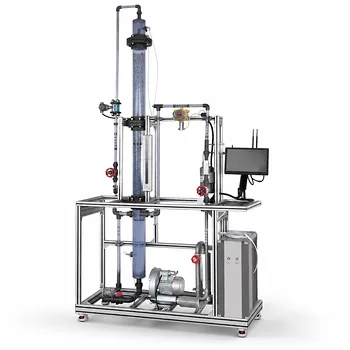
The definitive laboratory setup for sequential carbonate and organic carbon analysis relies on a multi-component absorption train apparatus. You first acidify the scale sample to liberate carbon dioxide solely from inorganic carbonates, absorb it on a solid sorbent, and weigh the gain. Then, without disturbing the sample, you introduce a strong oxidizer to convert all residual organic carbon into CO₂, which is absorbed and measured in the same way. This two-stage procedure on a single specimen eliminates splitting bias and delivers distinct gravimetric results for carbonate‑bound carbon and total organic carbon.
The core challenge is reliably separating inorganic carbon from organic carbon in a heterogeneous scale matrix. The absorption train method solves this by performing a selective acid decomposition followed by a destructive oxidation, all within the same closed system, ensuring that every milligram of carbon is accounted for without cross-contamination between fractions.
The Absorption Train Apparatus: Components and Purpose
The apparatus is a string of glassware units arranged in series, each designed to condition the gas stream before it reaches the final carbon dioxide absorber. Its architecture prevents interference from moisture, sulfur gases, and atmospheric CO₂.
The CO₂‑Free Air Supply
Ambient air is drawn through an alkali scrubber (typically filled with a strong base solution like sodium hydroxide). This removes any atmospheric carbon dioxide that would otherwise contribute a large blank, ensuring the carrier gas is carbon‑free before it enters the reaction zone.
The Reaction Flask and Condenser
The weighed scale sample is placed in a reaction flask equipped with a reflux condenser. The condenser returns acid fumes and water vapor to the flask, preventing carry‑over of corrosive droplets into downstream components, while allowing low‑boiling carbon dioxide to pass freely.
The Interferent Scrubbers and Drying Tubes
Between the reaction flask and the absorption tower, the gas stream passes through a train of purification stages:
- A scrubber containing sulfuric acid to trap water vapor.
- A scrubber containing chromic acid to oxidize any reduced sulfur species (H₂S, SO₂) that might be released from the scale during acidification. Sulfur gases can react with alkaline absorbers and skew mass measurements.
- U-tubes filled with anhydrous copper sulfate and calcium chloride provide final drying and polishing.
The Carbon Dioxide Absorber
The heart of the detection system is a pre‑weighed tower packed with Ascarite (sodium hydroxide‑coated silica). As CO₂‑laden air percolates through, carbon dioxide reacts quantitatively to form sodium carbonate. The mass increase of the tower directly corresponds to the mass of CO₂ absorbed, from which carbon mass is calculated.
Step‑by‑Step Procedure for Carbonate and Organic Carbon
The true power of this method is the sequential release of carbon fractions from a single aliquot of scale. You simply change the liquid reagent added to the reaction flask.
Phase 1: Selective Carbonate Decomposition
First, sulfuric acid is introduced slowly into the reaction flask via a side arm or dropping funnel. The acid attacks carbonate minerals (calcite, aragonite, siderite) and liberates CO₂:
CaCO₃ + H₂SO₄ → CaSO₄ + CO₂ + H₂O
The generated CO₂ is swept by the CO₂‑free air stream through the purification train directly into the Ascarite tower. After a set time (typically 15–30 minutes of bubbling), the tower is detached and weighed. The mass gain gives the carbonate carbon content of the scale.
Phase 2: Total Organic Carbon Oxidation
Without opening the system or replacing the sample, a potassium dichromate–sulfuric acid mixture is now added to the same reaction flask. This potent oxidizing environment converts all non‑carbonate organic matter—humic substances, biofilm residues, synthetic polymers—into CO₂.
The temperature may be raised slightly (under reflux) to ensure complete oxidation. The evolved CO₂ is once again collected in a freshly weighed Ascarite tower. The mass gain after this second absorption directly quantifies the organic carbon (often called “free carbon”) originally present.
Calculating Carbon Fractions
Each absorption event yields a mass of CO₂. Convert to carbon by multiplying by the atomic mass ratio (12.01/44.01). The first absorption gives carbonate‑C; the second gives organic‑C. The sum represents total carbon in the scale. The difference is critical for distinguishing scaling pathways—high carbonate‑C indicates mineral precipitation, while elevated organic‑C points to biofouling or polymer carry‑over.
Understanding the Trade‑offs and Common Pitfalls
No analytical method is without compromise. The absorption train, while excellent for sequential fractionation, demands careful control to produce reliable data.
Blank Correction Is Non‑Negotiable
Even with an alkali scrubber, trace CO₂ can persist. Run a full procedural blank (no sample, with all reagents) to correct for any carbon contributed by the acids or the system itself. Neglecting this step can inflate both fractions, especially the organic carbon signal if the oxidizer mixture contains traces of organic impurities.
Incomplete Oxidation Risks
The chromic acid scrubber in the gas path protects the Ascarite from sulfur interference, but the dichromate oxidation in the reaction flask may not fully combust recalcitrant carbon forms (e.g., chars, graphitic particles). For pilot‑plant scales containing heat‑altered organics, confirm completeness by running a known organic standard or by extending the oxidation time.
Water Management
Water is a persistent enemy of gravimetric CO₂ absorption. If the drying tubes become saturated, moisture reaches the Ascarite, causing erratic mass gains and potentially dissolving the sorbent. Regularly replace or regenerate the calcium chloride and copper sulfate U‑tubes, and visually inspect the sulfuric acid scrubber.
Safety with Strong Oxidizers
Potassium dichromate‑sulfuric acid solutions are highly corrosive and carcinogenic. Always work in a fume hood, wear proper protective equipment, and dispose of waste carefully. The method is simple in principle but hazardous in execution—factor this into laboratory training and throughput expectations.
Making the Right Choice for Your Analysis Goal
The absorption train method is not a one‑size‑fits‑all solution. Tailor your approach based on what you need to learn from the pilot‑unit scale.
- If your primary focus is distinguishing scaling mechanisms: Use this sequential procedure exactly as described. The unambiguous split between carbonate‑C and organic‑C allows you to correlate carbonate mass with solution supersaturation indices and organic mass with biological or polymeric fouling events.
- If your primary focus is total carbon mass balance: You can skip the acid addition and run only the dichromate oxidation. However, you would lose the critical speciation data that reveals the root cause of deposit formation.
- If your scale has high sulfur or volatile organic content: Enhance the gas‑cleaning train with an additional scrubber (e.g., silver sulfate for chloride, or a second chromic acid trap) and validate recovery with a carbonate‑rich and an organic‑rich reference material similar to your scale matrix.
- If your priority is field‑deployable simplicity: The absorption train is a laboratory‑grade setup. For routine on‑site monitoring, consider faster proxy methods like loss‑on‑ignition at stepped temperatures, but always validate those proxies against this definitive sequential reference method at key intervals.
A single analytical sequence that first deconstructs the inorganic backbone and then annihilates the organic matrix gives you the most authoritative view into what your scale really contains—and why it formed.
Summary Table:
| Phase | Reagent | Target Fraction | Key Outcome |
|---|---|---|---|
| Phase 1: Carbonate Decomposition | Sulfuric Acid | Carbonate Carbon (Inorganic) | Liberates $CO_2$ from mineral scale (calcite, aragonite) |
| Phase 2: Organic Oxidation | Potassium Dichromate + Sulfuric Acid | Organic Carbon (TOC) | Oxidizes biofilms and organic residues into $CO_2$ |
Optimize Your Water Treatment Research with LABPARK
Are you looking to enhance your laboratory's analytical capabilities and hands-on training? LABPARK provides state-of-the-art Educational and Vocational Unit Operations Pilot Plants in chemical engineering, bioprocess & biotech, and environmental & water treatment.
Designed specifically for universities, research institutes, and enterprises, our systems deliver real-world scale-up experience and reliable data to study scale deposition, membrane fouling, and purification processes.
Contact LABPARK today to discover how our pilot plants can elevate your research and training programs!
Related Products
- Carbon Dioxide Adsorption and Capture Educational Unit Operations Pilot Plant
- Carbon Dioxide Absorption and Desorption Educational Pilot Plant for Carbon Capture Studies
- Low Concentration Carbon Dioxide Capture Pressure Swing Adsorption Educational Pilot Plant
- Bench Scale Carbon Dioxide Capture Educational Unit Operations Pilot Plant
- Carbon Dioxide Capture and Utilization Educational Pilot Plant for Unit Operations
People Also Ask
- How does operating pressure influence the transition between absorption and desorption in a CO2 pilot plant?
- How do physical vs chemical adsorption impact pilot plant design? Key operational & regeneration strategies.
- How is moisture removal managed in an adsorption unit operations pilot plant? Dew Point Control Guide
- What are the key differences between PSA and TSA? Choosing the Right Adsorption Pilot Plant
- What unit operations are critical for CCUS training pilot plants? Build hands-on engineering expertise.