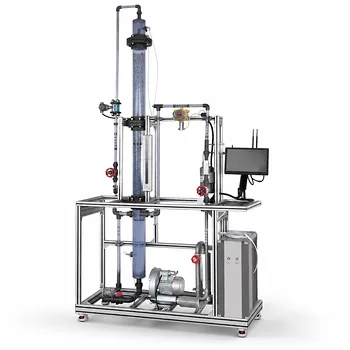
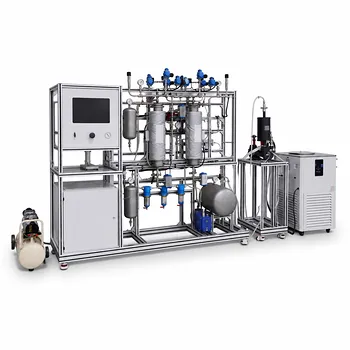
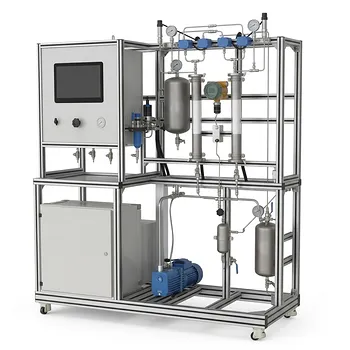
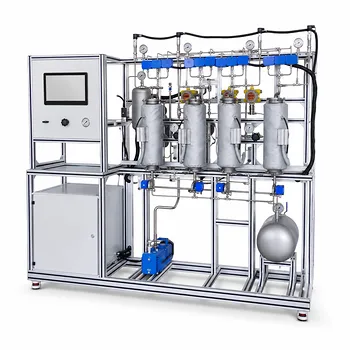
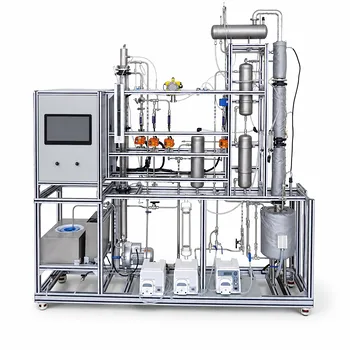
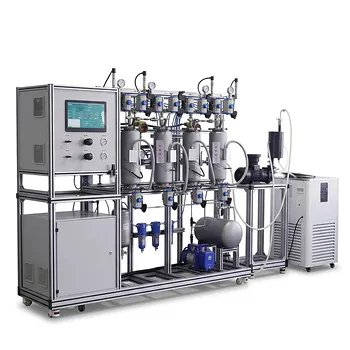
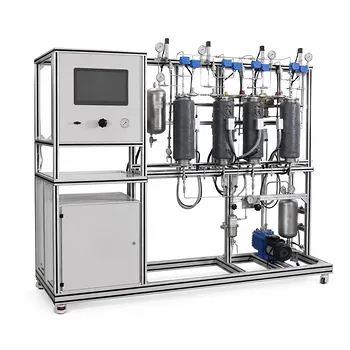
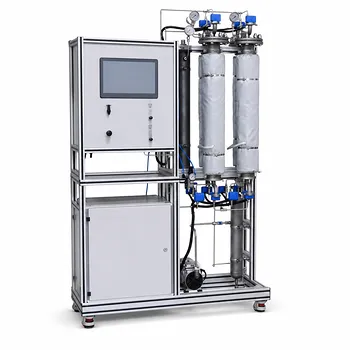
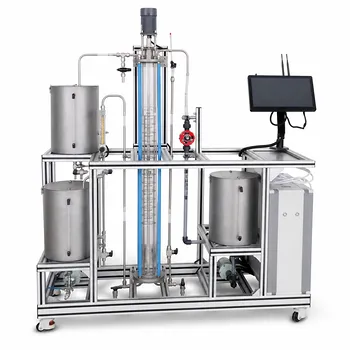
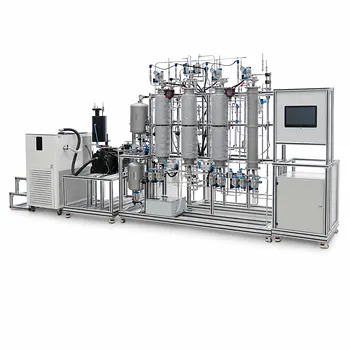
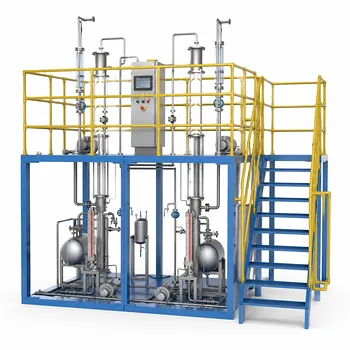
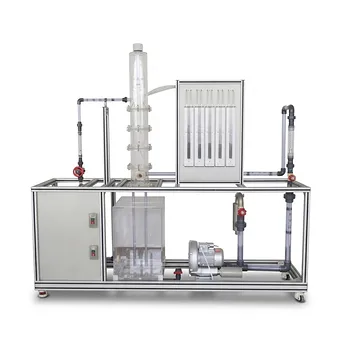
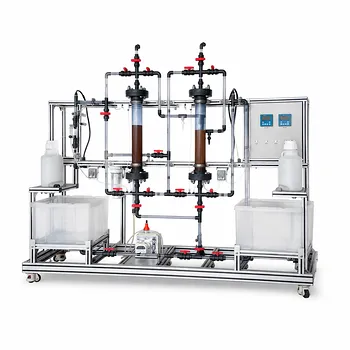
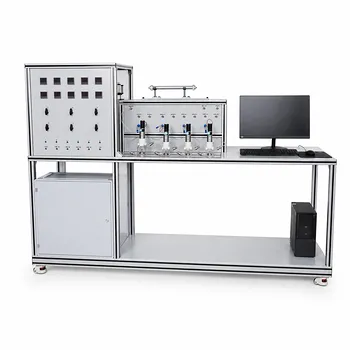
Measuring mass transfer when a chemical reaction is involved moves from textbook equations to tangible reality on an educational gas absorption packed column pilot plant. The unit directly yields critical operational parameters: liquid-phase holdup, pressure drop across the packing, flooding limits, and the mass transfer enhancement factor that arises when a reactive absorbent replaces a purely physical solvent. By varying gas and liquid flow rates while tracking solute concentrations at the inlet and outlet, students calculate Height of a Transfer Unit (HTU) and Number of Transfer Units (NTU), gaining immediate insight into how a chemical reaction shrinks the required column height compared to plain physical absorption.
The educational packed column transforms absorption theory into an engineer’s diagnostic toolkit. Running the same column with CO₂‑water (physical) and then with CO₂‑amine or alkaline solutions (chemical) reveals exactly how a fast reaction boosts driving force, cuts HTU, and elevates the enhancement factor—all while hydrodynamic boundaries like flooding remain the ultimate design constraint.
Why a Packed Column Plant Is the Ideal Sandbox for Reactive Absorption
A packed column gives you continuous, counter‑current contact between gas and liquid—the same configuration used in industrial acid‑gas scrubbers. The pilot‑scale unit compresses the essential physics into a transparent, instrumented system.
You Can Isolate the Effect of Chemistry on Transport
Physical absorption (e.g., CO₂ in water) is limited by physical solubility and slow liquid‑side diffusion. Switching to a reactive solvent (e.g., a dilute sodium hydroxide or amine solution) immediately shifts the bottleneck: the dissolved gas is consumed by reaction, steepening the concentration gradient in the liquid film. The packed column makes this shift visible in real‑time through changes in outlet concentration, temperature, and eventually hydrodynamics.
All Critical Flow Regimes Can Be Explored Safely
From a stable trickle‑bed to the dramatic onset of flooding, the pilot plant lets you push gas and liquid rates while watching pressure drop and liquid holdup. These visual and numerical cues anchor the theory of loading‑point and flooding‑gas velocity—the limits that dictate commercial column diameter and packing choice.
Core Hydrodynamic Parameters: Holdup, Pressure Drop, and Flooding
Before you can interpret mass transfer, you must master the column’s fluid mechanics. The pilot plant turns these into measurable quantities.
Liquid‑Phase Holdup (hL)
Holdup is the volume fraction of the column occupied by liquid at a given set of flow rates. You typically measure it by simultaneously shutting inlet and outlet valves and draining the column, or via differential pressure cells. Holdup directly controls the liquid residence time and the wetted area of the packing—more holdup means more interfacial area for mass transfer, up to the point where it chokes the gas path.
Pressure Drop Across the Packing
A differential manometer or transducer measures the pressure drop (ΔP) between the top and bottom of the bed. At low gas rates, ΔP rises slowly with gas velocity. Once the loading point is passed, liquid begins to accumulate and ΔP steepens sharply. At flooding, ΔP skyrockets. By plotting log ΔP vs. log gas velocity at fixed liquid rates, you pinpoint the flooding limit for each packing type—data directly used to size commercial towers.
Flooding Limits
Flooding occurs when the gas velocity is so high that liquid is physically blown upward and held at the top of the packing, or when liquid bridles the void space. The pilot plant lets you systematically map the flooding curve for gas‑liquid pairs. Because chemical absorption often requires higher liquid rates to supply reactant, understanding how reaction‑enhanced absorption affects flooding tendency is a priceless lesson in operational safety margins.
Quantifying Mass Transfer: HTU, NTU, and the Enhancement Factor
With hydrodynamics under control, you measure inlet and outlet solute concentrations to compute the performance metrics that define absorption efficiency.
Height of a Transfer Unit (HTU) and Number of Transfer Units (NTU)
By applying an overall material balance and using the operating‑line / equilibrium‑line method, you calculate NTU from concentration data and the known equilibrium relationship. HTU is simply the packed bed height divided by NTU. The key experiment: compare HTU for physical absorption (e.g., CO₂‑water) with that for chemical absorption under identical hydrodynamic conditions. A dramatically lower HTU when a reactant is present is the direct signature of the reaction enhancement.
The Mass Transfer Enhancement Factor (E)
The enhancement factor, E, is the ratio of the absorption rate with chemical reaction to the rate that would occur if only physical dissolution were happening. In the pilot plant, you determine E by first measuring the physical mass transfer coefficient from an unreactive run and then measuring the reactive run’s overall transfer rate. The ratio isolates how reaction kinetics accelerate the process. Students learn that E can exceed an order of magnitude for fast pseudo‑first‑order reactions, a core concept in solvent selection.
Extending to Effective Interfacial Area and Individual Coefficients
Using established correlations (such as Onda’s) that link liquid holdup and flow rates to the liquid‑film mass transfer coefficient (kL) and effective interfacial area (ae), you can decouple the hydrodynamic and kinetic contributions. With accurate chemical kinetics for your reactive solute‑solvent pair, the measured overall transfer rate lets you back‑calculate ae and compare it with values predicted by packing vendor data—a powerful reality check on design methods.
The Chemical Reaction Experiment: Physical vs. Chemical Absorption in One Setup
The pilot plant’s true educational power is the side‑by‑side comparison of two otherwise identical runs.
Physical Absorption Baseline
Using CO₂ and deionized water, you collect a set of liquid outlet concentrations over a range of gas and liquid flow rates. The driving force is simply the difference between the bulk liquid CO₂ concentration and the dissolved equilibrium given by Henry’s law. This run yields the physical volumetric mass transfer coefficient and establishes the HTU that would be needed if no reaction were present.
Chemical Absorption with a Reactive Solvent
With the same flow rates and packing, you now introduce a dilute alkaline or amine solution. The outlet CO₂ concentration plummets, and the calculated HTU shrinks significantly. The improvement is quantified as the enhancement factor E. By changing the reactant concentration (e.g., NaOH molarity), you can observe the transition from a slow reaction regime (E ≈ 1) to the fast pseudo‑first‑order regime where E levels off, demonstrating how reaction kinetics and liquid‑side mass transfer become coupled.
Operational Insights That Only a Plant Can Teach
Because the system is transparent or heavily instrumented, you notice secondary effects: a rise in temperature from the exothermic reaction, possible precipitation (e.g., carbonates) that alters packing wettability, and slight changes in holdup due to viscosity shifts. These remind the student that industrial absorption never runs in ideal neat theory.
Understanding the Trade‑offs and Limitations of Educational‑Scale Columns
Even the best educational plant has constraints. Recognizing them builds the judgment needed for scale‑up.
Wall Effects and Packing Size
A small‑diameter column (often 4–10 cm) may have a diameter less than 10 times the packing size, encouraging liquid to channel down the wall rather than through the packing’s interior. This reduces effective interfacial area and makes measured kL or ae values less representative of large towers. Careful packing selection (keeping size ≤ 1/8 of column diameter) and installing redistributors every few meters can mitigate the issue in taller educational rigs.
Limited Height and the Number of Transfer Units
Short laboratory columns may yield only 1–3 theoretical stages. While enough to demonstrate the enhancement factor, very shallow beds limit the accuracy of HTU determination because concentration changes are small. You must pay meticulous attention to analytical precision (gas chromatography, titration) to obtain meaningful data.
Chemical Handling and Safety
Reactive absorbents such as amines or caustic solutions introduce hazards: corrosion, toxicity, and exotherms. The educational plant forces rigorous safety thinking—material compatibility, ventilation, and solvent regeneration constraints mirror the real‑world design checks that precede any industrial gas treating selection.
Reaction Reversibility and Operational Robustness
An irreversible reaction (e.g., NaOH with CO₂) is excellent for showing maximum enhancement but is not representative of commercial solvent systems that must be regenerated. For deeper insight, mildly reactive amines like MDEA, which react reversibly, can be used on a pilot scale, but the slower kinetics reduce the enhancement factor and require careful temperature control to avoid shifting equilibrium mid‑column.
Making the Right Choice for Your Learning Objective
The exact parameters you prioritize depend on whether you are teaching fundamentals, validating design models, or screening solvents.
- If your primary focus is comparing physical versus chemical absorption: Run identical hydrodynamics (gas/liquid flow rates, packing) with an inert absorbent (water) and a fast‑reacting absorbent (dilute NaOH). Concentrate on the measured HTU reduction and compute the enhancement factor E. This stark contrast builds core intuition.
- If your primary focus is understanding hydrodynamic limits: Map pressure drop versus gas velocity at several fixed liquid rates, note the loading and flooding points, and measure liquid holdup by draining the column. Use at least two packings (e.g., ceramic Raschig rings vs. structured high‑porosity plastic) to see how geometry impacts capacity.
- If your primary focus is obtaining reliable mass transfer coefficients for design: Use a system with well‑known kinetics (CO₂‑NaOH or CO₂‑buffer) and apply Onda’s correlations to determine kL and effective interfacial area ae. Compare your results against literature values for your packing; discrepancies will teach scale‑up pitfalls better than any lecture.
- If your primary focus is solvent screening: Test a series of absorbents (water, NaOH, MDEA, or even a catalyzed carbonate solution) at identical hydrodynamic conditions. Plot enhancement factor against reaction rate constant or solvent concentration. This exercise directly connects chemical kinetics to column sizing—exactly the decision an industrial engineer makes when selecting a solvent for a new gas treating plant.
An educational packed column pilot plant is far more than a demonstration tool—it is a measurement platform that converts the abstract interplay of fluid mechanics, thermodynamics, and reaction kinetics into hard numbers that directly determine how tall and how wide an absorber must be.
Summary Table:
| Parameter | Type | What it Measures / How | Educational/Design Significance |
|---|---|---|---|
| Liquid Holdup ($h_L$) | Hydrodynamic | Volume fraction of column occupied by liquid | Controls liquid residence time & wetted packing area |
| Pressure Drop ($\Delta P$) | Hydrodynamic | $\Delta P$ between top & bottom using manometers | Identifies loading & flooding limits for column sizing |
| Flooding Limits | Hydrodynamic | Maximum gas velocity before liquid is blown upward | Dictates safe operating window & column diameter |
| HTU & NTU | Mass Transfer | Height & Number of Transfer Units via mass balance | Measures absorption efficiency; demonstrates chemical reaction enhancement |
| Enhancement Factor ($E$) | Mass Transfer | Ratio of chemical to physical absorption rate | Isolates reaction kinetics' effect on mass transfer acceleration |
Bring Unit Operations Theory to Life with LABPARK
Are you looking to bridge the gap between textbook equations and practical engineering for your students or research team? LABPARK designs and manufactures premium Educational and Vocational Unit Operations Pilot Plants tailored for universities, research institutes, and enterprises.
Whether you need advanced systems for chemical engineering (like our gas absorption packed columns), bioprocess & biotech, or environmental & water treatment, we provide the robust, highly instrumented equipment you need to master mass transfer, hydrodynamics, and chemical reactions.
Contact LABPARK today to discuss your laboratory requirements and receive a customized solution for your department.
Related Products
- Packed Bed Absorption Educational Unit Operations Pilot Plant
- Absorption and Desorption Educational Unit Operations Pilot Plant
- Bench Scale Dual Column Gas Separation and Capture Educational Pilot Plant
- Pressure Swing Adsorption Educational Unit Operations Pilot Plant
- Carbon Dioxide Adsorption and Capture Educational Unit Operations Pilot Plant
People Also Ask
- How Do Flow Regimes Transition in Packed Bed Pilot Plants? Key Scale-up Insights
- How does reactant concentration determine absorption column control? Gas-film vs. dual-film.
- How is the packing height of an absorption column calculated? Master HTU & NTU Concepts
- How does static vs. operating holdup affect pilot plant calibration? Avoid Critical Scale-Up Errors
- Why is counter-current flow selected for gas absorption? Maximize Pilot Plant Efficiency