Knowledge Chemical Engineering Education What parameters adjust rotary vacuum filter capacity & cake thickness? Key Pilot Plant Controls
Author avatar

Tech Team · LABPARK

Updated 1 month ago

What parameters adjust rotary vacuum filter capacity & cake thickness? Key Pilot Plant Controls


Understanding the levers of a rotary vacuum filter is the first step to mastering continuous solid‑liquid separation. Students and researchers can directly influence production capacity (filtrate volume per hour) and filter cake thickness by adjusting four key operating parameters: drum rotation speed, submergence ratio, vacuum level, and feed slurry concentration. Each of these dials changes the physical dynamics of cake formation and filtrate removal in a predictable – but often counterbalancing – way.

The four most impactful dials are drum speed, submergence depth, vacuum level, and slurry concentration. Adjusting any of these creates a tug-of-war between production rate and cake quality. Understanding the inherent trade-offs turns a pilot‑plant experiment into genuine engineering insight, not just a set of observations.

The Core Adjustable Parameters

Drum Speed (n): The Pulse of Production

Rotational speed controls how quickly the filter surface re‑enters the slurry trough.
Increasing n means the drum completes more revolutions per hour, pulling more slices of the filtration cycle into every minute – this directly elevates the overall volumetric production capacity.

However, the time the cake has to build in each revolution shrinks.
At higher speeds, each pass deposits a thinner filter cake, which can become so thin that it fails to release cleanly from the cloth, hampering discharge.

Submergence Ratio (ψ): How Much Time the Drum Spends Under the Slurry

The submergence ratio defines the fraction of the drum surface immersed in the feed trough at any instant.
A larger ψ extends the active filtration arc, effectively giving the cake a longer section of each revolution to form – this boosts both capacity and cake thickness simultaneously.

The trade‑off is that a deeper submergence steals arc time from the washing and drying zones.
If the pilot plant has fixed zone boundaries, a very high submergence can leave less surface for de‑watering and washing, potentially raising the final cake moisture.

Vacuum Degree: The Driving Force

The operating vacuum creates the pressure difference (ΔP) that pulls liquid through the cake and the medium.
Applying a higher vacuum intensifies this driving force, directly accelerating the filtration rate and increasing capacity.

For many solids, however, a stronger vacuum compacts the cake – especially if the cake is compressible.
A compressed cake has higher specific resistance, so the initial boost in flow can be partially self‑limiting. Cake thickness may rise initially but then plateau, and over‑compaction can make subsequent washing and drying less effective.

Slurry Concentration: The Building Blocks

The solid volume fraction in the feed determines how many particles are available to be deposited per unit area.
A higher concentration speeds up cake deposition dramatically; for a given drum speed and submergence, this yields a thicker cake and a faster rate of solids removal.

The effect on filtrate throughput is more nuanced.
While a higher concentration delivers more solids, the thicker cake also increases flow resistance. The net result on liquid production capacity often depends on whether the system is limited by growth of the cake or by the inherent resistance of the medium – a relationship that can be mapped experimentally.

Understanding the Trade‑offs

The Speed‑Thickness Dilemma

Pushing the drum speed up is the fastest way to increase throughput, but the resulting thinner cake can cling to the cloth or require impractical doctor‑blade clearances.
A slower drum gives a robust, easily discharged cake at the expense of lower hourly output. Finding the earliest speed at which the cake still releases cleanly is a classic optimisation exercise.

The Vacuum‑Compaction Trade‑off

Higher vacuum raises both capacity and driving force, but it also squeezes the cake structure.
For compressible materials, this can severely reduce porosity, elevate specific cake resistance, and even block the cloth. A pilot plant study typically maps the sweet spot where the gain in pressure overcomes the extra resistance without crushing the cake.

Balancing Submergence and Washing/Drying Time

A deep submergence ratio grows a thick, well‑formed cake, which is often desirable for easy discharge.
But if the washing and drying arcs are cut short, the cake may leave the drum too wet for the next processing step.
In practice, students adjust submergence while monitoring the residual moisture content to find the best compromise between cake production and de‑watering quality.

How to Design Your Pilot Plant Experiment

Select your primary goal and then manipulate the parameters systematically, while holding others constant to isolate effects.

  • If your primary focus is maximum volumetric throughput: Prioritise higher drum speed and a generous submergence ratio, but closely monitor cake discharge performance and washing effectiveness.
  • If your primary focus is a thick, easily discharged cake: Reduce drum speed and increase slurry concentration, then confirm that the applied vacuum can still de‑water the thicker cake to an acceptable level.
  • If your primary focus is minimising residual moisture: Experiment with elevated vacuum levels while reducing submergence to extend the drying arc; keep the cake thickness moderate to avoid pore collapse.
  • If your primary focus is studying cake compressibility: Vary the vacuum degree step‑wise while measuring the specific cake resistance, to quantify how the solids respond to mechanical pressure in a dynamic, continuous setting.

By methodically isolating each control parameter, you transform the rotary vacuum filter pilot plant into a true investigative instrument – one that reveals the physical principles governing large‑scale production, not just the numbers on a dial.

Summary Table:

Parameter Adjustment Effect on Capacity Effect on Cake Thickness Key Trade-off
Drum Speed (n) Increase Increases Decreases Thinner cake may not discharge cleanly
Submergence Ratio (ψ) Increase Increases Increases Reduces washing and drying time
Vacuum Degree Increase Increases Increases (initially) Can compact compressible cakes, blocking flow
Slurry Concentration Increase Variable (liquid capacity may drop) Increases Thicker cake increases flow resistance

Bring Real-World Filtration Insights to Your Laboratory

LABPARK provides premium Educational and Vocational Unit Operations Pilot Plants in chemical engineering, bioprocess & biotech, and environmental & water treatment. Specially designed for universities, research institutes, and enterprises, our equipment helps students and researchers bridge the gap between theoretical calculations and practical process optimization.

Ready to enhance your teaching and research capabilities? Contact LABPARK today to explore our custom pilot plant solutions and request a quotation!

Related Products

People Also Ask

Related Products

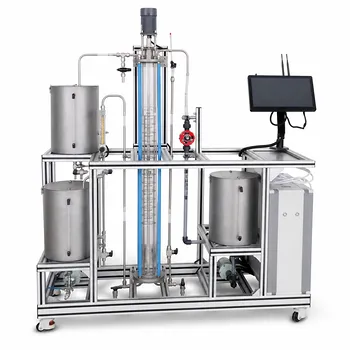
Educational Rotary Disc Liquid-Liquid Extraction Pilot Plant

Educational Rotary Disc Liquid-Liquid Extraction Pilot Plant

A transparent rotary disc column for educational liquid-liquid extraction experiments. This pilot plant enables students to study mass transfer, droplet dynamics, and flooding behavior, bridging theory and practice in chemical engineering unit operations education. Features variable-speed agitation and PLC control.

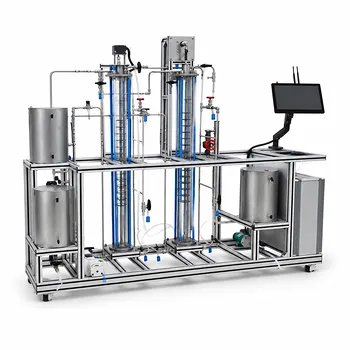
Comprehensive Liquid-Liquid Extraction Pilot Plant for Engineering Education

Comprehensive Liquid-Liquid Extraction Pilot Plant for Engineering Education

Comprehensive liquid-liquid extraction pilot plant for engineering education, integrating rotary and vibratory columns for hands-on observation of phase behavior, flooding limits, and mass transfer efficiency, enabling precise HTU and mass transfer coefficient calculations.

Constant Pressure Filtration Educational Unit Operations Pilot Plant

Constant Pressure Filtration Educational Unit Operations Pilot Plant

Hands-on educational pilot plant for constant pressure filtration. Classic plate and frame filter press allows students to study kinetics, determine specific cake resistance, perform cake washing and evaluate washing rates. Ideal for chemical engineering curriculum. Mobile, customizable, safety-compliant design.

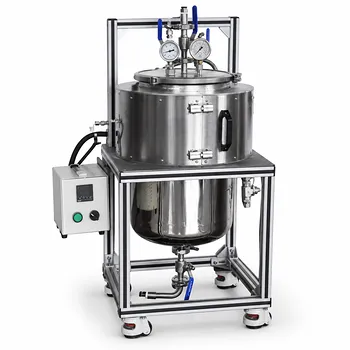
Hot Filtration Educational Unit Operations Pilot Plant Laboratory System

Hot Filtration Educational Unit Operations Pilot Plant Laboratory System

This integrated laboratory bench-scale hot filtration pilot plant enables students to study solid-liquid separation under thermal conditions, featuring a stainless steel vessel, removable heating jacket, and multi-layer filter plates for unit operations education, ideal for chemical engineering laboratory curriculum.

Multi-Functional Special Distillation Educational Pilot Plant

Multi-Functional Special Distillation Educational Pilot Plant

Versatile multi-functional special distillation pilot plant for chemical engineering education. Supports continuous, vacuum, azeotropic, reactive, extractive distillation. Transparent glass columns enable real-time visual observation of hydrodynamics and separation processes.

High-Gravity Emulsification and Mass Transfer Educational Pilot Plant

High-Gravity Emulsification and Mass Transfer Educational Pilot Plant

This integrated educational pilot plant utilizes rotating packed bed technology to demonstrate high-gravity emulsification and mass transfer, providing engineering students with hands-on experience in process intensification and unit operations through a modular, customizable design with digital monitoring.

Rising and Falling Film Evaporation Educational Unit Operations Pilot Plant

Rising and Falling Film Evaporation Educational Unit Operations Pilot Plant

Hands-on educational pilot plant for studying rising and falling film evaporation, flow regimes, and heat transfer. Customizable for university labs with industrial instrumentation and data acquisition. Enables comparative evaluation of evaporation modes and energy efficiency.

Multifunctional Membrane Separation Educational Pilot Plant with Ultrafiltration, Nanofiltration, Reverse Osmosis

Multifunctional Membrane Separation Educational Pilot Plant with Ultrafiltration, Nanofiltration, Reverse Osmosis

An integrated laboratory bench-scale membrane separation system for higher education engineering labs combining Ultrafiltration, Nanofiltration, and Reverse Osmosis processes. Features industrial PLC control with touch-screen HMI, transparent piping, and academic assessment software. Ideal for chemical and environmental engineering curricula.

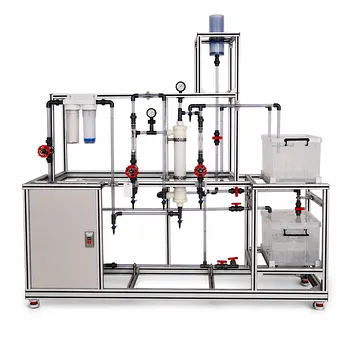
Ultrafiltration Membrane Separation Educational Pilot Plant

Ultrafiltration Membrane Separation Educational Pilot Plant

This ultrafiltration membrane separation educational pilot plant enables undergraduate students to process PVA solutions, study hollow fiber membrane dynamics, and perform quantitative analysis with spectrophotometry for hands-on learning of unit operations and industrial maintenance and membrane cleaning protocols.

Multi-Functional Membrane Separation Educational Pilot Plant for Unit Operations Lab

Multi-Functional Membrane Separation Educational Pilot Plant for Unit Operations Lab

The Multi-functional Membrane Separation Educational Unit Operations Pilot Plant is an integrated bench-scale laboratory system designed for teaching undergraduate engineering education. It features Ultrafiltration, Nanofiltration, and Reverse Osmosis modules in a compact, mobile unit for practical hands-on learning.

Hollow Fiber Ultrafiltration Membrane Separation Educational Pilot Plant

Hollow Fiber Ultrafiltration Membrane Separation Educational Pilot Plant

Explore our hollow fiber ultrafiltration membrane separation educational pilot plant for hands-on learning of industrial ultrafiltration processes, flux analysis, fouling mitigation, and process control. Compact, customizable, and built for engineering labs.

Natural Product Extraction Unit Operations Training Pilot Plant

Natural Product Extraction Unit Operations Training Pilot Plant

Integrated natural product extraction pilot plant for chemical engineering training bridges theory and industrial practice with modular extraction and evaporation/concentration units, hybrid touchscreen and manual control, realistic process simulation, and self-contained softened water and vacuum utilities.

Gas-Solid Heterogeneous Separation Demonstration Educational Unit Operations Pilot Plant

Gas-Solid Heterogeneous Separation Demonstration Educational Unit Operations Pilot Plant

Comprehensive visual transparent gas-solid separation pilot plant for chemical engineering labs. Demonstrates gravity settling inertial settling cyclone and bag filter technologies. Enables real-time analysis of fluid-particle mechanics pressure drop and collection efficiency. Ideal for undergraduate unit operations courses.

Absorption and Desorption Educational Unit Operations Pilot Plant

Absorption and Desorption Educational Unit Operations Pilot Plant

Dual packed column absorption and desorption pilot plant for chemical engineering education, offering real-time mass transfer coefficient measurement, durable mobile frame, industrial touch-screen interface, and customizable design for varied laboratory curricula, enabling hands-on study of gas absorption and stripping.

Dual-Mode Rectification Pilot Plant for Practical Training Unit Operations

Dual-Mode Rectification Pilot Plant for Practical Training Unit Operations

Industrial-scale dual-mode rectification pilot plant for chemical engineering practical training. Features real-material and simulated-material operation modes, sieve-plate column with sight glasses for visual observation of hydrodynamics, and customizable SCADA control for safe, hands-on learning of unit operations and mass transfer.

Dual-Mode Gas Absorption and Desorption Unit Operations Training Pilot Plant

Dual-Mode Gas Absorption and Desorption Unit Operations Training Pilot Plant

Industrial-scale pilot plant for gas absorption and desorption training in chemical engineering. Features dual-mode operation with real and simulated materials, transparent columns for flow visualization, and customizable design. Supports independent or combined loops for hands-on unit operations experiments.

Multi-Functional Drying Educational Unit Operations Pilot Plant

Multi-Functional Drying Educational Unit Operations Pilot Plant

Versatile multi-functional drying educational unit operations pilot plant integrating tunnel, fluidized bed, and spray drying. Enables hands-on study of drying curves, psychrometry, and gas-solid separation for chemical engineering curriculum in higher education labs.

Continuous Batch Extractive Distillation Educational Pilot Plant

Continuous Batch Extractive Distillation Educational Pilot Plant

Versatile pilot plant for continuous, batch, and extractive distillation training. High-borosilicate glass column for visualizing hydraulics, 15.6-inch touchscreen with data logging, precise reflux ratio control 1-99, and durable corrosion-resistant frame. Ideal for chemical engineering education and process research.

Educational Unit Operations Pilot Plant for Intraparticle Diffusion Effective Factor Measurement

Educational Unit Operations Pilot Plant for Intraparticle Diffusion Effective Factor Measurement

Designed for chemical engineering university labs, this pilot plant allows hands-on determination of catalyst particle intraparticle diffusion effective factors and gas-solid reaction kinetics using a fixed-bed tubular reactor with industrial touchscreen control, bridging theory and practical reactor design.

Ion Exchange Water Purification Educational Pilot Plant for Engineering Unit Operations

Ion Exchange Water Purification Educational Pilot Plant for Engineering Unit Operations

This bench-scale ion exchange pilot plant trains engineering students in water purification. Dual transparent columns simulate industrial softening and demineralization. Students observe fluid dynamics, perform resin regeneration, and analyze breakthrough curves. The corrosion-resistant frame ensures durability in unit operations experiments.


Leave Your Message