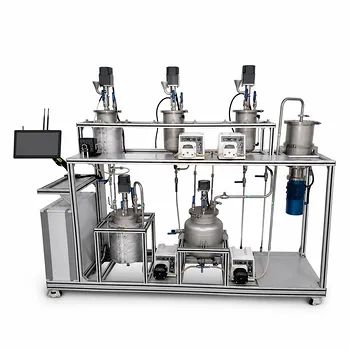
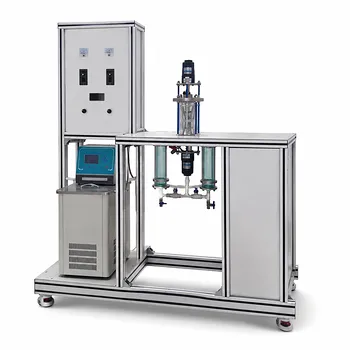
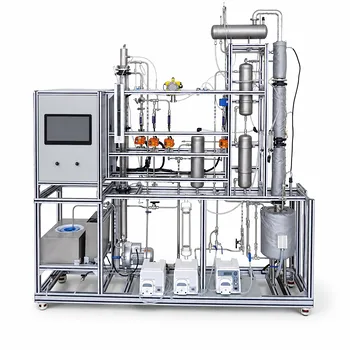
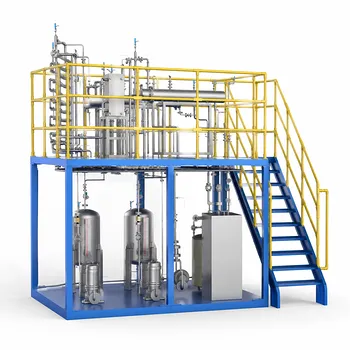
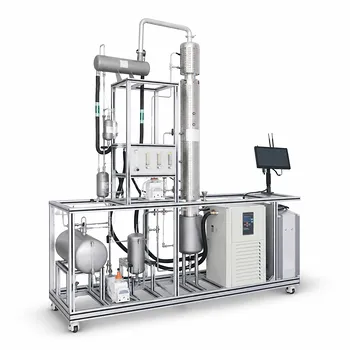
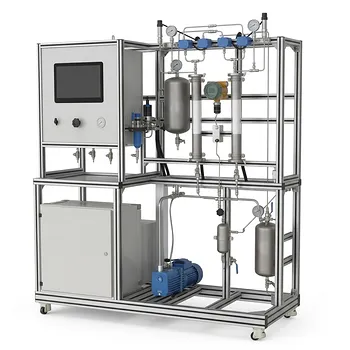
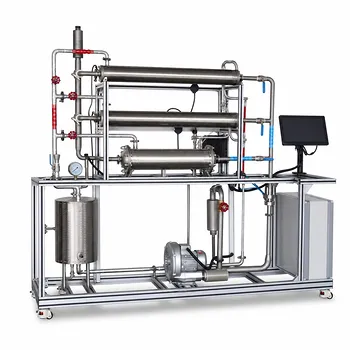
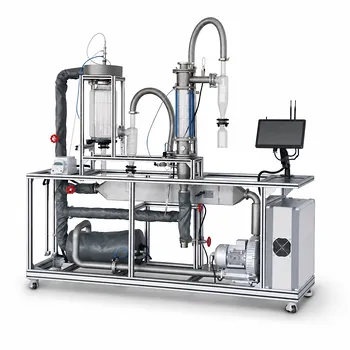
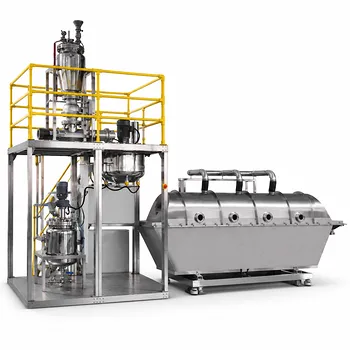
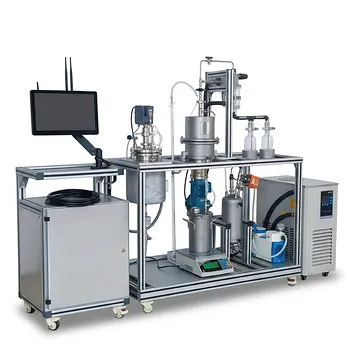
Mass transfer pilot plants are the proving ground for process scale-up—but their utility hinges on meeting a precise set of design criteria.
A mass transfer unit operations pilot plant must deliver five non‑negotiable performance requirements: a large interfacial contact area, reliable phase distribution, high operating flexibility, low flow resistance, and safe, transparent construction. These pillars ensure the plant faithfully reproduces industrial mass transfer phenomena for effective teaching and generates the trustworthy data essential for scale‑up research.
A mass transfer pilot plant is not merely a scaled‑down column; it is a carefully engineered system that must provide a large, well‑distributed interfacial area, flexible operation, low energy losses, and complete observability. Beyond these physical attributes, its real research value lies in its ability to characterize mass transfer coefficients (kLa) and support structured scale‑up methodologies, ensuring that the data it generates accurately predicts commercial performance.
The Five Foundational Design Requirements
Maximizing Interfacial Area within a Limited Volume
The heart of any mass transfer operation is the interfacial area between phases. Pilot‑plant designs must pack as much contact area as possible into a compact volume—through structured packing, random packing, or specialized tray designs—to achieve rapid, efficient mass transfer. Without a high specific surface area, the pilot plant cannot replicate the intimate phase contact that industrial columns deliver, and mass transfer rates will be artificially low.
Guaranteeing Uniform Phase Distribution
Even the best packing underperforms if the phases do not flow evenly. The pilot plant must incorporate reliable liquid distributors and, for packed columns taller than 3–5 m, intermediate redistributors. These features suppress channelling, short‑circuiting, and axial back‑mixing, which distort experimental results.
Further, the packing material must be preferentially wetted by the continuous phase but not by the dispersed phase; otherwise droplets coalesce, destroying the interfacial area. For columns, keeping the packing size between 1⁄10 and 1⁄8 of the tower diameter prevents wall‑effect channelling that skews data.
Delivering High Operating Flexibility
The plant must handle a wide range of flow rates and operating parameters so that researchers can intentionally approach and map flooding, weeping, and other limiting conditions. This flexibility is the only way to define the true operating window for scale‑up.
If the intended process requires more than about 3 theoretical stages, a simple packed column becomes impractical. In such cases, the pilot plant should incorporate pulsed or agitated column designs to maintain efficiency without an unworkably tall unit.
Minimizing Flow Resistance for Energy Efficiency
Industrial columns are sensitive to pressure drop; a pilot plant must mimic this reality. Low flow resistance is engineered through careful packing selection, distributor design, and column geometry to keep auxiliary pump and blower power consumption realistic. Excessive pressure drop not only wastes energy but can also alter phase equilibria and compromise data for heat‑sensitive materials.
Embedding Observability and Safety
Effective teaching depends on seeing phase behaviour—droplet formation, bubble dispersion, froth height—in real time. Transparent sections (e.g., borosilicate glass columns) are therefore essential visual tools.
At the same time, safety cannot be secondary. The pilot plant must include robust pressure relief systems, temperature control loops, and chemical containment measures to protect students and researchers when exploring the edges of the operating envelope.
Why These Requirements Are Crucial for Teaching and Scale‑Up
Bridging Theory and Practice in Education
A well‑designed pilot plant transforms abstract mass transfer equations into tangible experience. Visual observation of flooding, weeping, or entrainment builds intuition that no textbook can replicate. The flexibility to deliberately create suboptimal flow conditions helps students grasp why uniform distribution and low pressure drop matter, cementing core engineering principles.
De‑risking Process Scale‑Up
Industrial failures often trace back to uncharacterized mass transfer limitations. A research‑grade pilot plant must enable independent measurement of the volumetric mass transfer coefficient (kLa). For reactions like catalytic hydrogenation, a critical rule of thumb applies: the mass transfer capability must satisfy kLa ≥ 10×(maximum reaction rate / saturated reactant concentration). If the pilot plant cannot meet this “10 % rule,” the dissolved gas concentration will not remain saturated, and the data will conflate kinetics with transport limitations—leading to flawed scale‑up.
Beyond a single coefficient, the plant must support Design of Experiments (DOE) to map multi‑variable interactions and multivariate statistical process control (MSPC) for data analysis. The physical pilot plant thus becomes the validation bridge between laboratory‑scale design space models and the final commercial unit.
Avoiding the Trap of Mass Transfer Limitations
When researchers skip thorough pilot‑plant characterization, scale‑sensitive parameters (e.g., agitation shear rates, local mass transfer coefficients) often mask intrinsic reaction rates. A pilot plant that fails to decouple thermodynamics, kinetics, and transport phenomena produces scale‑up predictions that are, at best, lucky guesses. The plant’s design must therefore embed the sampling ports, variable‑speed drives, and internal geometry that permit researchers to quantify and eliminate transport artefacts.
Understanding the Trade‑offs
Simplicity vs. Performance
Packed columns are structurally simple, low‑cost, and easy to operate—but they are limited to processes requiring fewer than roughly 3 theoretical stages. When a separation demands many equilibrium stages, a pure packed bed becomes impractical, and the pilot plant must adopt more complex pulsed, agitated, or tray columns. This simplicity‑performance trade‑off directly affects equipment cost, maintenance, and the skill required to run experiments.
Flexibility vs. Energy Efficiency
Wide‑range flow flexibility often means oversized pumps, blowers, and control valves that conflict with the goal of low flow resistance. A plant that can turn down to 10 % of design flow may consume disproportionately more energy in low‑throughput runs, or require frequent component swaps to maintain efficiency.
Transparency vs. Operating Envelope
Glass columns offer unbeatable visual insight, but they impose pressure and temperature ceilings far below those of metal construction. A pilot plant built entirely from borosilicate glass cannot be used for high‑pressure hydrogenations or high‑temperature distillations without significant safety risks.
Cost vs. Fidelity
A fully instrumented, highly‑flexible pilot plant is expensive. The challenge is to balance the budget with the specific experimental goals: a teaching plant may prioritise robust visibility and simple controls, while a research plant must invest in precise sensors, data acquisition, and modular internals even if that raises the price tag.
Making the Right Choice for Your Goal
- If your primary focus is hands‑on chemical engineering education: choose a plant with maximum visual access (glass columns), simple packed or tray configurations that clearly demonstrate flooding and weeping, and interlocks that make safety training intuitive.
- If your primary focus is rigorous scale‑up research for kinetics‑limited reactions (e.g., hydrogenation): insist on a reactor where kLa can be independently measured and that exceeds the 10× mass transfer rule; include ports for gas/liquid sampling and variable‑speed agitation.
- If you need a multi‑purpose pilot plant for contract research: invest in a highly flexible skid with interchangeable internals (packed, tray, agitated columns), automated data acquisition, and the ability to execute statistical DOE across wide parameter spaces.
- If your process demands many theoretical stages (e.g., difficult distillations or extractions): do not rely solely on a packed column; integrate a pulsed or agitated column or a multi‑stage tray column to avoid excessive height and chronic back‑mixing.
Ultimately, the right pilot plant transforms mass transfer principles from textbook equations into actionable, scalable knowledge, safeguarding both academic learning and industrial investment.
Summary Table:
| Key Design Requirement | Engineering Solution | Teaching & Scale-Up Benefit |
|---|---|---|
| 1. Maximize Interfacial Area | Structured/random packing, specialized trays | Replicates industrial-scale mass transfer rates in a compact volume. |
| 2. Uniform Phase Distribution | Liquid distributors & intermediate redistributors | Prevents channeling and back-mixing to ensure reliable data. |
| 3. Operating Flexibility | Wide flow rate range, pulsed/agitated designs | Allows mapping of flooding/weeping limits and operating windows. |
| 4. Low Flow Resistance | Optimized column geometry & packing selection | Minimizes pressure drop to protect heat-sensitive material data. |
| 5. Observability & Safety | Glass columns, pressure relief, control loops | Facilitates real-time visual learning while protecting researchers. |
Elevate Your Engineering Lab with LABPARK
Bridge the gap between theoretical textbook equations and industrial-scale reality. LABPARK designs and supplies premium Educational and Vocational Unit Operations Pilot Plants in chemical engineering, bioprocess & biotech, and environmental & water treatment.
Tailored for universities, research institutes, and enterprises, our pilot plants are engineered to deliver:
- High-Fidelity Data: Easily characterize mass transfer coefficients ($k_L a$) for risk-free process scale-up.
- Operational Safety & Visibility: Transparent borosilicate glass columns combined with robust safety interlocks for safe, hands-on student training.
- Modular Flexibility: Easily adaptable configurations to match your specific curriculum or R&D workflows.
Ready to transform your laboratory capabilities? Contact LABPARK today to discuss your project needs with our technical experts!
Related Products
- Dual-Mode Rectification Pilot Plant for Practical Training Unit Operations
- Multimodal Absorption and Desorption Pilot Plant for Unit Operations Training
- High-Gravity Emulsification and Mass Transfer Educational Pilot Plant
- Liquid-Liquid Mass Transfer Coefficient Determination Educational Pilot Plant
- Carbon Dioxide Absorption and Desorption Educational Pilot Plant for Carbon Capture Studies
People Also Ask
- How does polyphosphate hydrolysis affect scale and corrosion in pilot plants? Essential Monitoring Guide
- How do predictive thermodynamic models integrate into pilot plants? Bridging Theory and Practice
- How can process control schemes be configured to teach basic and advanced control?
- Why Use Center Points in Process Analyzer Calibration? Key Benefits Explained
- Which cross-validation strategy should be selected for pilot plant time-series & batch data? Avoid Data Leakage