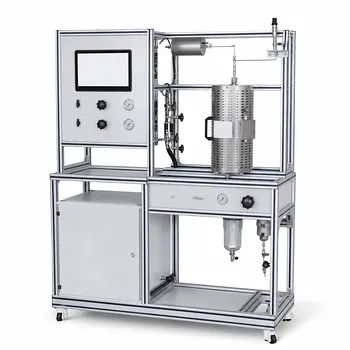
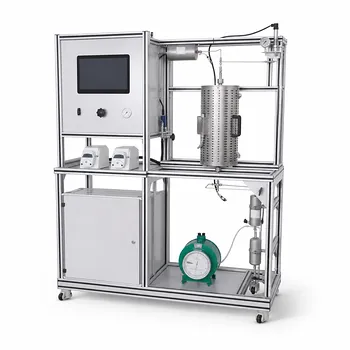
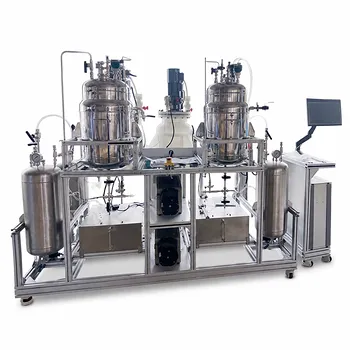
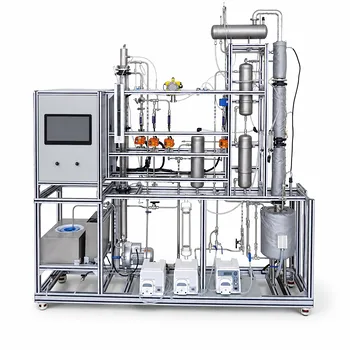
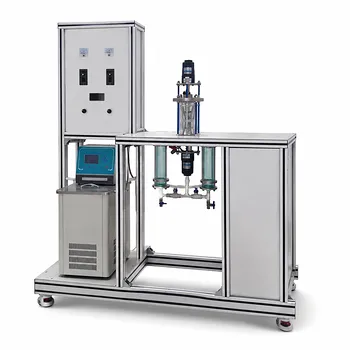
Space time is the master variable that dictates the size, throughput, and conversion of a continuous stirred-tank reactor. It defines how long a fluid element spends in the reactor on average and directly determines the reactor’s processing capacity. In a CSTR, the significance lies in the fact that a single value—space time—encapsulates the interplay between reactor volume, feed rate, and reaction kinetics, making it the central parameter for design and scale‑up. Using a chemical reactor training system, students evaluate space time by deliberately varying the feed flow rate for a known reactor volume, measuring the steady‑state outlet conversion, and constructing a graphical rectangle whose area is proportional to the space time—transforming an abstract formula into a tangible, visual engineering insight.
Space time is not simply a residence time; it is the key that connects the physical size of a CSTR to the chemical conversion it delivers. In a pilot‑plant training system, you prove this relationship by plotting reaction rate data against conversion: the area of the resulting rectangle, scaled by the inlet concentration, equals the space time, thereby experimentally validating the CSTR design equation.
Why Space Time Is the Heart of CSTR Performance
The Definition: Processing One Reactor Volume
Space time, τ, is defined as τ = Vr / Q0 (reactor volume divided by volumetric feed rate). It tells you how long it takes to process one complete reactor volume of feed under inlet conditions. A smaller space time means the reactor can handle more feed per unit time—higher throughput—but potentially at the cost of reduced conversion.
The Design Equation: Linking Kinetics and Size
In a perfectly mixed CSTR, the composition is uniform and equal to the outlet conditions. Therefore, the design equation simplifies to τ = C_A0 · X_A / r_A, where the reaction rate r_A is evaluated at the exit concentration. This direct relationship means that for a given desired conversion and known kinetics, you can instantly calculate the reactor volume needed for a specified feed rate—or vice‑versa.
The Direct Impact on Conversion and Throughput
Space time governs how close the reaction can get to completion. A larger τ (slower feed or bigger reactor) drives the exit composition closer to equilibrium, increasing conversion. Conversely, for a fixed reactor, the maximum achievable throughput is limited by how small you can make τ without causing an unacceptable drop in conversion. This trade‑off is at the core of every industrial CSTR decision.
Bringing Theory to Life: Practical Evaluation in a Training System
Adjusting Feed Flow to Vary Space Time
A chemical reactor pilot plant is equipped with a precisely controllable feed pump and a CSTR of known volume. By changing the pump setpoint, you directly alter Q0, which in turn changes τ. Starting from a low flow (long τ) and stepping up to higher flows (short τ) covers a wide range of operating conditions without any hardware modification.
Measuring Steady-State Conversion at the Exit
At each flow setting, the system must reach a steady state—no further change in outlet concentration with time. Students sample the reactor outlet and, for example, titrate or use online sensors to determine the concentration of the limiting reactant. The fractional conversion X_A is then calculated from X_A = (C_A0 – C_A)/C_A0. Repeating this at multiple τ values builds an experimental dataset.
Constructing the Graphical Rectangle on a 1/r_A vs. X_A Plot
The heart of the training exercise is plotting the inverse of the reaction rate, 1/r_A (y‑axis), as a function of conversion, X_A (x‑axis), for the measured outlet conditions. For a single CSTR run, the operating point corresponds to a single rectangle; its width is X_Af and its height is 1/r_Af. The area of that rectangle equals X_Af / r_Af, which, when multiplied by the known inlet concentration C_A0, gives τ = C_A0 · (X_Af / r_Af). In many simplified training scenarios (or when C_A0 = 1), the rectangle area is directly taken as the space time.
Interpreting the Area to Validate the Design Equation
By plotting the rectangles for different flow rates, students see that larger τ (slower flows) produce wider, taller rectangles, while shorter τ (faster flows) produce narrower ones. Overlaying the kinetic curve (1/r_A vs. X_A) reveals that the CSTR operates at the outlet concentration on the curve. This visualisation cements the understanding that reactor sizing is essentially “graphical integration”: the reactor volume (via τ) is directly proportional to the area bounded by the kinetic curve.
Understanding the Trade‑offs and Common Pitfalls
The Inlet Concentration Scaling Factor
A frequent student mistake is to assume the rectangular area is always numerically equal to τ. In reality, τ = C_A0 × area. If the inlet concentration is not unity, the area must be scaled. Modern training software often handles this automatically, but manual data analysis requires careful unit tracking to avoid gross volume over‑ or under‑design.
Steady‑State Verification
CSTRs can require several space times to reach true steady state, especially when a flow change is large. Sampling prematurely yields a conversion that does not correspond to the intended τ, leading to a distorted kinetic plot. A practical evaluation plan must include a monitoring protocol to confirm constant outlet composition before recording data.
Assumption of Ideal Mixing
Real pilot‑plant CSTRs may exhibit dead zones or bypassing. If the mixing is not perfect, the measured conversion will deviate from the ideal design equation, and the graphical rectangle will no longer represent the true space time. Recognising these deviations teaches the practical limits of ideal reactor models.
Sensitivity to Flow Rate Changes at Low Conversion
When τ is very short, a small absolute error in flow measurement translates into a large relative error in τ. The plotted rectangles can become squeezed near the ordinate axis, making it hard to distinguish trends. Running experiments over a wide range of τ—including longer ones where conversion is substantial—improves the reliability of the kinetic curve construction.
Making the Right Choice for Your Training Objectives
A chemical reactor training system is not just a demonstration rig; it is a miniature design lab. How you use it should align with your educational or vocational goals.
- If your primary focus is mastering the CSTR design equation: Start by measuring the kinetic curve independently, then use the training system to vary flow, record conversion, and check that the measured τ matches the calculated τ = C_A0·X_A/r_A. This builds unshakable confidence in the equation.
- If your primary focus is industrial scale‑up intuition: Experiment with a fixed desired conversion and use the training system to see how dramatically the reactor volume must change when you attempt to double throughput. The graphical rectangle will grow in height and width, offering a visceral sense of why scale‑up cannot be done linearly.
- If your primary focus is reactor network optimisation: Use the pilot plant’s ability to rearrange CSTRs of different sizes in series. Measure the total conversion for a given total τ and compare configurations (larger‑to‑smaller vs. smaller‑to‑larger) to validate the principle that for reaction orders >1, the first reactor should be small; for orders <1, the first should be large.
- If your primary focus is troubleshooting non‑ideal behaviour: Deliberately operate at extremely high or low stirrer speeds, or introduce air pockets, and record the deviation from the ideal τ–X_A relationship. This teaches the real‑world value of the space time concept as a baseline against which to measure mixing quality.
Space time is the engineer’s compass for navigating reactor design, and a hands‑on training system turns that compass into a reliable, repeatedly testable instrument—ensuring that the next time you size a full‑scale CSTR, you do it with understanding, not just a formula.
Summary Table:
| Parameter / Step | Formula / Method | Practical Significance |
|---|---|---|
| Space Time ($\tau$) | $\tau = V_r / Q_0$ | Measures the average time feed spends in the reactor, defining throughput. |
| CSTR Design Equation | $\tau = C_{A0} \cdot X_A / r_A$ | Directly links physical reactor size to kinetic conversion at exit conditions. |
| Flow Rate Adjustment | Varying pump flow rate ($Q_0$) | Allows testing of different space times without modifying physical reactor hardware. |
| Graphical Evaluation | Plotting $1/r_A$ vs. $X_A$ | The area of the resulting rectangle represents the space time (scaled by $C_{A0}$). |
Bring Chemical Engineering Principles to Life with LABPARK
Are you looking to bridge the gap between theoretical kinetics and hands-on laboratory execution? LABPARK designs and manufactures premium Educational and Vocational Unit Operations Pilot Plants tailored for universities, research institutes, and enterprises.
Our advanced training systems in chemical engineering, bioprocess & biotech, and environmental & water treatment allow students and researchers to visualize complex reactor dynamics, evaluate space time, and master industrial scale-up with ease.
Ready to upgrade your laboratory capabilities? Contact LABPARK today for a customized proposal!
Related Products
- Multi-Reactor Educational Pilot Plant for Reaction Engineering Unit Operations
- Fixed Bed Gas Solid Catalytic Reaction Educational Pilot Plant
- Carbon Dioxide Hydrogenation Methanol Synthesis Educational Unit Operations Pilot Plant
- Fixed-Bed Chemical Reaction and Gas Dust Tar Removal Unit Operations Pilot Plant
- Ethylbenzene Dehydrogenation Educational Unit Operations Pilot Plant
People Also Ask
- How do educational unit operations pilot plants address safety and waste management when scaling up?
- How do educational unit operations pilot plants bridge theory and design? Bridge the Engineering Gap
- Why Compare Predicted and Experimental Excess Enthalpy? Key to Accurate Pilot Plant Scale-up
- How to study gasification in pilot plants? Compare exit gas composition & efficiency
- Why Use PTFE & Hastelloy in Chemical Pilot Plants? Prevent Corrosion & Ensure Safety