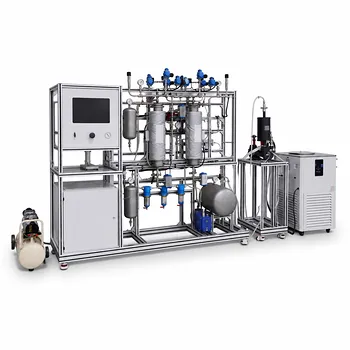
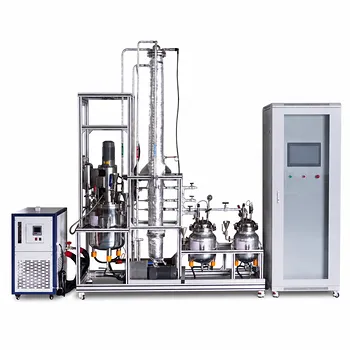
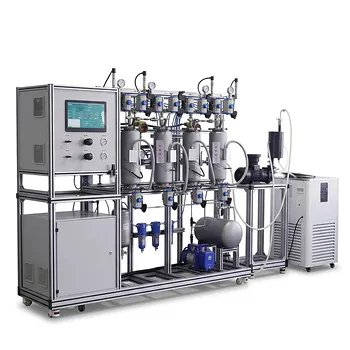
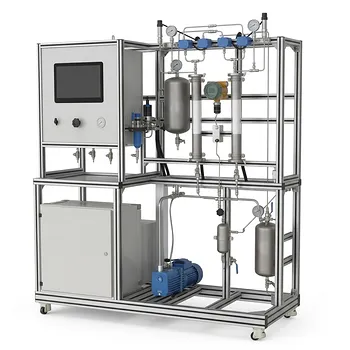
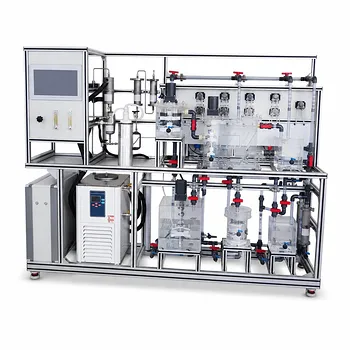
It’s a strategic retrofit. Integrating a membrane separation stage into your existing adsorption-based vapor recovery pilot plant means installing a membrane module upstream of the adsorption beds. This hybrid configuration acts as a protective, load-leveling buffer that shaves concentration peaks of heavy hydrocarbons before they hit the adsorber, effectively preventing bed overloading and boosting your plant’s overall capacity to meet tighter emission standards.
The core challenge in a pilot plant is handling fluctuating feed conditions. Integrating a membrane upstream doesn't just add another step; it fundamentally transforms your adsorption unit from a fragile single-point solution into a robust, high-capacity hybrid system optimized for real-world variability, all with acceptable investment costs.
The Strategic Rationale for Upstream Membrane Integration
This isn't about replacing your adsorption unit. It’s about making it work dramatically better. The deep need you are addressing is likely system reliability and performance consistency in a research or small-scale production environment, where fluctuating feed streams are the norm, not the exception.
The Vulnerability of Standalone Adsorption
Pilot plants often face highly variable concentrations of volatile organic compounds (VOCs). An adsorption bed designed for an average load can quickly become overwhelmed by concentration spikes. When this happens, the bed saturates prematurely, breakthrough occurs early, and you fail to meet your target emission limits. The primary reference correctly identifies this overloading as the core problem to solve.
The Membrane as a Load-Leveling Shock Absorber
Installing a thin-film composite membrane with a rubbery, hydrocarbon-selective layer in the feed line creates an intelligent, self-regulating gatekeeper. This membrane preferentially permeates larger hydrocarbon molecules. When a concentration spike arrives, the membrane’s permeation rate for those heavy compounds naturally increases, selectively siphoning them off into a concentrated permeate stream. The remaining gas, or retentate, now has a flattened, more consistent hydrocarbon profile that the downstream adsorption beds can handle with ease.
The Engineering Process of Integration
The physical change is elegantly simple, which is a key advantage for a pilot plant focused on demonstrating proof-of-concept. The process is driven by pressure and potential differences, avoiding complex thermal cycles.
Feed Line Placement
The membrane module is simply inserted into the main process feed line, directly before the inlet to the adsorption unit. There’s no need to dismantle or replace your existing adsorbers. The modification is at the piping level, making it a modular bolt-on enhancement.
The Permeate/Retentate Split
The incoming gas stream is compressed and fed to the membrane’s high-pressure side. The permselective layer allows hydrocarbons to dissolve into the membrane material and diffuse through. A vacuum is typically applied on the permeate side to maximize the driving force, creating two streams:
- The Permeate: A highly enriched stream of recovered hydrocarbons, which can be condensed and collected as a valuable product.
- The Retentate: The lean, bulk gas stream with a significantly reduced and flattened hydrocarbon load. This stream proceeds directly to your existing adsorption unit for final polishing.
The Tangible Benefits: More Than Just an Add-On
The benefits of this hybrid approach cascade through your entire operation, turning a simple retrofitting strategy into a comprehensive performance upgrade.
Shaving Peaks to Meet Stringent Emission Standards
This is the most immediate and critical benefit. By forcing the adsorption unit to see a consistently low inlet concentration, you virtually eliminate the risk of transient breakthrough events. The adsorber’s outlet gas remains clean and compliant, even when the plant’s raw feed is highly dynamic. The system’s environmental performance becomes predictable.
Preventing Adsorption Bed Overloading
The membrane handles the bulk of the heavy-lifting for high-molecular-weight VOCs. These longer-chain hydrocarbons are the ones that adsorb most strongly and are hardest to regenerate, leading to bed fouling and reduced capacity over time. By stripping them out upstream, the membrane prevents this gradual bed fouling and extends the working life of your adsorbent material. You effectively unburden the adsorber from the most troublesome fraction of the gas stream.
Enhancing Processing Capacity Without Replacing Beds
With the peak-shaving mechanism in place, your adsorption unit can now process a higher total gas throughput or tolerate a richer average feed, all without breaking through emission limits. You achieve a significant capacity de-bottlenecking. Instead of upsizing your adsorbers—a major capital expense—you achieve the same goal by adding a smaller, more cost-effective membrane module.
Understanding the Trade-offs and Operational Nuances
A purely positive picture is incomplete. Objectively, this integration introduces new operational considerations you must manage in a pilot plant setting.
The Permeate Stream Isn't Waste
The primary benefit comes with a secondary stream. The concentrated permeate must be handled. It represents a product recovery opportunity, but it also requires a condensation or further processing step. You’ve exchanged a bed fouling problem for a permeate management one, which is typically a desirable trade-off in terms of cost and complexity.
The Critical Vacuum Pump
The membrane’s performance is heavily dependent on the pressure differential across it. This means your system now relies on a vacuum pump on the permeate side. This adds a piece of rotating equipment with associated maintenance needs and energy consumption. While the supplementary references suggest overall lower energy use compared to cryogenic condensation, the vacuum pump is a new, non-trivial parasitic load your energy balance must account for.
No Freeze-Outs, Just New Quirks
Unlike a low-temperature condenser that can ice up and force downtime, a membrane operates continuously without phase change, as the references confirm. However, membranes are susceptible to plasticization from high hydrocarbon loads, compaction over time, and fouling from particulates. You are trading the operational downtime of a defrost cycle for the gradual, long-term performance decline of a membrane element that will eventually need replacement.
Making the Right Choice for Your Pilot Plant's Goal
Your integration strategy should align perfectly with what you’re trying to prove or achieve in your pilot plant. This configuration is not one-size-fits-all.
- If your primary focus is demontrating compliance with future stringent emission standards: Integrate the membrane. This hybrid setup is the definitive way to showcase a failsafe, best-available-technology (BAT) approach that guarantees peak-shaving performance against the most aggressive regulations.
- If your primary focus is maximizing product recovery for high-value solvents: Integrate the membrane and carefully optimize the permeate condensation. The economic driver shifts from simply treating waste gas to actively reclaiming a sellable product, with the adsorption unit serving as a final clean-up guard bed.
- If your primary focus is teaching advanced process intensification concepts: This hybrid system is an ideal teaching platform. It perfectly demonstrates the synergy of unit operations, allowing students to study how a passive, pressure-driven membrane can fundamentally change the performance landscape of a traditional mass-transfer adsorption process in a single, compact system.
- If your primary focus is scaling up a process for a variable field environment: The membrane’s load-leveling effect makes it the superior choice for a robust, skid-mounted system. It provides the operational flexibility needed to handle unpredictable upstream conditions without constant operator intervention, making your technology transfer-ready.
The decision to integrate a membrane is a decision to future-proof your pilot plant, transforming it from a single-operation setup into a resilient, efficient, and deeply instructive hybrid system.
Summary Table:
| Integration Step | Action & Mechanism | Key Operational Benefit |
|---|---|---|
| Feed Placement | Module installed upstream of adsorption unit | Easy modular retrofitting without replacing existing adsorbers |
| Membrane Separation | Selective peak-shaving of heavy hydrocarbons | Prevents adsorbent bed overloading and extends media lifespan |
| Permeate Split | Vacuum-driven separation & condensation | Recovers valuable product while delivering a stable load to adsorbers |
Upgrade Your Research and Training Pilot Plants with LABPARK
Are you looking to optimize your chemical engineering, bioprocess, or environmental treatment processes? LABPARK provides state-of-the-art Educational and Vocational Unit Operations Pilot Plants in chemical engineering, bioprocess & biotech, and environmental & water treatment tailored for universities, research institutes, and enterprises.
Whether you need to demonstrate advanced hybrid separation technologies, prevent system overloading, or train future engineers on robust vapor recovery systems, our high-quality pilot plants are engineered to deliver reliable results.
Contact LABPARK today to discuss your pilot plant specifications and discover how we can elevate your research and training capabilities!
Related Products
- Ultrafiltration Membrane Separation Educational Pilot Plant
- Multifunctional Membrane Separation Educational Pilot Plant with Ultrafiltration, Nanofiltration, Reverse Osmosis
- Multi-Functional Membrane Separation Educational Pilot Plant for Unit Operations Lab
- Photocatalytic Membrane Separation and Degradation Unit Operations Pilot Plant
- Hollow Fiber Ultrafiltration Membrane Separation Educational Pilot Plant
People Also Ask
- How do PEI, PVDF, and PSU membranes compare in pilot plants? Find the best fit.
- Pervaporation vs. Vapor Permeation: Handling Suspended Solids in Membrane Pilot Plants
- Why Use a Membrane Separation Pilot Plant vs. Lab Testing? Avoid Costly Scale-Up Failures
- How do membrane pilot plants demonstrate synthetic vs biological membrane advantages?
- Isotropic vs. Anisotropic Membranes: How to Choose the Best Pilot Plant Modules