Volumetric mass transfer coefficients are not a compromise—they are a deliberate simplification that transforms an intractable measurement problem into a straightforward engineering calculation.
In a gas absorption pilot plant, the practical benefit of using (K_G a) or (K_L a) instead of separate (K_G), (K_L), and (a) is that you can quantify column performance using only the data you can actually collect: inlet and outlet stream compositions and flow rates.
This collapses the impossible task of measuring the dynamic gas‑liquid interfacial area into a single, directly calculable parameter that makes experiments teachable, reproducible, and scalable to industrial design.
The interfacial area between gas and liquid in a packed column is effectively invisible to direct measurement. Volumetric coefficients absorb this complexity, enabling you to calculate mass transfer rates from bulk‑phase data alone—a practical necessity that underpins both education and industrial design.
The Measurement Problem at the Heart of Gas Absorption
Why Individual Coefficients Are Impractical
Individual film coefficients ((k_g), (k_l)) require the solute concentration at the gas‑liquid interface. In a running column, that interface is inaccessible—you cannot place a probe there without disturbing the flow.
Even overall coefficients ((K_G), (K_L)) relate flux to bulk‑phase driving forces ((p_A - p_A^) or (c_A^ - c_A)), which are measurable, but they still need the interfacial area (a) to convert a flux per unit area into the total solute transferred.
Without knowing (a), you are left with a number that cannot describe the total performance of the column.
The Hidden Variable: Specific Interfacial Area ((a))
The specific interfacial area changes dynamically with liquid flow rate, viscosity, surface tension, and the way the packing is wetted. There is no direct, real‑time measurement for (a) in a packed bed.
Attempting to separate (K) from (a) in a pilot plant introduces huge uncertainty and turns a simple demonstration into a research project. The volumetric coefficient sidesteps this entire problem.
How Volumetric Coefficients Solve the Problem
The Engineering Shortcut: Lumping (K) and (a)
By defining (K_G a = K_G \cdot a), you create a single, lumped parameter that embodies the mass transfer capability of the specific column, packing, and operating condition.
This parameter can be determined exclusively from macroscopic, measurable quantities—the solute absorption rate obtained from a material balance and the log‑mean driving force—without ever needing to know (a) itself.
Straightforward Calculation from Pilot Plant Data
In practice, you measure the inlet and outlet solute concentrations in both gas and liquid phases, the gas and liquid flow rates, and the column’s geometry.
You then establish the solute absorption rate ((G_A)) and the log‑mean driving force ((\Delta Y_m)) based on the equilibrium relationship.
Using the packed bed volume ((V_p)), the volumetric coefficient is found directly:
[
K_Y a = \frac{G_A}{V_p \cdot \Delta Y_m}
]
This calculation requires nothing but standard sampling techniques and a basic spreadsheet—exactly the simplicity a pilot plant should provide.
Why This Matters for Pilot Plant Work
Enabling Teaching and Student Learning
A gas absorption pilot plant is meant to let students verify mass transfer theory with their own hands.
If you forced them to measure the interfacial area, the experiment would become an exercise in frustration rather than a clear demonstration of principles.
Volumetric coefficients make the link between theory and data immediate and satisfying.
Reliable Scale‑Up from Pilot to Industrial Design
Industrial absorber design relies on transfer unit concepts (HTU = (G / (K_G a P))). The volumetric coefficient is the key scaling parameter.
When you measure (K_G a) at pilot scale under the target liquid load and gas velocity, you can confidently use that number to size a full‑scale column.
This direct scalability is the fundamental reason the volumetric coefficient is standard practice in process engineering.
Distinguishing the Interfacial Area Reference Base
A critical practical detail: the coefficient “(a)” may be defined as interfacial area per unit volume of gas‑liquid dispersion, while sometimes a variant (a') represents area per unit volume of liquid only.
They are related by the gas holdup: (a'(1 - \varepsilon_G) = a).
When using data from different sources to scale up, always confirm which basis is used—otherwise your oxygen delivery or absorption capacity estimates can be dangerously wrong.
Understanding the Trade‑offs
Loss of Mechanistic Detail
Lumping (K) and (a) means you can no longer tell whether a performance improvement comes from better mass transfer kinetics or simply from a larger interfacial area.
For fundamental mass transfer research, this is a real limitation. In a pilot plant focused on process design, however, that detail is often unnecessary.
Dependence on Operating Conditions
(K_G a) is not a fundamental physical constant. It changes with gas and liquid flow rates, temperature, and packing geometry.
A value measured at one pilot condition cannot be blindly used at a very different hydrodynamic state. Successful scale‑up requires you to maintain similar liquid load and gas velocity or use reliable correlations.
Calibration Challenges with Surfactants
If the gas‑liquid system contains surface‑active agents, standard correlations (like the Van’t Riet equation for stirred tanks) can break down.
Pilot plant (k_La) data must then be measured directly under representative conditions rather than predicted from pure‑component models. The volumetric approach still works, but the experiment must match reality.
Making the Right Choice for Your Goal
Your approach to mass transfer coefficients should align with what you are trying to achieve in the pilot plant.
- If your primary focus is demonstrating mass transfer principles in a teaching lab: Volumetric coefficients are your best tool. They deliver clear, calculable results that reinforce theory without unnecessary experimental tangles.
- If your primary focus is scaling up a gas absorption process: Use (K_G a) or (K_L a) measured at pilot scale to design the industrial column via HTU/NTU methods, ensuring you replicate the critical hydrodynamic parameters.
- If your primary focus is fundamental research on mass transfer mechanisms: Accept that you will need to estimate (a) separately (for example, through chemical methods or correlations) to decouple the coefficients. Be aware that this introduces large uncertainties, and the lumped parameter may still be your most trustworthy metric for overall performance.
The volumetric mass transfer coefficient is not just a convenience—it is the metric that turns a gas absorption pilot plant into a genuinely useful tool for engineers who must build something that works in the real world.
Summary Table:
| Feature | Individual/Overall Coefficients ($K_G, K_L$) | Volumetric Coefficients ($K_G a, K_L a$) |
|---|---|---|
| Measurement Requirement | Requires inaccessible interfacial area ($a$) | Calculated solely from bulk-phase inlet/outlet data |
| Primary Application | Fundamental mechanistic research | Process design, pilot experiments, and scale-up |
| Calculation Complexity | Highly complex, introduces large uncertainties | Straightforward calculation via LMTD & material balance |
Optimize Your Mass Transfer Operations with LABPARK
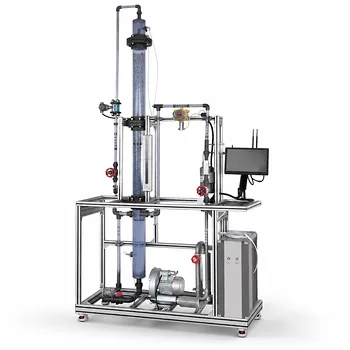
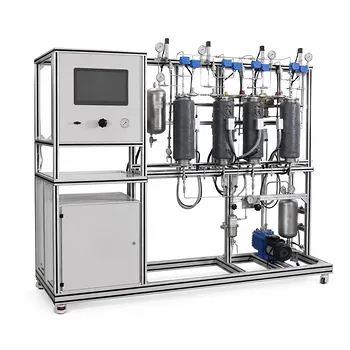
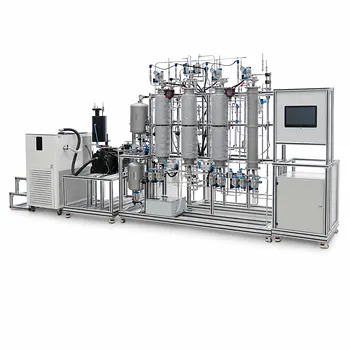
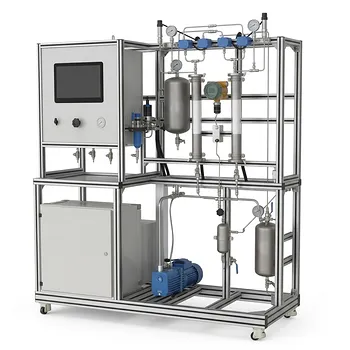
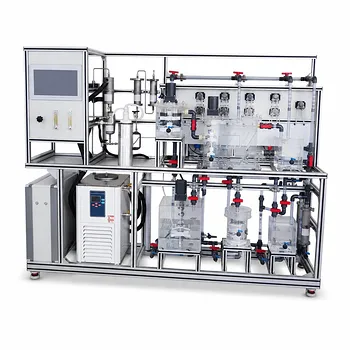
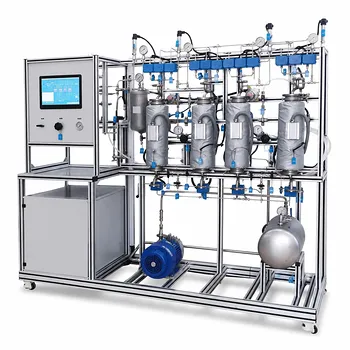
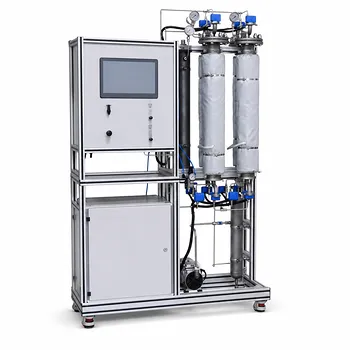
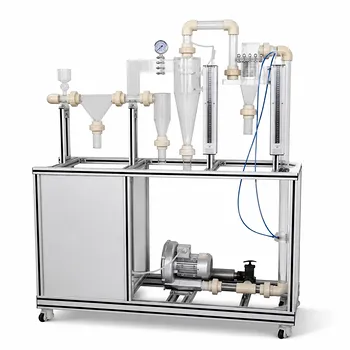
At LABPARK, we provide premium Educational and Vocational Unit Operations Pilot Plants in chemical engineering, bioprocess & biotech, and environmental & water treatment. Specifically designed for universities, research institutes, and enterprises, our systems help students and engineers master complex mass transfer concepts through hands-on, reproducible experiments.
Ready to upgrade your laboratory? Contact LABPARK today to discuss your project requirements!
Related Products
- Dual-Mode Gas Absorption and Desorption Unit Operations Training Pilot Plant
- Carbon Dioxide Absorption and Desorption Educational Pilot Plant for Carbon Capture Studies
- Carbon Dioxide Adsorption and Capture Educational Unit Operations Pilot Plant
- Absorption and Desorption Educational Unit Operations Pilot Plant
- Multi-Component Gas Pressure Swing Adsorption Pilot Plant for Unit Operations Education
People Also Ask
- How do two-film & penetration theories apply to gas absorption pilot plant teaching? Key pedagogical insights.
- How is the direction and driving force of mass transfer determined in a gas absorption unit operations pilot plant?
- How does partial pressure behavior influence gas absorption pilot plants? Master Mass Transfer
- Why does increasing flow fail to enhance absorption in fast chemical reactions? Pilot Plant Insights
- How to model chemical absorption as physical absorption? The pilot plant simplification criterion.