Knowledge Applied Chemistry Education What is the functional difference between quantitative and qualitative filter paper? Guide to Accurate Analysis
Author avatar

Tech Team · LABPARK

Updated 1 month ago

What is the functional difference between quantitative and qualitative filter paper? Guide to Accurate Analysis


The functional difference comes down to what is left behind. Qualitative filter paper is designed for routine separations where you only care about collecting a solid, not measuring its exact mass. Quantitative, or ashless, filter paper is chemically treated to virtually disappear when burned, enabling precise gravimetric analysis.

Quantitative filter paper’s near-zero ash content ensures that when it is incinerated, the residue you weigh is solely your target analyte. Using qualitative paper in that same scenario introduces a ghost in your data—an unknown, variable contaminant that can undermine mass balance calculations, purity verification, and ultimately, the control of your chemical process.

The Core Functional Difference

The distinction is not about the size of particles they catch; both can be manufactured with a range of pore sizes. The real difference is chemical purity under extreme conditions.

Ash Content Defines Their Roles

Qualitative filter paper contains organic binders and natural mineral residues. When burned in a muffle furnace, it leaves behind a measurable ash weight, typically many times more than its quantitative counterpart.

Quantitative filter paper undergoes an acid-washing process during manufacturing to remove these inorganic impurities. The result is an “ashless” grade that leaves an extremely low residue—often less than 0.01% of the paper’s original weight—after ignition.

A Question of Ignition

For qualitative paper, the ash leftover is a random contamination that variably adds to your sample’s weight. You cannot reliably subtract it, because the exact ash content from one filter to the next is not controlled.

Quantitative filters are not simply “cleaner”; they are manufactured with a known and negligible residue. This is what allows them to be burned away completely for all practical purposes, leaving the analyte isolated with high confidence.

How This Affects Analytical Monitoring

In a chemical process, analytical monitoring is the feedback loop that confirms a reaction is proceeding correctly and the product meets specifications. The filter paper you choose can silently corrupt that loop.

Compromising Gravimetric Analysis

The most direct impact is on any method that determines concentration by weight: precipitation, loss on drying, or sulfated ash tests. If you are monitoring the barium sulfate content in a process stream via gravimetric analysis, you must use an ashless filter. Incinerating a qualitative filter would add unknown milligrams of mineral ash to the crucible, directly misrepresenting the precipitate yield and purity output of your plant.

Distorting Mass Balance Calculations

Pilot plants and development labs rely on a “what goes in must come out” mass balance to validate yields and identify losses. Using qualitative paper for a solids collection step introduces an unmeasured mass input (the ash) that artificially inflates your “isolated product” figure. The error propagates, making a well-controlled process appear to have a higher yield than it actually does, or masking real process losses.

Masking Product Purity Issues

Any ash from a qualitative filter becomes indistinguishable from the inorganic components of your product. If you were monitoring the purity of a final active pharmaceutical ingredient by weighing the residue after dissolution and filtration, that extra ash could cause an out-of-specification result for “sulfated ash” or “residue on ignition”—not because your product is impure, but because your analytical tool was.

Trade-offs and Practical Realities

The highest-grade ashless filter is not always the right tool for the job. An objective assessment requires weighing accuracy against operational goals.

Cost and Speed vs. Accuracy

Quantitative filter paper is more expensive and, for routine work, its low-ash property is completely unnecessary. Qualitative paper is perfectly fit for clarifying a solvent, removing a catalyst for reuse, or preparing a sample for a non-gravimetric HPLC analysis. Forcing a shift to quantitative paper in these cases wastes budget without adding value.

The Risk of a Single Inventory

In a shared lab or pilot plant, keeping only one type of filter paper is dangerous. A process technician might habitually reach for qualitative paper, using it to prepare a sample for a critical gravimetric purity check. The resulting data will be precise (repeatable) but completely inaccurate (biased). The true risk is an invisible analytical bias that can persist for months, leading you to believe you are making a 99.5% pure product when the real value is a point lower.

Education as a Control

The functional difference is simple, but its consequences are often invisible to an untrained eye. The most effective control is not just stocking both papers, but ensuring every analyst understands why the choice matters. A suspiciously high “residue on ignition” result should trigger an audit of the filter paper lot, not just the product sample.

Making the Right Choice for Your Process

The best choice depends entirely on what question you are asking of your process.

  • If your primary focus is accurate compositional monitoring and mass balance closure: You must exclusively use quantitative, ashless filter paper for any step that ends with a dry weighing. The cost premium is negligible compared to the cost of an uninformed process decision.
  • If your primary focus is general sample preparation or bulk removal of solids before an instrumental method like HPLC or spectroscopy: Qualitative filter paper is the economical, technically appropriate choice. Its higher ash content is irrelevant when the filter itself is discarded before the final measurement.
  • If your primary focus is educational clarity or troubleshooting a pilot plant: Use this functional difference as a teaching moment to demonstrate the impact of analytical artifacts. Running a side-by-side ignition of both papers can reveal a source of persistent, unexplained process variance.

Your choice of a simple piece of paper determines whether the signal you extract from your process is real, or merely an artifact of your method.

Summary Table:

Feature Qualitative Filter Paper Quantitative (Ashless) Filter Paper
Ash Content Variable & measurable residues Negligible (typically < 0.01%)
Primary Application Clarification & general separation Gravimetric analysis & mass balance
Thermal Treatment Not suitable for ignition (adds mass) Designed to burn off cleanly
Relative Cost Economical for routine lab work Premium cost due to acid-washing

Ready to elevate your laboratory training and process scaling? LABPARK provides state-of-the-art Educational and Vocational Unit Operations Pilot Plants in chemical engineering, bioprocess & biotech, and environmental & water treatment. Whether you are a university equipping a teaching lab, a research institute, or an enterprise optimizing process control, our pilot plants bridge the gap between theory and industry-grade accuracy. Contact us today to find the perfect hands-on training solution for your institution!

Related Products

People Also Ask

Related Products

Constant Pressure Filtration Educational Unit Operations Pilot Plant

Constant Pressure Filtration Educational Unit Operations Pilot Plant

Hands-on educational pilot plant for constant pressure filtration. Classic plate and frame filter press allows students to study kinetics, determine specific cake resistance, perform cake washing and evaluate washing rates. Ideal for chemical engineering curriculum. Mobile, customizable, safety-compliant design.

Hot Filtration Educational Unit Operations Pilot Plant Laboratory System

Hot Filtration Educational Unit Operations Pilot Plant Laboratory System

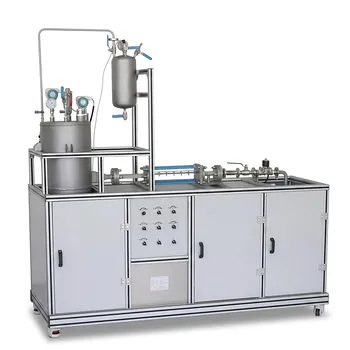
This integrated laboratory bench-scale hot filtration pilot plant enables students to study solid-liquid separation under thermal conditions, featuring a stainless steel vessel, removable heating jacket, and multi-layer filter plates for unit operations education, ideal for chemical engineering laboratory curriculum.

Rising and Falling Film Evaporation Educational Unit Operations Pilot Plant

Rising and Falling Film Evaporation Educational Unit Operations Pilot Plant

Hands-on educational pilot plant for studying rising and falling film evaporation, flow regimes, and heat transfer. Customizable for university labs with industrial instrumentation and data acquisition. Enables comparative evaluation of evaporation modes and energy efficiency.

Multifunctional Membrane Separation Educational Pilot Plant with Ultrafiltration, Nanofiltration, Reverse Osmosis

Multifunctional Membrane Separation Educational Pilot Plant with Ultrafiltration, Nanofiltration, Reverse Osmosis

An integrated laboratory bench-scale membrane separation system for higher education engineering labs combining Ultrafiltration, Nanofiltration, and Reverse Osmosis processes. Features industrial PLC control with touch-screen HMI, transparent piping, and academic assessment software. Ideal for chemical and environmental engineering curricula.

Fluid Friction Resistance Determination Educational Unit Operations Pilot Plant

Fluid Friction Resistance Determination Educational Unit Operations Pilot Plant

Engineered bench-scale system for university engineering labs. Provides hands-on fluid mechanics experience: quantitative energy loss analysis, flow regime observation, friction coefficient determination. Features four-point pressure measurement, transparent sections, industrial touchscreen PLC, 3D virtual simulation. Ideal for chemical, mechanical, civil engineering.

Ultrafiltration Membrane Separation Educational Pilot Plant

Ultrafiltration Membrane Separation Educational Pilot Plant

This ultrafiltration membrane separation educational pilot plant enables undergraduate students to process PVA solutions, study hollow fiber membrane dynamics, and perform quantitative analysis with spectrophotometry for hands-on learning of unit operations and industrial maintenance and membrane cleaning protocols.

Multi Functional Catalytic Reaction and Reactor Evaluation Educational Unit Operations Pilot Plant

Multi Functional Catalytic Reaction and Reactor Evaluation Educational Unit Operations Pilot Plant

Bench-scale educational pilot plant for catalytic reaction and reactor evaluation, integrating fixed bed, fluidized bed, and stirred tank reactors. Students compare reactor designs, evaluate catalysts, and study reaction kinetics and hydrodynamics. Perfect for unit operations labs in chemical engineering curricula.

Gas-Solid Heterogeneous Separation Demonstration Educational Unit Operations Pilot Plant

Gas-Solid Heterogeneous Separation Demonstration Educational Unit Operations Pilot Plant

Comprehensive visual transparent gas-solid separation pilot plant for chemical engineering labs. Demonstrates gravity settling inertial settling cyclone and bag filter technologies. Enables real-time analysis of fluid-particle mechanics pressure drop and collection efficiency. Ideal for undergraduate unit operations courses.

Centrifugal Pump Performance and Orifice Flowmeter Calibration Educational Pilot Plant

Centrifugal Pump Performance and Orifice Flowmeter Calibration Educational Pilot Plant

This versatile educational pilot plant enables engineering students to conduct centrifugal pump performance tests, orifice flowmeter calibration, and fluid mechanics experiments using a transparent flow loop, industrial HMI, and 3D virtual simulation for a comprehensive hands-on learning experience.

Comprehensive Heat Transfer Coefficient Determination Educational Unit Operations Pilot Plant

Comprehensive Heat Transfer Coefficient Determination Educational Unit Operations Pilot Plant

Advanced industrial-grade educational pilot plant for comprehensive heat transfer coefficient determination. Enables quantitative convective heat transfer analysis, evaluates double-pipe and shell-and-tube exchanger configurations, and includes digital data acquisition. Customizable for engineering curriculum. Ideal for engineering unit operations labs.

Photocatalytic Membrane Separation and Degradation Unit Operations Pilot Plant

Photocatalytic Membrane Separation and Degradation Unit Operations Pilot Plant

Bench-scale pilot plant integrating photocatalytic degradation with membrane separation for engineering education. Study advanced oxidation, microfiltration, and hybrid processes using industrial sensors. Features safety light-blocking curtain, low-noise compressor, and durable stainless-steel construction.

Two Phase Flow Pattern Velocity Resistance Measurement Educational Pilot Plant

Two Phase Flow Pattern Velocity Resistance Measurement Educational Pilot Plant

Benchtop educational pilot plant for university labs studying gas-liquid two-phase flow patterns, velocity, and resistance across circular, square, and rectangular conduits. Features 15.6-inch touchscreen, 5G connectivity, differential pressure sensors, safe water-air operation. Supports chemical engineering curricula.

Multi-Functional Membrane Separation Educational Pilot Plant for Unit Operations Lab

Multi-Functional Membrane Separation Educational Pilot Plant for Unit Operations Lab

The Multi-functional Membrane Separation Educational Unit Operations Pilot Plant is an integrated bench-scale laboratory system designed for teaching undergraduate engineering education. It features Ultrafiltration, Nanofiltration, and Reverse Osmosis modules in a compact, mobile unit for practical hands-on learning.

Educational Unit Operations Pilot Plant for Intraparticle Diffusion Effective Factor Measurement

Educational Unit Operations Pilot Plant for Intraparticle Diffusion Effective Factor Measurement

Designed for chemical engineering university labs, this pilot plant allows hands-on determination of catalyst particle intraparticle diffusion effective factors and gas-solid reaction kinetics using a fixed-bed tubular reactor with industrial touchscreen control, bridging theory and practical reactor design.

Three-Tube Heat Transfer Educational Pilot Plant for Unit Operations Training

Three-Tube Heat Transfer Educational Pilot Plant for Unit Operations Training

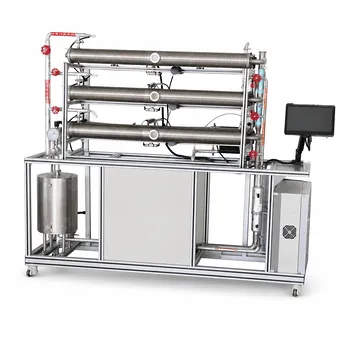
Three-tube heat transfer pilot plant for studying convective heat transfer enhancement and condensation. Allows comparison of smooth, corrugated, turbulent tubes, verifying empirical correlations. Ideal for chemical engineering education with safety and closed-loop steam recovery.

Continuous Batch Extractive Distillation Educational Pilot Plant

Continuous Batch Extractive Distillation Educational Pilot Plant

Versatile pilot plant for continuous, batch, and extractive distillation training. High-borosilicate glass column for visualizing hydraulics, 15.6-inch touchscreen with data logging, precise reflux ratio control 1-99, and durable corrosion-resistant frame. Ideal for chemical engineering education and process research.

Cavitation Phenomenon Demonstration and Analysis Educational Unit Operations Pilot Plant

Cavitation Phenomenon Demonstration and Analysis Educational Unit Operations Pilot Plant

Advanced educational pilot plant for demonstrating and analyzing cavitation phenomena in fluid systems. Features a transparent acrylic Venturi test section, high-precision pressure and flow sensors, digital data acquisition, and integrated safety relief valves for engineering curricula.

Educational Compression Refrigeration Performance Determination Unit Operations Pilot Plant

Educational Compression Refrigeration Performance Determination Unit Operations Pilot Plant

This educational pilot plant for compression refrigeration performance determination offers dual COP evaluation, regenerative cycle comparison, and calorimeter calibration. Customizable for curriculum integration, it features environmentally conscious design. Supports thermodynamic mapping on pressure-enthalpy diagrams and synchronous monitoring with centralized instrumentation.

General Purpose Cosmetics Production Unit Operations Training Pilot Plant

General Purpose Cosmetics Production Unit Operations Training Pilot Plant

Integrated pilot-scale cosmetics production training plant for chemical engineering education featuring utility supply emulsification blending and filtration modules with dual touchscreen manual control customizable mobile design ideal for practical hands-on unit operations and advanced process control learning.

Bernoulli Equation Demonstration Unit Operations Pilot Plant

Bernoulli Equation Demonstration Unit Operations Pilot Plant

Laboratory pilot plant for Bernoulli's equation demonstration with transparent PVC pipes, 23 piezometer tubes for pressure measurement, and hands-on experiments. Designed for engineering education to study energy conservation, hydraulic grade line, and localized losses in fluid steady-flow systems.


Leave Your Message