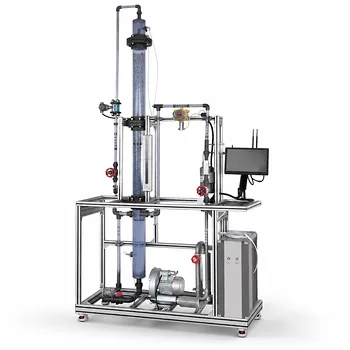
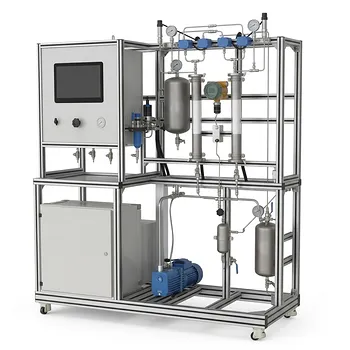
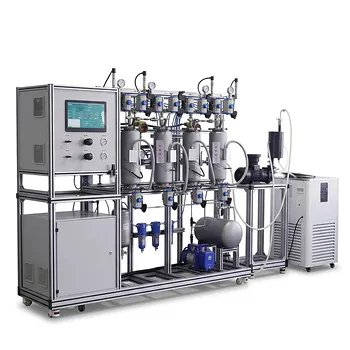
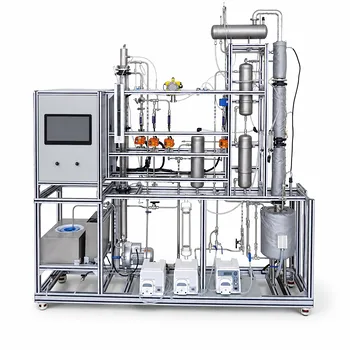
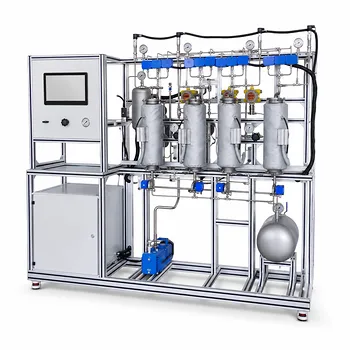
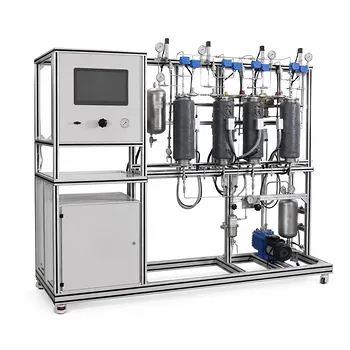
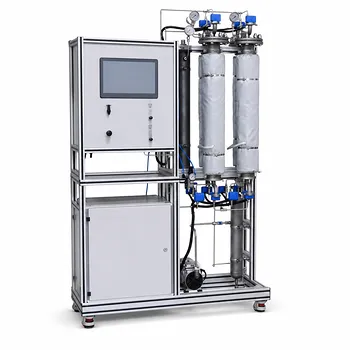
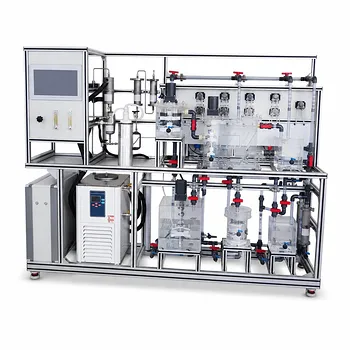
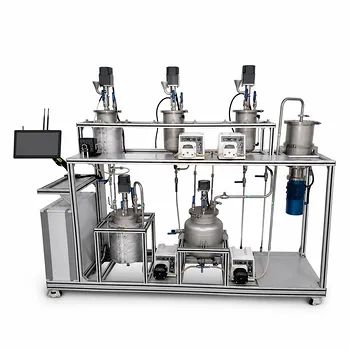
Hands-on configuration of multi-stage absorption systems transforms abstract mass transfer theory into tangible engineering insight. By enabling students to physically set up and compare different flowsheets—such as series, parallel, or split-feed operations—a flexible pilot plant reveals exactly how operating lines shift on a Y‑X equilibrium diagram, how to calculate transfer units (NOG, HOG) from real data, and how to weigh the economic trade-offs of solvent recycling and stage efficiency. It delivers an integrated learning experience that no textbook or simulation alone can replicate.
The educational value is not merely about learning to pipe up columns; it is about developing a process designer’s mind. Students learn to balance capital cost, solvent consumption, and separation efficiency by strategically arranging absorption stages, bridging the gap between idealized equilibrium stages and the real constraints of pilot‑scale operation.
Why Multi‑Stage Configurations Matter in Chemical Engineering Education
Moving Beyond the Single Equilibrium Stage
Standard coursework often treats absorption as a single‑stage or simple counter‑current column problem. Industrial reality is different: optimizing solvent consumption and meeting tight purity targets frequently demands multiple columns in series, parallel, or with split‑feed arrangements. A pilot plant that lets students reconfigure the flowsheet brings this industrial logic into the lab, forcing them to ask why a particular arrangement works for a given separation.
Connecting P&ID Flexibility to Process Intuition
Flexible piping is the secret weapon. Students physically redirect gas and liquid streams, then immediately see the consequences on outlet compositions. The most abstract part of absorption theory—the movement of the operating line on a Y‑X diagram—becomes a direct observation. They grasp that a series arrangement steepens the operating line by re‑using lean solvent, while parallel operation distributes the load. That intuition is hard to build without hands‑on manipulation.
Deepening the Understanding of Mass Transfer Fundamentals
Calculating Transfer Units in Real Time
A properly instrumented pilot plant (with concentration sensors, flow meters, and temperature probes) allows students to go beyond ideal stage assumptions. They calculate NOG and HOG for each column under varying flow rates and configurations. They see that a “stage” is not a fixed entity—efficiency depends on hydrodynamics, solvent loading, and the chosen arrangement. This moves their thinking from plug‑and‑chug to genuine performance analysis.
Quantifying the Impact of Chemical Enhancement
The same flexible plant can be used to compare physical and chemical absorption (for example, absorbing CO₂ into pure water versus an alkaline NaOH solution). The chemical reaction consumes dissolved solute in the liquid film, sharply increasing the absorption rate. By calculating mass transfer coefficients across configurations, students learn that a reactive solvent can dramatically reduce the required number of stages or the solvent circulation rate—a direct link to the economic trade‑offs at the heart of process design.
Understanding the Trade‑offs
Capital vs. Operating Cost: The Solvent Recycling Dilemma
The primary reference highlights the economic tension of solvent recycling. Recycling reduces fresh solvent makeup and effluent treatment, but it also returns partially loaded solvent to the absorber, shrinking the driving force. Students who test a closed‑loop recycle configuration on a twin‑tower rig can see that while operating cost drops, the required number of stages or packing height rises. No textbook diagram captures that delicate, data‑rich balancing act as vividly.
Flexibility vs. Cognitive Overload
A highly reconfigurable plant is a powerful teacher, but it can also overwhelm. Switching between multiple piping paths, sampling points, and control loops risks turning the session into a plumbing exercise if not properly scaffolded. The educational design must ensure students focus on the mass transfer principles and economic logic, not just on tightening fittings—a practical pitfall worth acknowledging.
Making the Right Choice for Your Teaching Goals
Use the flexibility of a multi‑stage absorption pilot plant to target the specific competencies you want to build.
- If your primary focus is reinforcing core mass transfer concepts: Run simple series‑vs‑parallel comparisons and ask students to draw the operating line from their own measured data. The aha‑moment happens when the Y‑X diagram matches what they physically changed.
- If your primary focus is teaching process economics: Introduce solvent cost, regeneration energy, and equipment amortization. Task students with a mini‑design project to find the lowest total cost combination of stage count and solvent flowrate using the pilot data as a basis.
- If your primary focus is preparing students for research or scale‑up: Incorporate chemical absorption experiments and require rigorous calculation of mass transfer coefficients and HETP under different configurations. This builds the data‑interpretation skills essential for translating bench results to industrial columns.
By making multi‑stage absorption a hands‑on, configurable challenge, you equip students with the engineering judgment to design separation processes that are not just theoretically correct but economically and operationally sound.
Summary Table:
| Configuration | Key Focus Areas | Educational & Practical Value |
|---|---|---|
| Series Setup | Operating line shifts & solvent reuse | Visualizes concentration driving force changes on Y-X diagrams |
| Parallel / Split-Feed | Load distribution & flow dynamics | Teaches flow optimization, column sizing, and capacity limits |
| Chemical Absorption | Reactive vs. physical mass transfer | Demonstrates HETP reduction and solvent chemical enhancement |
Bring Industrial-Scale Learning to Your Classroom
Bridge the gap between theoretical calculations and real-world engineering. LABPARK provides state-of-the-art Educational and Vocational Unit Operations Pilot Plants in chemical engineering, bioprocess & biotech, and environmental & water treatment.
Specifically designed for universities, research institutes, and enterprises, our flexible, hands-on pilot plants empower students to master complex process controls and system configurations.
Ready to elevate your engineering lab? Contact LABPARK today to discuss your laboratory requirements!
Related Products
- Dual-Mode Gas Absorption and Desorption Unit Operations Training Pilot Plant
- Absorption and Desorption Educational Unit Operations Pilot Plant
- Packed Bed Absorption Educational Unit Operations Pilot Plant
- Pressure Swing Adsorption Educational Unit Operations Pilot Plant
- Multimodal Absorption and Desorption Pilot Plant for Unit Operations Training
People Also Ask
- How do two-film & penetration theories apply to gas absorption pilot plant teaching? Key pedagogical insights.
- How does partial pressure behavior influence gas absorption pilot plants? Master Mass Transfer
- How is the direction and driving force of mass transfer determined in a gas absorption unit operations pilot plant?
- Why does increasing flow fail to enhance absorption in fast chemical reactions? Pilot Plant Insights
- What are the limitations of Henry's Law in gas absorption pilot plants? Avoid critical lab errors.