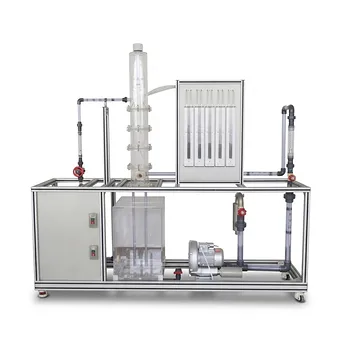
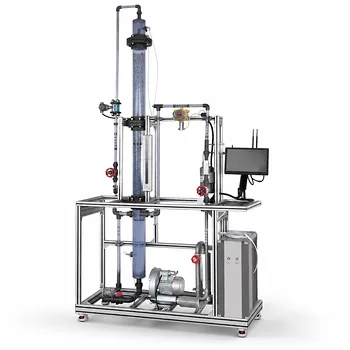
In a pilot-scale packed tower, the choice between a packing hold-down plate and a bed limiter comes down to one critical factor: the fragility of your packing material. Both devices prevent your packing from dancing under high gas velocities, but they do so in fundamentally opposite ways. Hold-down plates are free-floating weights that sit directly on the bed, while bed limiters are fixed grids that cage the packing without pressing on it.
Understanding the core distinction—free-floating vs. fixed, direct contact vs. clearance—is the key to protecting your bed from fluidization without crushing fragile media or wasting money on unnecessary mechanical complexity.
Why Bed Movement Is a Silent Killer in Pilot Columns
Your pilot plant is designed to generate reliable scale-up data. Any unexpected bed fluidization or shifting destroys that integrity. When gas velocity rises, the packing can lift, rotate, or even clog the top distributor, creating channeling and a dramatic drop in separation efficiency. A poorly restrained bed in a small tower will give you mass-transfer coefficients that simply don’t translate to production.
The Physics of Fluidization in Small Diameters
In pilot columns, wall effects amplify gas drag. The upward drag force on an individual packing element can exceed its buoyant weight much sooner than in a wide industrial column. This means your pilot tower is actually more vulnerable to fluidization at modest vapor rates.
Two Devices, One Mission—But Different Contact Rules
The common goal is to create a physical barrier that stops the bed from expanding upward. The difference lies entirely in how the barrier interacts with the packing as the bed settles over time. Glass and ceramic settle noticeably, while metal and plastic often spring back or remain dimensionally stable. Your device must account for this.
Deep Dive: Packing Hold-Down Plates
A hold-down plate is a weighted, perforated plate that rests directly on top of the packed bed. It is not bolted or clamped; its own mass provides the restraining force. The plate is typically constructed from a corrosion-resistant material and features large open area to avoid restricting gas or liquid flow.
How It Works Over the Life of the Bed
As the packing settles—due to vibration, thermal cycling, or erosion—the hold-down plate simply moves downward with it. This self-adjusting behavior ensures the packing stays compressed and cannot rattle, pivot, or abrade. The plate’s weight is carefully calculated to provide enough downward force to counteract fluidization buoyancy, but not so much that it crushes the elements.
The Primary Application: Brittle Ceramic and Graphite Packings
Ceramic and graphite random packings are hard but brittle. If they are allowed to fluidize, they chip and crack. A fixed barrier that leaves a small gap would permit particles to lift and slam back down, quickly turning your packing to dust. The gentle, constant compression of a hold-down plate immobilizes each piece and prevents these impact fractures.
Deep Dive: Bed Limiters
A bed limiter is a rigid, fixed grid or mesh that is mechanically fastened to the column wall just above the top of the packed bed. It provides a hard stop that blocks the packing from rising beyond a preset height, but it does not ordinarily rest on the packing.
The Principle of Clearance, Not Compression
After installation, a correctly designed bed limiter sits with a small gap between its lower surface and the top of the new packing. The packing can shift slightly within its own volume, but it cannot escape the space defined by the limiter. This approach preserves the packing’s natural void fraction and does not subject the material to a permanent external load.
Where Bed Limiters Excel: Metal, Plastic, and Structured Packings
Metal and plastic random packings are elastic and break-resistant. They can withstand the lifting force without fracturing, so a fixed cage works without damage. Moreover, a weighted hold-down plate would be inappropriate because these materials do not settle in the same progressive way—plastics can creep, metals expand, and a floating weight could end up applying uneven pressure. Structured packings require bed limiters almost exclusively, because a hold-down plate would block the precisely engineered inlet channels of each layer and disrupt liquid distribution.
Understanding the Trade-offs
Selecting the wrong retainer turns a safety device into a process liability. Here are the hard lessons pilot-plant operators learn.
The Risk of Over-Compression with Hold-Down Plates
If you install a hold-down plate on a bed of thin-walled metal Pall rings, you can deform the elements, reduce void fraction, and create a zone of elevated pressure drop right at the top of the bed. This localized flooding point damages tray efficiency and skews your HETP data.
The Hidden Danger of Bed Limiters in Settling Beds
A rigid bed limiter on a ceramic packing bed is a slow-motion disaster. The bed settles, a gap opens, and the top layer of saddles or rings now has room to bounce. Each bounce is a micro-collision that produces fines. Those fines migrate downward, plug the bed’s open area, and your pressure drop curve becomes your worst nightmare.
Maintenance and Cleaning Access
Bed limiters that are welded or heavily bolted are difficult to remove for inspection. In a pilot unit that changes packing frequently, this lost time adds up. Free-floating hold-down plates can be lifted out instantly, which is a distinct advantage during rapid serviceability turns.
Making the Right Choice for Your Goal
Your decision must align the mechanical behavior of the packing with the retention method. Here is a goal-oriented selection guide based on typical pilot-scale scenarios.
- If your primary focus is protecting fragile ceramic or graphite random packing: Use a weighted, free-floating hold-down plate. It eliminates the impact shock of fluidization and self-adjusts for settlement.
- If your primary focus is running metal or plastic random packing at high turndown: Install a fixed bed limiter with a calculated empty gap. It prevents lift without crushing, and accommodates thermal expansion or slight material creep.
- If your primary focus is piloting structured packings for a new distillation process: Use a bed limiter bolted just above the top layer, not a hold-down plate. Structured packing relies on undisturbed entrance geometry for proper liquid film formation.
- If your primary focus is frequent packing swaps for catalyst screening: Prefer a removable hold-down plate design where material permits, as it dramatically shortens turnaround time.
The device you place on top of your packing is a direct statement about the physical nature of that packing. Let the material dictate the method, and you’ll protect both the bed and the scale-up data it creates.
Summary Table:
| Feature | Packing Hold-Down Plates | Bed Limiters |
|---|---|---|
| Mechanism | Free-floating, weighted plate | Rigid, fixed grid/mesh |
| Bed Settlement | Self-adjusting (moves down with bed) | Fixed position (leaves a clearance gap) |
| Ideal Packing | Brittle materials (Ceramic, Graphite) | Elastic/Durable (Metal, Plastic, Structured) |
| Main Benefit | Prevents impact fractures in fragile media | Protects bed without applying load |
| Key Risk | Can deform metal/plastic or block structured paths | Allows brittle packing to bounce and disintegrate |
Scale Up with Confidence with LABPARK
Ensure precise chemical engineering data and protect your column internals with pilot plant solutions designed for longevity and accuracy. LABPARK provides state-of-the-art Educational and Vocational Unit Operations Pilot Plants in chemical engineering, bioprocess & biotech, and environmental & water treatment tailored for universities, research institutes, and enterprises.
Whether you require customized packed towers, advanced column internals, or full-scale pilot units, our systems deliver the reliability needed for successful scale-up.
Contact LABPARK Experts Today to discuss your laboratory's pilot-scale equipment requirements!
Related Products
- Constant Pressure Filtration Educational Unit Operations Pilot Plant
- Plate Column Hydrodynamics Tray Demonstration Educational Pilot Plant
- Packed Bed Absorption Educational Unit Operations Pilot Plant
- Multi-Functional Membrane Separation Educational Pilot Plant for Unit Operations Lab
- Rising and Falling Film Evaporation Educational Unit Operations Pilot Plant
People Also Ask
- How do educational unit operations pilot plants bridge theory and design? Bridge the Engineering Gap
- How do educational unit operations pilot plants address safety and waste management when scaling up?
- Why splitting a filtration batch doesn't always reduce cycle time? Pilot Plant Insights
- Why Demo Constant-Rate to Constant-Pressure Filtration on a Pilot Plant? Key Practical Insights
- How to select solid-liquid separation equipment for pilot plants? A Step-by-Step Guide