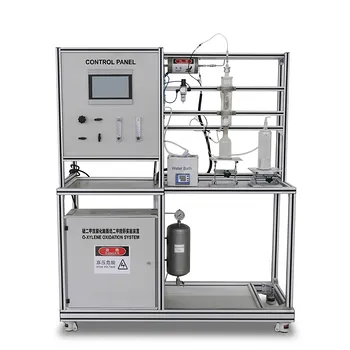
The temperature-conversion criterion redefines how you set safety limits for a tubular reactor pilot plant. Instead of relying on conservative, one-size-fits-all rules, it maps the exact thermal behavior of your reaction onto a plot of temperature versus conversion. This gives you a more accurate and less restrictive safe operating window, allowing the plant to run at conditions—like higher heats of reaction or lower coolant flows—that older methods would wrongly flag as dangerous.
Older empirical runaway criteria force you to sacrifice conversion for an inflated safety margin. The temperature‑conversion criterion (e.g., Morbidelli & Varma) uncovers the true runaway boundary, letting you push the reactor closer to its physical limits while staying provably safe.
Why Traditional Safety Margins Hold You Back
Classical methods for pilot‑plant safety often rely on fixed thresholds, such as a maximum allowed temperature rise or a constant safety factor on coolant temperature. These heuristics are valuable for quick screening, but they come from generic assumptions—not from the specific kinetics of your reaction.
The Conservatism Problem
Such rules over‑estimate the danger zone. To be safe, they force you to operate at deliberately mild conditions: low feed temperatures, high coolant flow, or reduced reactant concentrations. While safe, this also means you never explore the reactor’s full potential.
The Lost Learning Opportunity
In an educational or research setting, this is a critical drawback. Students and researchers need to see where stability truly ends—not where a generic rule draws an artificial line. An overly conservative limit prevents you from studying the fascinating behavior near the real runaway boundary, where subtle changes in temperature or flow can tip the system.
How the Temperature‑Conversion Criterion Changes the Game
A criterion based on the temperature‑conversion (X‑T) plane treats safety as a path‑dependent problem. It looks at the coupled evolution of temperature and conversion along the reactor length, not just a single hot‑spot temperature.
Pinpointing the True Runaway Boundary
Models like the Morbidelli‑Varma criterion identify the parametric sensitivity of the reactor. They locate the exact set of operating conditions where a tiny perturbation—in, say, coolant temperature—causes a disproportionately large jump in the reactor temperature profile. That jump is the real‑world signature of an incipient runaway, and the X‑T plane shows it with mathematical precision.
A Less Conservative, More Valuable Safe Window
Because the criterion discards inflated safety margins, it expands the experimental space. The pilot plant can operate:
- At higher reactant inlet temperatures, driving faster kinetics.
- With lower coolant flow rates, saving energy and simulating realistic heat‑transfer limitations.
- At higher heat of reaction, meaning you can study more energetic chemistries without instantly tripping a false alarm.
This directly translates to higher reactant conversion for a given reactor length, all while remaining demonstrably safe. For an educator, it means students can conduct experiments that were previously “off‑limits”; for a researcher, it means gathering data in the regime that actually matters for scale‑up.
Preventing Both Runaway and Quenching
The X‑T plane also distinguishes between a true thermal runaway (a sharp, uncontrolled temperature spike) and a profile that is simply displaying high sensitivity but remains bounded and non‑catastrophic. This granular insight helps prevent unnecessary emergency shutdowns that disrupt campaigns and waste expensive materials.
Understanding the Trade‑offs
No method is without its demands. A temperature‑conversion criterion delivers precision, but you must acknowledge what it asks in return.
The Need for a Kinetic Model
You cannot plot an X‑T trajectory without a reasonably accurate kinetic model of the reaction. For an unfamiliar chemistry, this means you must first invest time in calorimetry or parameter estimation—something that crude “max‑T” rules skip entirely.
Computational and Instrumental Requirements
Applying the criterion involves solving differential equations and scanning parameter spaces. While modern software makes this straightforward, it still demands reliable on‑line temperature and conversion data (e.g., from a spectroscopic probe). In a bare‑bones teaching setup, this may add a layer of complexity.
When a Simple Rule Suffices
For extremely well‑known, mild reactions run under constant supervision, a simple temperature limit might be adequate. The advantage of the X‑T criterion emerges when you need to push the envelope—higher throughput, novel catalysts, or energetic compounds.
Making the Right Choice for Your Pilot Plant
Choosing a safety criterion is a decision about your experimental objectives. Here is how to align the method with your goals:
- If your primary focus is maximum conversion at the edge of stability: Use the temperature‑conversion criterion. It replaces guesswork with a physics‑based boundary, letting you safely explore high‑performance conditions that traditional rules would forbid.
- If your primary focus is rapid screening of well‑characterized, low‑risk reactions: An older empirical rule may save setup time. However, always validate it against a parametric sensitivity analysis whenever you scale up or change the chemistry.
- If your primary focus is education on real reactor stability: Adopt the X‑T criterion immediately. It teaches the dynamic, coupled nature of thermal runaways far more effectively than any static limit, and it prepares students for industrial safety analysis.
The real power of the temperature‑conversion criterion is that it transforms safety from a blunt restriction into a precise, navigable boundary—giving you the freedom to run your pilot plant at its full, safe potential.
Summary Table:
| Feature | Traditional Empirical Rules | Temperature-Conversion (X-T) Criterion |
|---|---|---|
| Safety Boundaries | Fixed, static thresholds (often overly conservative) | Dynamic, path-dependent boundaries (parametric sensitivity) |
| Experimental Window | Narrow; restricts feed temperatures and concentrations | Maximized; allows operations closer to physical limits |
| Data Requirements | Simple temperature & coolant flow limits | Kinetic models and real-time tracking (X-T plane) |
| Primary Outcome | Safe but low-yield operations | Optimized conversion rates without sacrificing safety |
Scale Up Safely with LABPARK Pilot Plants
Ready to bring advanced chemical engineering concepts to life in your lab? LABPARK provides high-performance Educational and Vocational Unit Operations Pilot Plants tailored for chemical engineering, bioprocess & biotech, and environmental & water treatment.
Whether you are a university teaching reactor dynamics, a research institute exploring kinetics, or an enterprise scaling up processes, our pilot plants deliver the precision and safety controls you need.
Contact LABPARK today to discuss your pilot plant requirements!
Related Products
- Tubular Reactor Flow Characteristics Determination Educational Unit Operations Pilot Plant
- Educational Unit Operations Pilot Plant for Intraparticle Diffusion Effective Factor Measurement
- O-Xylene Oxidation to Phthalic Anhydride Educational Unit Operations Pilot Plant
- Residence Time Distribution and Reactor Flow Characteristics Determination Educational Pilot Plant
- Fixed-Bed Chemical Reaction and Gas Dust Tar Removal Unit Operations Pilot Plant
People Also Ask
- How to apply Simpson's rule to tracer test data? Reactor Characterization Guide
- When configuring a reactor unit operations pilot plant for highly exothermic reactions, how to prevent thermal runaway?
- How do educational unit operations pilot plants address safety and waste management when scaling up?
- How do educational unit operations pilot plants bridge theory and industrial process development? Hands-On Learning
- How do educational unit operations pilot plants bridge theory and design? Bridge the Engineering Gap