Knowledge Chemical Engineering Education Evaluating Thermal Conductivity in Bubble vs. Packed Columns: Key Factors for Pilot Plants
Author avatar

Tech Team · LABPARK

Updated 1 month ago

Evaluating Thermal Conductivity in Bubble vs. Packed Columns: Key Factors for Pilot Plants


The fundamental factor to consider is that while both systems rely on turbulent mixing to drive heat transfer, a packed column introduces a significant, additional solid-phase conduction resistance that a bubble column does not.

In a gas-liquid pilot plant, the evaluation of thermal conductivity and the energy balance hinges on the dominant mechanism of axial and radial heat dispersion. For a bubble column, the effective axial thermal conductivity is overwhelmingly driven by liquid circulation and bubble-induced turbulence. Your modeling can safely assume it is proportional to the effective axial mass diffusivity. However, when you introduce packing, this assumption begins to break down. The solid material creates a secondary pathway—and a bottleneck—for heat transfer, slightly reducing the effective thermal conductivity compared to an open bubble column.

When evaluating pilot plants, the core distinction is whether the solid packing acts as a simple baffle or as a parallel heat conduction pathway. In a bubble column, heat dispersion is driven purely by fluid mixing, making thermal and mass diffusivities directly analogous. In a packed column, the solid packing’s own thermal resistance and its suppression of large-scale liquid circulation must be independently accounted for in the energy balance, breaking the simple proportionality.

The Physics of Dispersion in Open Columns

The starting point for any energy balance is understanding how heat moves against the bulk flow. This mechanism is fundamentally different between the two contactors.

The Direct Proportionality in Bubble Columns

In a bubble column, energy is dispersed by the same chaotic liquid motion that disperses mass. The rising gas bubbles create large-scale liquid circulation loops and intense local turbulence.

This means the effective axial thermal conductivity is not just a material property—it’s a fluid dynamic parameter. Because a single physical mechanism governs the transport of both heat and dissolved species, you can tightly couple your mass and energy transport models.

The Added Resistance of Solid Packing

Introducing structured or random packing fundamentally alters the thermal landscape. You are now inserting a solid phase that has its own thermal conductivity, which may be lower or higher than the liquid but invariably adds contact resistance.

The packing suppresses the large, convective circulation cells that dominate bubble column mixing. Heat must now be conducted through the liquid films, across the liquid-solid interface, and through the solid material itself. This serial resistance is why the effective axial thermal conductivity in a packed column is slightly lower than in a bubble column under similar gas throughputs.

Deconstructing the Non-Isothermal Energy Balance

Writing a correct energy balance requires identifying every source and sink of heat. The construction of the column directly influences two critical terms.

Managing Heat Exchange with Internal Coils vs. Walls

Your choice of heat transfer surface is a critical design variable, especially when moving toward non-Newtonian fluids. In a bubble column, heat transfer coefficients from the reactor wall and from immersed coils are nearly identical for standard Newtonian media.

However, for non-Newtonian and highly viscous fluids, this is not true. Immersed coils become significantly more efficient. The pilot plant setup must integrate coils if the process involves polymeric or filamentous broths, as wall cooling alone will create a stagnant, insulating thermal boundary layer.

Accounting for Phase Change and Reaction Heat

The energy balance is not solely about external heating or cooling. You must precisely account for the latent heat of solvent evaporation into the gas stream and the exothermic heat of reaction.

In a packed column, the localized heat of absorption can create significant temperature gradients not seen in a well-mixed bubble column. These hot spots can affect reaction kinetics and selectivity, making the energy balance not just a thermal management exercise but a key determinant of product yield.

Understanding the Trade-offs

Selecting between these two systems for a non-isothermal study requires a clear-eyed view of their limitations and common modeling pitfalls.

The primary pitfall in modeling is the blind application of the axial dispersion model with a constant Peclet number for both heat and mass. While this is acceptable for a batch bubble column, it introduces a systematic error in a packed column. You will underestimate the temperature gradients. The energy balance of a packed column is more forgiving of power interruptions—the solid acts as a heat sink—but far more difficult to clean or sterilize, a major drawback in bioprocess pilot plants where contamination risk is paramount.

Making the Right Choice for Your Pilot Plant Goal

Your experimental objective drives the decision. Match the physical system to your primary data need.

  • If your primary focus is validating coupled mass-heat transport models: The bubble column is your best candidate. The direct proportionality between mass and thermal diffusivity simplifies model validation and removes a confounding variable.
  • If your primary focus is studying heat transfer in a high-viscosity, non-Newtonian system: The bubble column with immersed coils is non-negotiable. Wall-based heat transfer will fail, and packing would create catastrophic fouling and maldistribution.
  • If your primary focus is replicating a catalytic reaction with a solid phase: The packed column is mandatory. The heat conduction resistance of the packing is not an error term; it is the physical reality you are trying to investigate for scale-up.

Your choice defines which physics you are isolating, and a physically accurate energy balance is possible only when your model matches the dominant heat transfer pathway of your chosen contactor.

Summary Table:

Parameter Bubble Column Pilot Plant Packed Column Pilot Plant
Primary Heat Dispersion Fluid mixing & bubble turbulence Fluid mixing + solid-phase conduction
Axial Thermal Conductivity Higher (coupled with mass diffusivity) Lower (limited by packing resistance)
Heat Exchange Method Wall or immersed coils Wall jacket (susceptible to hot spots)
Ideal Application Model validation & high-viscosity fluids Catalytic reactions & solid-phase replication

Advance Your Research with LABPARK Pilot Plants

Accurate thermodynamic modeling starts with the right equipment. LABPARK designs and manufactures high-performance Educational and Vocational Unit Operations Pilot Plants for chemical engineering, bioprocess & biotech, and environmental & water treatment.

Whether you are a university, research institute, or enterprise, our systems provide the precise control needed to analyze heat transfer, validate energy balances, and scale up processes safely.

Contact LABPARK today to discuss your pilot plant requirements!

Related Products

People Also Ask

Related Products

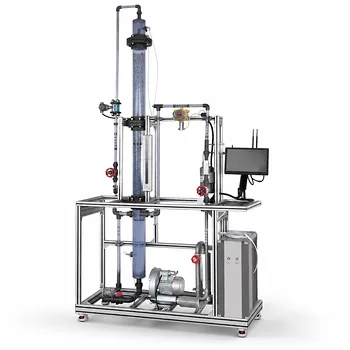
Packed Bed Absorption Educational Unit Operations Pilot Plant

Packed Bed Absorption Educational Unit Operations Pilot Plant

Study gas-liquid absorption, pressure drop, flooding, and mass transfer coefficients with this pilot plant. Transparent packed column, industrial touchscreen, real-time sensor data, automated analysis. Investigate two-phase flow, loading points, column efficiency. Comprehensive data logging and assessment software included.

Comprehensive Liquid-Liquid Extraction Pilot Plant for Engineering Education

Comprehensive Liquid-Liquid Extraction Pilot Plant for Engineering Education

Comprehensive liquid-liquid extraction pilot plant for engineering education, integrating rotary and vibratory columns for hands-on observation of phase behavior, flooding limits, and mass transfer efficiency, enabling precise HTU and mass transfer coefficient calculations.

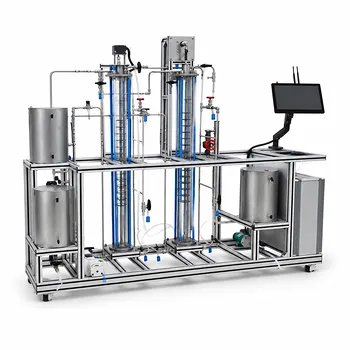
Absorption and Desorption Educational Unit Operations Pilot Plant

Absorption and Desorption Educational Unit Operations Pilot Plant

Dual packed column absorption and desorption pilot plant for chemical engineering education, offering real-time mass transfer coefficient measurement, durable mobile frame, industrial touch-screen interface, and customizable design for varied laboratory curricula, enabling hands-on study of gas absorption and stripping.

Bench Scale Dual Column Gas Separation and Capture Educational Pilot Plant

Bench Scale Dual Column Gas Separation and Capture Educational Pilot Plant

This dual-column educational pilot plant provides hands-on teaching of gas adsorption, separation, and capture processes. It features stainless steel columns, regeneration up to 400°C, and a 15.6-inch touchscreen PLC for TSA and PSA studies in chemical engineering curricula, process simulation.

Two-Dimensional Fluidization Hydrodynamics Educational Pilot Plant for Unit Operations Training

Two-Dimensional Fluidization Hydrodynamics Educational Pilot Plant for Unit Operations Training

Explore gas-solid and liquid-solid fluidization hydrodynamics with our transparent 2D educational pilot plant. Ideal for chemical engineering unit operations labs, it demonstrates fixed to fluidized bed regimes, measures pressure drop, and integrates QR-code digital learning for enhanced student training.

Two Phase Flow Pattern Velocity Resistance Measurement Educational Pilot Plant

Two Phase Flow Pattern Velocity Resistance Measurement Educational Pilot Plant

Benchtop educational pilot plant for university labs studying gas-liquid two-phase flow patterns, velocity, and resistance across circular, square, and rectangular conduits. Features 15.6-inch touchscreen, 5G connectivity, differential pressure sensors, safe water-air operation. Supports chemical engineering curricula.

Multi-Functional Special Distillation Educational Pilot Plant

Multi-Functional Special Distillation Educational Pilot Plant

Versatile multi-functional special distillation pilot plant for chemical engineering education. Supports continuous, vacuum, azeotropic, reactive, extractive distillation. Transparent glass columns enable real-time visual observation of hydrodynamics and separation processes.

Plate Column Hydrodynamics Tray Demonstration Educational Pilot Plant

Plate Column Hydrodynamics Tray Demonstration Educational Pilot Plant

Advanced transparent educational pilot plant for chemical engineering labs demonstrates plate column hydrodynamics with industrial sieve bubble cap serrated valve trays for visual observation of gas-liquid contact pressure drop measurement and operational limit analysis including flooding weeping entrainment

Pressure Swing Adsorption Educational Unit Operations Pilot Plant

Pressure Swing Adsorption Educational Unit Operations Pilot Plant

Integrated bench-scale pressure swing adsorption pilot plant for hands-on teaching of gas-solid separation, mass transfer, and process optimization using nitrogen-oxygen model, featuring dual-column design, industrial touchscreen control, digital assessment suite, and customizable hardware and software configurations for educational laboratories.

Fluidized Bed Gas Solid Catalytic Reaction Educational Pilot Plant

Fluidized Bed Gas Solid Catalytic Reaction Educational Pilot Plant

Our educational fluidized bed gas-solid catalytic reaction pilot plant is ideal for chemical engineering labs. Students study fluidization dynamics, catalyst evaluation, and process control hands-on. Features include a customizable reactor, touchscreen HMI, and safety interlocks for safe, curriculum-aligned experiments.

Continuous Batch Extractive Distillation Educational Pilot Plant

Continuous Batch Extractive Distillation Educational Pilot Plant

Versatile pilot plant for continuous, batch, and extractive distillation training. High-borosilicate glass column for visualizing hydraulics, 15.6-inch touchscreen with data logging, precise reflux ratio control 1-99, and durable corrosion-resistant frame. Ideal for chemical engineering education and process research.

Micro-Scale Gas-Solid Catalytic Reaction Educational Pilot Plant

Micro-Scale Gas-Solid Catalytic Reaction Educational Pilot Plant

Explore heterogeneous catalysis with this micro-scale gas-solid catalytic reaction educational pilot plant. Designed for university labs, it enables hands-on study of reaction kinetics and transport phenomena in a benchtop packed bed reactor with high-precision flow control and touchscreen automation.

Fixed-Bed Chemical Reaction and Gas Dust Tar Removal Unit Operations Pilot Plant

Fixed-Bed Chemical Reaction and Gas Dust Tar Removal Unit Operations Pilot Plant

Integrated educational pilot plant for studying catalytic gas-solid reactions and downstream gas purification. Features dual fixed-bed reactor, three-stage heating, and touchscreen control for hands-on engineering training. Ideal for chemical and environmental engineering curricula.

Dual-Mode Gas Absorption and Desorption Unit Operations Training Pilot Plant

Dual-Mode Gas Absorption and Desorption Unit Operations Training Pilot Plant

Industrial-scale pilot plant for gas absorption and desorption training in chemical engineering. Features dual-mode operation with real and simulated materials, transparent columns for flow visualization, and customizable design. Supports independent or combined loops for hands-on unit operations experiments.

Multimodal Absorption and Desorption Pilot Plant for Unit Operations Training

Multimodal Absorption and Desorption Pilot Plant for Unit Operations Training

Multimodal absorption and desorption pilot plant for higher education labs. Bridges theory and industrial practice with transparent packed columns, three operational modes (real-material, simulated, semi-physical), and SCADA control. Students explore mass transfer, column hydraulics, and process control. Customizable.

Gas-Solid Heterogeneous Separation Demonstration Educational Unit Operations Pilot Plant

Gas-Solid Heterogeneous Separation Demonstration Educational Unit Operations Pilot Plant

Comprehensive visual transparent gas-solid separation pilot plant for chemical engineering labs. Demonstrates gravity settling inertial settling cyclone and bag filter technologies. Enables real-time analysis of fluid-particle mechanics pressure drop and collection efficiency. Ideal for undergraduate unit operations courses.

Educational Unit Operations Pilot Plant for Intraparticle Diffusion Effective Factor Measurement

Educational Unit Operations Pilot Plant for Intraparticle Diffusion Effective Factor Measurement

Designed for chemical engineering university labs, this pilot plant allows hands-on determination of catalyst particle intraparticle diffusion effective factors and gas-solid reaction kinetics using a fixed-bed tubular reactor with industrial touchscreen control, bridging theory and practical reactor design.

Multi-Component Gas Pressure Swing Adsorption Pilot Plant for Unit Operations Education

Multi-Component Gas Pressure Swing Adsorption Pilot Plant for Unit Operations Education

Multi-component gas pressure swing adsorption pilot plant designed for unit operations education. Features four-tower configuration, IoT touchscreen control, dual regeneration, and real-time breakthrough curve analysis for engineering training with safety interlocks and mobile frame simulates industrial PSA processes.

Comprehensive Fluid Mechanics Educational Unit Operations Pilot Plant

Comprehensive Fluid Mechanics Educational Unit Operations Pilot Plant

Hands-on fluid mechanics pilot plant for engineering education covering over 13 principles including pipe flow, minor losses, flowmeter calibration, and pump performance with industrial-grade components, smooth and rough piping, venturi and orifice flowmeters, and centrifugal pump testing and analysis.

Gas Phase Mixing and Residence Time Distribution Determination Educational Unit Operations Pilot Plant

Gas Phase Mixing and Residence Time Distribution Determination Educational Unit Operations Pilot Plant

Integrated lab system for gas-phase mixing and RTD determination. Supports pulse and step tracer methods with dual CSTR and PFR reactors, industrial components, and PC data logging. Provides hands-on study of non-ideal flow and reactor behavior for university students.


Leave Your Message