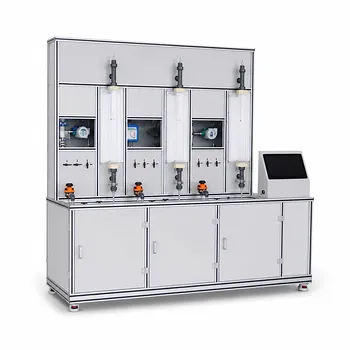
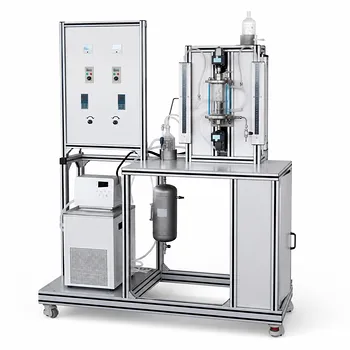
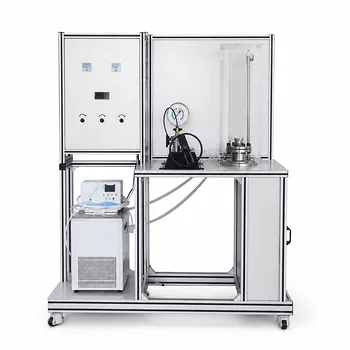
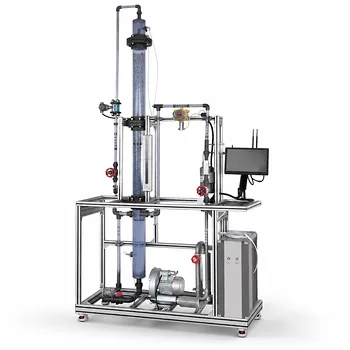
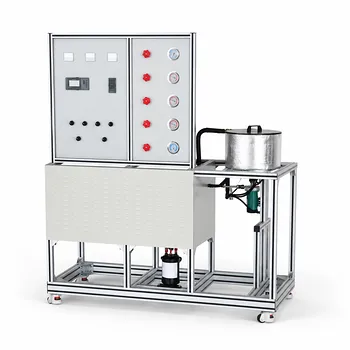
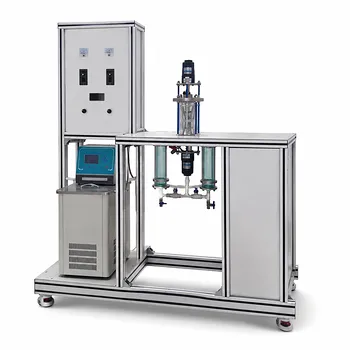
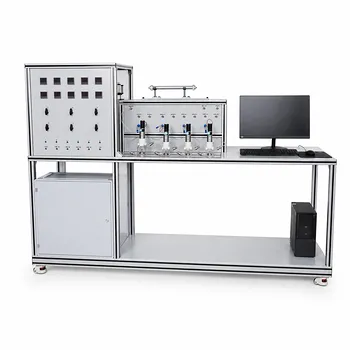
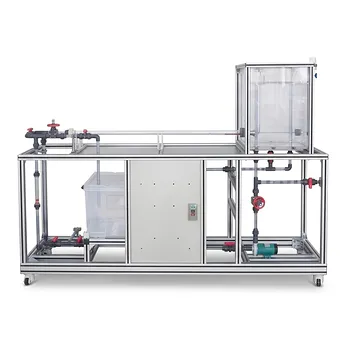
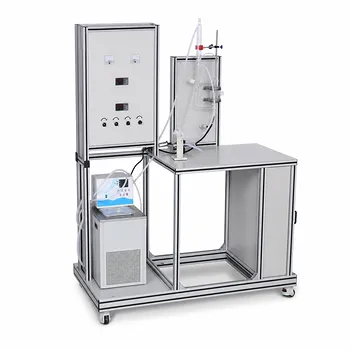
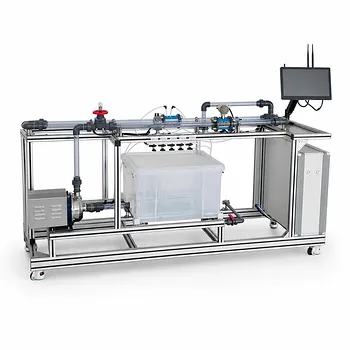
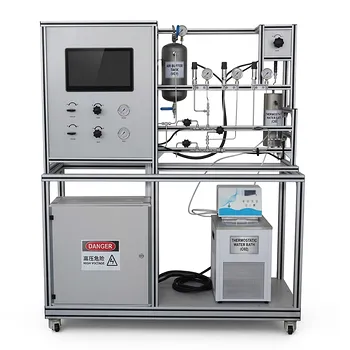
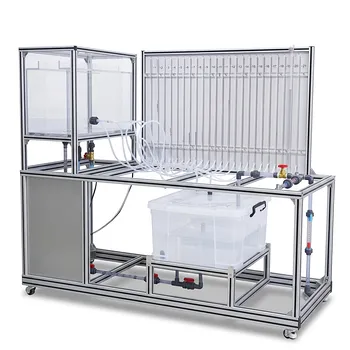
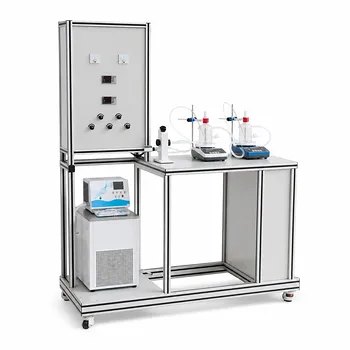
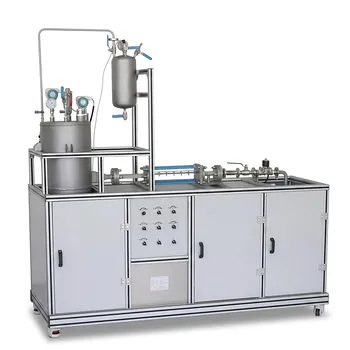
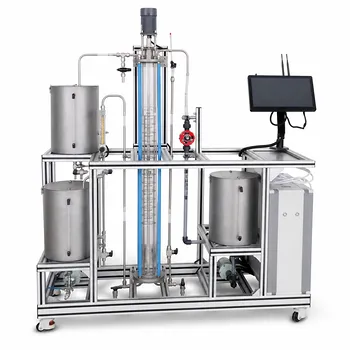
Understanding diffusion coefficients is essential for designing mass transfer equipment. In educational unit operations laboratories, the Stefan Tube is the classic experiment for measuring gas-phase diffusivity, while pilot-scale absorption towers or liquid-liquid extraction units are widely used to investigate liquid-phase mass transfer. Both setups allow students to apply Fick’s law, track concentration profiles, and calculate fundamental transport parameters under controlled conditions.
The Stefan tube directly yields a diffusion coefficient by observing the steady evaporation of a liquid into a stagnant gas, whereas absorption and extraction columns teach students to evaluate overall mass transfer coefficients that couple diffusion with convective effects. This dual approach bridges molecular-level theory and practical industrial design.
The Stefan Tube: A Benchmark for Gas-Phase Diffusivity
This simple, visual experiment is the most common method in undergraduate and graduate labs.
How the Stefan Tube Works
A vertical tube is partially filled with a volatile liquid (such as acetone or ethanol). A slow stream of inert gas passes across the top of the tube, creating a stagnant gas column inside. As the liquid evaporates, the vapor diffuses upward through the stationary gas.
Students record the slowly receding liquid level over time. Using the pseudo-steady-state form of Fick’s law, they calculate the molecular diffusion coefficient (DAB) directly from the rate of level drop, known temperature, and system pressure.
Why It Remains an Educational Cornerstone
- Direct visualization of the diffusion process reinforces the link between concentration gradient and mass flux.
- The theory requires only Fick’s first law and mass balance—no complicated hydrodynamics.
- Reliable literature values exist for common solvent-air systems, allowing immediate comparison and error analysis.
- The apparatus is low-cost and easy to operate, making it accessible even in large laboratory classes.
Pilot-Scale Columns for Liquid-Phase Mass Transfer
While the Stefan tube targets molecular diffusion in a gas, liquid-phase diffusivity in education is typically explored through absorption or extraction units.
Absorption Towers in the Laboratory
A typical setup uses a packed column where water flows downward while a gas phase (e.g., air doped with CO₂ or ammonia) moves upward. By measuring inlet and outlet concentrations, students determine the overall volumetric mass transfer coefficient (KLa).
This coefficient combines the effects of molecular diffusion with fluid convection, directly connecting lab data to the design equations used for industrial absorbers. Students learn that KLa depends on the liquid flow rate, packing geometry, and the physical properties of the system—especially the diffusion coefficient.
Liquid-Liquid Extraction Units
In a countercurrent extraction column (e.g., a spray or packed column), one liquid phase disperses into another immiscible phase. The solute transfers across the interface at a rate governed by diffusion on both sides.
Students analyze concentration profiles along the column and calculate the overall mass transfer coefficient based on either phase. This exercise requires them to isolate the diffusive contribution from the convective resistance, deepening their understanding of two-film theory and the role of diffusivity in limiting transfer rates.
Supplementary Methods Found in Advanced Labs
Some educational plants incorporate specialized techniques that provide direct diffusivity measurements without the complexities of a full pilot column.
Taylor Dispersion Method
A sharp pulse of solute is injected into a slow laminar flow through a long, narrow tube. The spreading of the pulse is monitored via a detector (e.g., refractive index or conductivity). The dispersion coefficient is directly related to the molecular diffusion coefficient. This method can be applied to both gases and liquids and is often part of modern mass transfer training units.
Chromatographic and Electrochemical Techniques
- Gas Chromatography (GC): The migration rate of components through a packed column can be used to estimate gaseous diffusion coefficients from retention times and plate theory.
- Rotating Disc Electrode (RDE): By imposing a known flow field near an electrode surface, the mass transfer-limited current gives the liquid-phase mass transfer coefficient, which scales with the 2/3 power of diffusivity.
- Cyclic Voltammetry: The diffusion-limited current peak is used to extract diffusion coefficients directly from the Randles-Sevcik equation. These electrochemical methods connect mass transfer to reaction engineering and are valuable in integrated lab sequences.
Understanding the Trade-offs
Every experimental approach involves compromises. Recognizing them is key to interpreting results correctly.
Advantages and Limitations of the Stefan Tube
- Advantages: Pure molecular diffusion; simple theory and setup. Gives a true binary diffusion coefficient.
- Limitations: Only applicable to gas-gas systems at pseudo-steady conditions. Assumes isothermal, isobaric conditions with no bulk flow error. Cannot capture concentration-dependent diffusivity.
Complexity of Column Setups
- Advantages: Mimics real equipment; teaches students to combine diffusion with hydrodynamics. Yields overall coefficients that are directly useful for scale-up.
- Limitations: Requires careful flow control and long running times to reach steady state. Axial dispersion can mask true mass transfer rates. Extracting the molecular diffusivity from KLa requires additional hydrodynamic correlations (e.g., Onda’s or Sherwood’s correlations), adding uncertainty.
Choosing Methods for Learning Objectives
A lab curriculum that only measures pure diffusivity may leave students without a feel for process equipment. Conversely, diving straight into a packed column can bury the fundamental transport physics behind operational complexities. The most effective education combines a simple diffusion measurement (Stefan tube or Taylor dispersion) with a pilot-scale column experiment.
Making the Right Choice for Your Laboratory Curriculum
The ideal experiment depends on the core learning goal you want to achieve.
- If your primary focus is reinforcing molecular transport fundamentals: A Stefan tube experiment (for gases) paired with a Taylor dispersion rig (for liquids) provides clean, reproducible data and a direct tie to Fick’s law.
- If your primary focus is demonstrating industrial mass transfer equipment: Use a packed absorption tower or an extraction column. This lets students untangle diffusion, convective transfer, and equipment efficiency.
- If your primary focus is integrating multiple unit operations: Combine an electrochemical method (RDE/cyclic voltammetry) with a classic column. This links mass transfer to reaction engineering and process control.
- If you want students to critically evaluate correlations: Have them measure liquid diffusivity via a column experiment and then compare the extracted diffusivity with a Wilke-Chang prediction. This builds confidence in both measurement and estimation techniques.
Each of these setups, chosen deliberately, transforms a theoretical diffusion coefficient into a tangible, measurable reality that prepares students for the demands of process design and scale-up.
Summary Table:
| Experimental Setup | Target Phase | Measurement Principle | Key Educational Focus |
|---|---|---|---|
| Stefan Tube | Gas | Evaporation rate of volatile liquid into stagnant gas | Pure molecular diffusion & Fick's Law |
| Absorption / Extraction Columns | Liquid | Concentration profiles & overall mass transfer coefficient ($K_L a$) | Convective mass transfer & industrial scale-up |
| Taylor Dispersion | Gas & Liquid | Spreading of a solute pulse in laminar flow | Direct diffusivity & advanced instrumentation |
| Electrochemical Methods (RDE/CV) | Liquid | Mass transfer-limited current at electrode surface | Diffusion coupled with reaction kinetics |
Equip Your Unit Operations Lab for Success with LABPARK
Are you looking to enhance your curriculum with reliable, hands-on learning systems? LABPARK provides state-of-the-art Educational and Vocational Unit Operations Pilot Plants in chemical engineering, bioprocess & biotech, and environmental & water treatment.
We help universities, research institutes, and enterprises bridge the gap between theoretical transport phenomena and practical industrial application with robust, easy-to-operate equipment.
Ready to upgrade your engineering laboratory?
Contact LABPARK Today to consult with our experts and get a customized solution for your department!
Related Products
- Two Phase Flow Pattern Velocity Resistance Measurement Educational Pilot Plant
- Educational Unit Operations Pilot Plant for Intraparticle Diffusion Effective Factor Measurement
- Dual-Drive Stirred Gas-Liquid Mass Transfer Coefficient Determination Pilot Plant
- Carbon Dioxide PVT Curve Determination Educational Unit Operations Pilot Plant
- Packed Bed Absorption Educational Unit Operations Pilot Plant
People Also Ask
- How to update chemometric calibration models in pilot plants? Best practices for process engineers.
- Why Correct Sig Figs & Rounding Matter in Educational Pilot Plants: Ensure Data Accuracy
- How does nuclear yield inefficiency translate to chemical engineering education? Optimize kinetics with pilot plants.
- How can educational pilot plants be used to teach process safety and risk assessment in chemical engineering curricula?
- How to identify two-phase gas-liquid flow patterns? Master fluid dynamics with pilot plants