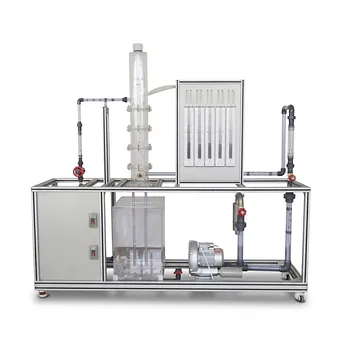
For educational pilot plants studying multicomponent hydrocarbon systems, the Peng-Robinson (PR) equation delivers a clear, measurable advantage over Soave-Redlich-Kwong (SRK) where it matters most: predicting the liquid phase. PR consistently yields more accurate liquid density values, vapor pressure estimates, and equilibrium K-factors—especially in the critical and retrograde regions—allowing students to reconcile their thermodynamic models with the physical separation behavior they observe in real glassware.
The core reason is thermodynamic fidelity in the difficult retrograde region. While both are two-constant cubic models, PR’s volume-dependent formulation dramatically reduces vapor pressure bias and faithfully reproduces the amount of liquid dropout. In educational settings, this closes the gap between simulation and experiment, making the abstract concepts of retrograde condensation and convergence pressure tangible and verifiable.
Why Phase Behavior Accuracy is the Educational Foundation
In a pilot plant, the primary learning goal is connecting theory to physical observation. The equation of state is the lens through which students interpret temperature, pressure, and composition data.
The Critical Role of Retrograde Condensation
Retrograde condensation—where a gas mixture forms liquid as pressure decreases—is one of the most conceptually challenging topics in chemical thermodynamics.
- PR’s accuracy in this region creates a reliable learning tool. When students simulate a natural gas separation, the PR model predicts the precise pressure at which the first liquid droplets appear and, more importantly, the volume percentage of that liquid.
- SRK systematically overestimates liquid volumes. This means if a student’s control system is tuned to an SRK model, the theoretical prediction will show a higher liquid holdup than the pilot plant actually produces. The mismatch undermines trust in the model.
Matching K-Factors and Convergence Pressure
Equilibrium ratios (K-factors) are the fundamental variables in any distillation or separation calculation. Their convergence to unity defines the system’s pressure limits.
- The PR model’s convergence pressure is significantly lower (e.g., 3400 psia vs. 3700 psia for SRK in a nine-component sour gas mixture). This directly translates to more accurate dew point predictions in the upper retrograde region.
- Why this matters to a pilot plant operator: If they use SRK to predict initial liquid formation in a high-pressure separator, they will calculate a dew point pressure that is too high. The physical plant will show no condensation at that pressure, leading to confusion and a breakdown of the educational objective.
Quantifying the Predictive Advantage
The superiority of PR over SRK for these systems is not anecdotal. It is rooted in consistent, lower statistical errors across experimental datasets.
Vapor Pressure and Liquid Density Precision
The accuracy of any phase envelope calculation starts with pure-component vapor pressures. PR demonstrates a consistently lower Average Absolute Deviation (AAD).
- PR achieves an AAD of approximately 0.60% and an RMS error of 0.73% for light hydrocarbons such as methane, ethane, and propane.
- In contrast, SRK’s AAD is about 1.01% with an RMS of 1.19%. This difference is significant because SRK’s error structure includes a positive bias, leading to systematically high vapor pressures and overly large liquid molar volumes.
Critical Point and Multicomponent Mixtures
Educational pilot plants often handle complex 3- to 12-component mixtures containing paraffins, nitrogen, CO₂, and H₂S. Accurate critical-loci predictions are essential for safe operation.
- PR predicts mixture critical temperatures and pressures with an average absolute pressure error of ~2.33% and a temperature error of ~1.31%. This level of accuracy ensures that the simulated phase envelope correctly warns the operator when they are approaching a dangerous supercritical thermal runaway region.
- The improved density prediction near the critical point is a direct consequence of PR’s mathematical form, which gives it superior volumetric behavior without adding computational complexity.
The Operational Value in a Teaching Environment
Preference in an educational lab is not only about theoretical purity. The model must also support a rapid, interactive learning cycle.
Computational Simplicity Without Sacrifice
Both PR and SRK are two-constant cubic equations, meaning they share the same core advantage: they can be solved analytically.
- Students can perform VLE calculations and flash calculations by hand or with simple spreadsheets. This is impossible with multi-constant equations like BWRS, which require iterative density solvers and would obscure the underlying physics.
- PR offers a superior output for the exact same computational cost. Switching from SRK to PR in Aspen HYSYS or a custom Python script does not slow down tray-by-tray distillation simulations, allowing students to run rapid sensitivity analyses on feed composition and see instant physical effects.
Handling the Reality of Wet and Sour Streams
Real pilot plant streams—especially those in gas processing units—contain water, which can lead to a three-phase liquid-liquid-gas equilibrium or hydrate formation.
- PR’s compatibility with fitted binary interaction parameters for water-hydrocarbon pairs allows it to model this complexity. A student can use the same PR framework to predict the water dew point in a vapor stream and the potential for liquid water dropout.
- SRK, in its standard form, is less robust for these three-phase predictions. This makes PR a single, versatile model that can be used from the debutanizer column to the dehydration unit, reinforcing a unified thermodynamic framework.
Understanding the Trade-offs and Educational Pitfalls
Presenting PR as the unequivocal choice would ignore the critical learning opportunity that comes from understanding model limitations. The preference for PR in pilot plants is based on performance for specific systems and objectives.
The “Treasure Trove” of SRK Parameters
SRK has been a workhorse for decades, particularly in the petrochemical industry. A vast library of highly tuned, mixture-specific binary interaction parameters exists for SRK.
- If the precise SRK parameters for a student’s exact feed mixture are known, the gap in accuracy can narrow significantly. However, in a teaching lab with constantly changing synthetic mixtures, this advantage is lost. PR’s inherent predictive accuracy without heavy tuning is more valuable.
Non-Ideality at the Extremes
Neither PR nor SRK is a silver bullet. Both equations diverge from reality when modeling highly polar molecules or extremely long-chain heavy fractions.
- The educational value lies in observing the breakdown. A well-designed experiment might intentionally use a system where both models fail, teaching students why an activity-coefficient model is needed. However, for the core multicomponent hydrocarbon VLE curriculum, PR simply provides a cleaner, more truthful signal.
The Data Validation Imperative
PR’s accuracy can be so high that students may uncritically accept its output. The key pitfall is a lack of skepticism.
- The model’s predictions must still be validated against the actual pilot plant data. The true pedagogical power of PR is that its small errors create a tight correlation with experiment, making any deviation immediately obvious and prompting a valuable investigation into heat loss, measurement error, or model assumptions.
Making the Right Choice for Your Teaching Objective
Your primary objective determines the final selection. Use this guidance to align the thermodynamic model with the learning outcome.
- If your primary focus is demonstrating retrograde condensation and accurate K-factors in natural gas: Use Peng-Robinson. Its accurate liquid volume and dew point predictions will make the observed phase behavior in the high-pressure sight glass match the simulation output, turning a confusing phenomenon into a clear, repeatable observation.
- If your primary focus is head-to-head model comparison and student error analysis: Run both PR and SRK side-by-side. The systematic overestimation of liquid volumes and convergence pressures by SRK becomes a powerful teaching moment when compared to the pilot plant’s empirical data, solidifying the student’s understanding of how a model’s functional form drives its predictive accuracy.
The goal of an educational pilot plant is not just to run an experiment, but to make the invisible thermodynamic logic visible. For multicomponent hydrocarbon systems, the Peng-Robinson equation provides the clearest lens to achieve that.
Summary Table:
| Parameter / Feature | Peng-Robinson (PR) | Soave-Redlich-Kwong (SRK) |
|---|---|---|
| Vapor Pressure AAD | ~0.60% (Lower error) | ~1.01% (Higher error) |
| Liquid Density / Volume | Highly accurate predictions | Overestimates liquid volumes |
| Convergence Pressure | Lower, precise dew points | Higher, less accurate in retrograde |
| Best Educational Use | Natural gas VLE & retrograde studies | Petrochemical systems with tuned BIPs |
Bring complex thermodynamic theories to life in your laboratory. LABPARK provides premium Educational and Vocational Unit Operations Pilot Plants in chemical engineering, bioprocess & biotech, and environmental & water treatment. Designed specifically for universities, research institutes, and enterprises, our pilot plants enable students and researchers to align physical experimental observations with advanced thermodynamic models like Peng-Robinson.
Ready to elevate your engineering training and research capabilities? Contact LABPARK today to find the perfect pilot plant solution for your lab!
Related Products
- Multi-Reactor Educational Pilot Plant for Reaction Engineering Unit Operations
- Multi-Functional Special Distillation Educational Pilot Plant
- Multi-Functional Membrane Separation Educational Pilot Plant for Unit Operations Lab
- High-Gravity Emulsification and Mass Transfer Educational Pilot Plant
- Micro-Scale Gas-Solid Catalytic Reaction Educational Pilot Plant
People Also Ask
- How do reactor pilot plants define QbD design space? Master chemical process scale-up.
- When configuring a reactor unit operations pilot plant for highly exothermic reactions, how to prevent thermal runaway?
- How do metal ion-catalyzed reaction mechanisms inform chemical engineering pilot plant design? From kinetics to scale-up
- What are the barriers to process intensification & how do pilot plants help?
- What role do educational pilot plants play in scaling green chemistry? Bridging the Lab-to-Industry Gap