The bridge between molecular motion and industrial-scale separation starts with a simple question: How fast does a gas move through another? The primary experimental methods used to determine gas diffusion coefficients in educational laboratories are the Stefan Tube Method, the Taylor Dispersion Method, and Gas Chromatography (GC). These techniques give students a tangible measurement of diffusivity (m²/s), which they then directly apply to calculate macroscopic mass transfer coefficients for designing absorption columns, distillation towers, and drying processes.
The true value of measuring a diffusion coefficient in the lab is not the number itself. It's the moment a student sees that a single molecular property, when combined with flow and geometry, can predict the performance of an entire pilot-scale absorption tower.
The Foundational Experimental Methods
To empower students to design separation equipment, we must first equip them with reliable ways to measure the fundamental transport property: the diffusion coefficient. Each method offers a different window into the physics of mass transfer.
Stefan Tube Method: Observing the Slow Retreat of a Liquid Interface
This is the classic visual experiment. A vertical tube is partially filled with a volatile liquid, and a stagnant gas is passed over the top. As the liquid evaporates, the vapor diffuses upward.
Students measure the rate of fall of the liquid meniscus over time. By knowing the vapor pressure and temperature, they apply Fick's law for a stagnant medium to back-calculate the diffusion coefficient.
The beauty is its simplicity. It directly demonstrates the concept of diffusion through a stagnant film, mirroring the assumptions used in many early-stage absorption column models.
Taylor Dispersion Method: Reading the Smear of a Pulse
In a flowing stream, molecular diffusion interacts with the parabolic velocity profile to create a unique dispersion signature. A sharp pulse of tracer gas is injected into a carrier gas flowing through a long, narrow tube.
A detector at the tube's exit records a broadened, Gaussian-like peak. The width of this peak, not its arrival time, holds the key. By measuring the peak variance, students can extract the molecular diffusion coefficient with high accuracy.
This method reinforces the critical interplay between convection and diffusion, a fundamental concept for understanding residence time distributions in real reactors and packed beds.
Gas Chromatography: Unpacking Separation to Find Diffusion
A gas chromatograph is more than an analytical tool; it's a physical demonstration of differential migration. A sample pulse travels through a column packed with a stationary phase.
By measuring the broadening of the eluted peak and knowing the column's properties, students can calculate the diffusion coefficient of the sample in the carrier gas. This is often done through the van Deemter equation, connecting plate height to flow rate and mass transfer kinetics.
It teaches that a diffusion coefficient isn't just a number in a textbook; it's the limiting factor in how quickly two components can be separated.
Electrochemical Approaches: When the Interface is Electric
While not always core, methods like the Rotating Disc Electrode (RDE) provide a powerful alternative. The electrode spins, creating a known, well-defined flow pattern that brings reactants to the surface.
The resulting current is limited by mass transfer. By measuring this limiting current at different rotation speeds, students directly calculate the mass transfer coefficient and, with known kinematic viscosity, the diffusivity of the electroactive species. This links an easily measured electrical signal directly to a transport property.
From Molecular Hops to Column-Sized Coefficients
Measuring the diffusion coefficient is only half the journey. The crucial step is using it to design and analyze real unit operations, which is the heart of the educational mass transfer laboratory.
The Missing Link from Fick's Law to a Mass Transfer Coefficient
Fick's law describes diffusion in a perfectly stagnant fluid. But a pilot-scale absorption column is turbulent, with complex phase geometries. Educators bridge this gap by introducing the mass transfer coefficient (k).
Students learn that a mass transfer coefficient is, in essence, a diffusion coefficient divided by an effective film thickness. The methods above provide the D. The experimental pilot plant then provides the data to determine k. This direct connection transforms a theoretical model into a predictive tool.
Validating Theory with the Absorption Pilot Plant
The ultimate proving ground is the bench-scale absorption or stripping unit. Here, students couple their measured (or literature-based) diffusion coefficient with mass balance equations.
By sampling both the liquid and gas phases at multiple points along the packed column, they calculate the overall mass transfer rate (Nₐ). Using the operating line and equilibrium curve, they then resolve the overall mass transfer coefficient, Kₗa or Kɢa, and the individual phase coefficients.
This process reveals the profound truth: the performance of a multi-million-dollar gas processing plant is governed by the same molecular-scale hopping they measured in a simple glass tube.
The Bridge of Dimensionless Numbers
Education isn't complete without a final synthesis. Students are guided to correlate their lab data using dimensionless groups like Sherwood (Sh), Reynolds (Re), and Schmidt (Sc) numbers.
The Schmidt number (v/D) is a direct ratio of momentum diffusivity to mass diffusivity — the D they measured becomes a key player. By generating a Sh-vs-Re correlation in the lab, they create a design equation that can scale their findings from a 2-meter column to a 20-meter column, solidifying the principle of dynamic similarity.
Understanding the Trade-offs in Educational Laboratories
Objectivity demands we acknowledge that no single method is perfect, and the educational context introduces practical constraints that can create pitfalls.
Accuracy vs. Simplicity: The Stefan Tube is intuitive but suffers from errors due to temperature fluctuations and incorrect meniscus reading. The Taylor Dispersion method is more precise but requires a deeper understanding of fluid dynamics, which can obscure the core mass transfer lesson if not carefully framed. Time Constraints: A single Stefan Tube run can take hours to yield enough data, while a GC-based method is rapid. Laboratories must balance the pedagogical value of watching diffusion slowly unfold against the need to complete a syllabus. Connecting the Dots: The biggest pitfall is treating the diffusion measurement and the pilot plant operation as two isolated experiments. Without deliberately forcing students to use the measured D to predict the pilot column's performance, the exercise becomes a sequence of steps, not an integrated analysis. Electrochemical Hurdles: RDE methods require clean, inert electrolytes and perfectly polished electrodes. Contamination or a scratch on the disc will yield mass transfer data that reflects surface defects, not molecular diffusion, leading to frustratingly irreproducible results.
Making the Right Choice for Your Learning Objective
The method you prioritize should directly serve the conceptual leap you want your students to make.
- If your primary focus is demonstrating diffusion through a stagnant film: Choose the Stefan Tube Method. Its visual simplicity powerfully anchors the core assumption used in many absorption models.
- If your primary focus is teaching the interplay between convection, dispersion, and molecular transport: Choose the Taylor Dispersion Method. It forces students to deconvolute flow effects from molecular properties, a key skill for understanding real reactors.
- If your primary focus is linking separation efficiency to fundamental transport: Choose Gas Chromatography. It directly shows how the diffusion coefficient limits the speed and sharpness of a separation.
- If your primary focus is an electronics-driven measurement of mass transfer: Choose the RDE. It provides a clean introduction to convective-diffusion controlled reactions and sensor technology.
- If your primary focus is the integrated design experience: Always follow any D-measurement method with a pilot-scale absorption or stripping experiment. Require students to compare their predicted mass transfer coefficients with the values calculated from column concentration profiles.
The ultimate goal is not just to measure a diffusion coefficient, but to wield it as the foundational design tool it truly is.
Summary Table:
| Method | Core Principle | Key Advantage | Educational Focus |
|---|---|---|---|
| Stefan Tube | Evaporation rate of liquid meniscus in stagnant gas | Visually simple, intuitive | Diffusion through a stagnant film |
| Taylor Dispersion | Peak broadening of a tracer pulse in flowing stream | High accuracy, accounts for flow | Interplay of convection & diffusion |
| Gas Chromatography | Peak broadening through a packed column | Rapid measurements | Separation efficiency vs. transport |
| Rotating Disc Electrode | Mass-transfer-limited current at a spinning disc | Direct electrochemical measurement | Convective-diffusion control |
Elevate Your Mass Transfer Lab with LABPARK
Bridging the gap between molecular theory and industrial-scale operations requires the right experimental tools. LABPARK provides state-of-the-art Educational and Vocational Unit Operations Pilot Plants in chemical engineering, bioprocess & biotech, and environmental & water treatment for universities, research institutes, and enterprises.
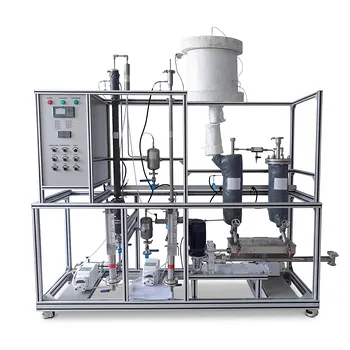
Our pilot-scale absorption columns and mass transfer units help students apply measured diffusion coefficients to real-world chemical processes.
Ready to transform your laboratory training? Contact our experts today to find the perfect pilot plant for your program!
Related Products
- Tubular Reactor Flow Characteristics Determination Educational Unit Operations Pilot Plant
- Three-Tube Heat Transfer Educational Pilot Plant for Unit Operations Training
- Bernoulli Equation Demonstration Unit Operations Pilot Plant
- Multi-Stage Stirred Tanks in Series Residence Time Distribution and Mixing Performance Determination Educational Pilot Plant
- Multi Functional Catalytic Reaction and Reactor Evaluation Educational Unit Operations Pilot Plant
People Also Ask
- How do educational unit operations pilot plants address safety and waste management when scaling up?
- How do educational unit operations pilot plants bridge theory and design? Bridge the Engineering Gap
- What are the formulas for single-pass vs overall conversion in pilot plants? Master reactor mass balances
- How Do Pilot Plants Teach Limiting Reactants, Yield, & Selectivity? Real-World ChE Practice
- Why are implicit numerical methods preferred for stiff kinetics? Optimize Reactor Simulation