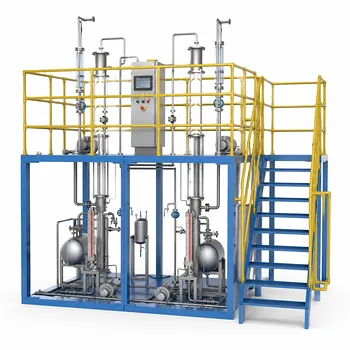
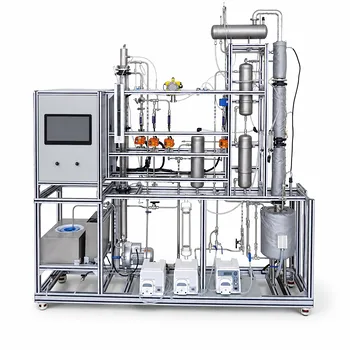
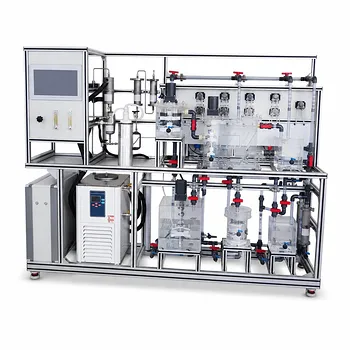
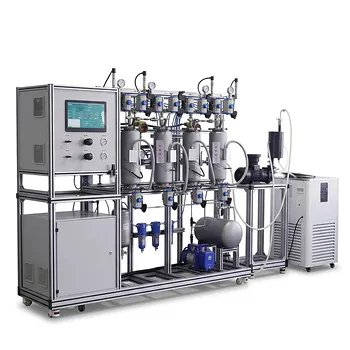
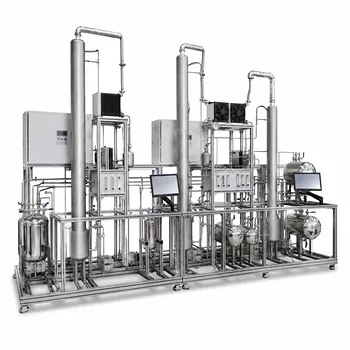
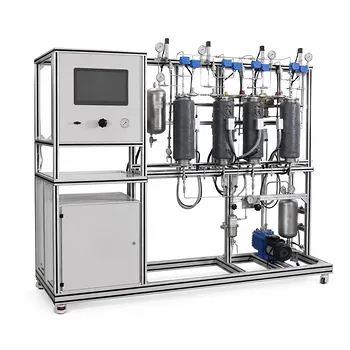
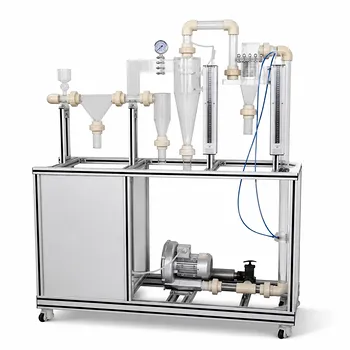
You can practically evaluate at least four solvent regeneration strategies in a unit‑operations pilot plant. Gas stripping, thermal desorption, vacuum desorption, and combined methods each use a different driving force to release dissolved gases from a liquid, and a well‑instrumented pilot column lets you directly measure their energy efficiency, regeneration rate, and operating limits.
Core takeaway: A pilot plant transforms desorption from a textbook concept into a measurable engineering trade‑off. By controlling temperature, pressure, and stripping‑gas flow in a counter‑current column, you can quantify exactly what it costs—in energy, time, and solvent stability—to pull a solute back out of a liquid, which is the heartbeat of any industrial gas‑recovery or solvent‑regeneration loop.
Desorption Methods You Can Put to the Test
The four families of desorption that a pilot plant brings into the lab all revolve around one goal: lowering the solute’s equilibrium partial pressure in the gas phase so it leaps out of the liquid. The plant’s modular heating jackets, vacuum pump, and gas injection lines let you study each mechanism in isolation or in combination.
Gas Stripping (Air or Steam)
This is the most intuitive method and the direct reverse of absorption. An inert gas—typically air or nitrogen, or sometimes low‑pressure steam—is blown counter‑currently through the column. The stripping gas enters at the bottom, the solute‑rich liquid enters at the top.
Because the entering gas is virtually free of the solute, the partial pressure of the solute in the gas phase is near zero. The concentration gradient forces the solute out of the liquid and into the rising bubbles or film.
In a pilot plant, you control the liquid‑to‑gas ratio (L/G) precisely with flow meters. You can then measure outlet gas concentrations with sensors to calculate mass transfer coefficients and stripping efficiency. The same column can be run in a closed loop with an absorber upstream, mimicking industrial solvent regeneration.
Thermal Desorption
Here, the driving force is temperature‑dependent solubility. You heat the solvent—often via a jacket or an internal coil—before it enters the column or while it is inside. As the liquid warms, the solute’s Henry’s law constant climbs, meaning it is happier in the gas phase.
The solute then desorbs without needing an external stripping gas, though a small sweep of inert gas is sometimes added. The pilot plant’s adjustable heating system and array of thermocouples let you map the temperature profile and directly see how much regeneration you get for each degree of heating. This method is especially educational for demonstrating the energy penalty of solvent regeneration versus the purity of the recovered solute.
Vacuum Desorption
Instead of adding heat, you reduce the system pressure with a vacuum pump. When the pressure drops, the partial pressure of the dissolved solute exceeds the new, lower total pressure, and the gas flashes out of the liquid.
Vacuum‑rated seals and pressure transducers on a well‑designed pilot plant allow you to operate at sub‑atmospheric pressures safely. You can then measure regeneration rates and observe how the column’s hydraulic behaviour changes—for example, the risk of flooding shifts when vapour velocities increase under vacuum. This method is ideal for studying the separation of heat‑sensitive solutes or for evaluating processes that must avoid thermal degradation.
Combined Methods
Industrial practice rarely relies on a single mechanism. A common configuration you can replicate in the pilot plant is to heat the liquid, flash it to atmospheric pressure, and then strip it with a small amount of inert gas.
The pilot plant’s flexibility—separate heating, pressure control, and gas injection—lets you sequence these operations and measure the incremental benefit of each step. Students and researchers can run designed experiments that isolate the contributions of thermal, vacuum, and stripping effects, making it an unmatched platform for teaching process intensification.
Why Pilot‑Scale Evaluation Changes the Game
The deep need behind “which methods can be evaluated” is understanding what you actually learn by running these experiments rather than just modeling them. The pilot plant answers questions that a spreadsheet cannot.
Quantifying Energy Efficiency and Regeneration Rates
You can measure the exact energy input—kilowatts of heating, kilowatt‑hours of vacuum—and match it against the mass of solute recovered. This turns desorption into an engineering cost problem: how many megajoules does it take to regenerate one kilogram of solvent? Those numbers are the foundation of feasibility studies.
Observing Real Fluid Mechanics
A textbook assumes perfect counter‑current flow. In a packed column, you see the real thing: liquid distribution, entrainment, flooding points, and the effect of gas velocity on pressure drop. Gas stripping at a high L/G ratio might flood the column, while vacuum desorption can pull vapour velocities into an entirely different regime. These observations are impossible to get from software alone.
Demonstrating Closed‑Loop Solvent Regeneration
Many pilot plants can connect an absorption column and a desorption column in a continuous loop. The solvent circulates, absorbs the solute in one column, and is stripped in the other. This is pure gold for training students in integrated process design—they can measure steady‑state concentrations, track solvent degradation, and see how the two unit operations are thermodynamically coupled.
Understanding the Trade‑offs
Every desorption method carries a downside, and a pilot plant is the honest mirror that shows you which one hurts the most.
- Gas stripping is simple, but if the stripping gas cannot be vented (or is not air), you need a gas‑handling or recirculation system. The gas also leaves saturated with water vapour, which can be an evaporative energy loss.
- Thermal desorption can deliver deep regeneration, but heating speeds up solvent degradation, corrosion, and can create unwanted side reactions—especially with chemically reactive solvents.
- Vacuum desorption avoids high temperatures, but vacuum systems are capital‑intensive, and at very low pressures the volumetric flow of vapour becomes enormous, leading to oversized columns and higher pressure drops.
- Combined methods offer the best efficiency, but they multiply the control loops and interaction effects, making it harder to pinpoint which parameter is driving the performance.
Making the Right Choice for Your Study
After mapping the landscape, the method you choose to evaluate should match the question you really need to answer.
- If your primary focus is understanding mass transfer fundamentals and column hydraulics: Begin with simple air stripping. It is the cleanest demonstration of counter‑current mass transfer, flooding, and pressure drop, with the fewest confounding variables.
- If your primary focus is energy optimization and process economics: Run a comparative campaign with thermal desorption and a combined (heat‑plus‑flash‑plus‑strip) sequence. The pilot plant’s energy balances will show you exactly where the BTU’s go.
- If your primary focus is protecting heat‑sensitive solutes or solvents: Invest your pilot time in vacuum desorption. It will teach you the realities of low‑pressure operation and help you avoid thermal degradation that you cannot predict from ambient‑pressure data.
- If your primary focus is replicating a real industrial closed‑loop process: Connect both absorption and desorption columns and cycle the solvent. Only then will you see the long‑term effects of solvent makeup, impurity accumulation, and the true steady‑state performance of your chosen desorption strategy.
When you move from theory to a unit‑operations pilot plant, desorption ceases to be a single arrow in a textbook and becomes a rich design space of measurable trade‑offs—and that is exactly the judgment a good engineer must build.
Summary Table:
| Desorption Method | Driving Force | Key Advantage | Main Limitation |
|---|---|---|---|
| Gas Stripping | Concentration gradient (inert gas/steam) | Simple setup; ideal for mass transfer studies | Requires gas-handling or recirculation systems |
| Thermal Desorption | Temperature-dependent solubility | High solute recovery rates and deep regeneration | High energy use; risks solvent thermal degradation |
| Vacuum Desorption | Reduced system pressure (flashing) | Protects heat-sensitive solvents and solutes | Volumetric vapor expansion requires larger columns |
| Combined Methods | Multi-stage energy and pressure shifts | Maximum regeneration efficiency and process flexibility | Highly complex control loops and system interactions |
Elevate Your Engineering Research and Training with LABPARK
Bridging the gap between textbook theory and industrial practice requires reliable, hands-on systems. LABPARK provides advanced Educational and Vocational Unit Operations Pilot Plants in chemical engineering, bioprocess & biotech, and environmental & water treatment for universities, research institutes, and enterprises.
Our highly instrumented pilot columns allow your students and researchers to precisely control temperature, pressure, and flow rates to master complex absorption and desorption processes.
Ready to upgrade your lab's capabilities?
Contact LABPARK today to discuss your pilot plant requirements and request a customized quotation!
Related Products
- Multimodal Absorption and Desorption Pilot Plant for Unit Operations Training
- Dual-Mode Gas Absorption and Desorption Unit Operations Training Pilot Plant
- Absorption and Desorption Educational Unit Operations Pilot Plant
- Carbon Dioxide Absorption and Desorption Educational Pilot Plant for Carbon Capture Studies
- Thermal Desorption Exhaust Gas and Tail Water Treatment Educational Pilot Plant
People Also Ask
- How do predictive thermodynamic models integrate into pilot plants? Bridging Theory and Practice
- Which cross-validation strategy should be selected for pilot plant time-series & batch data? Avoid Data Leakage
- How can process control schemes be configured to teach basic and advanced control?
- Why Use Center Points in Process Analyzer Calibration? Key Benefits Explained
- How does polyphosphate hydrolysis affect scale and corrosion in pilot plants? Essential Monitoring Guide