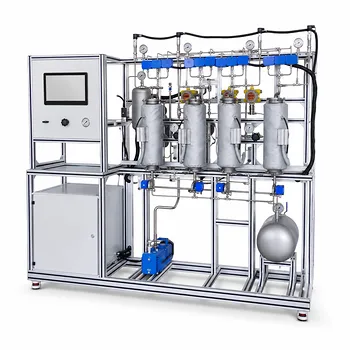
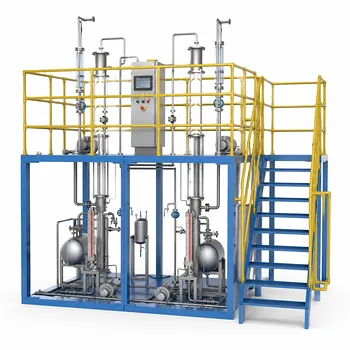
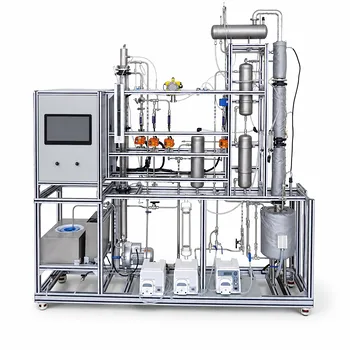
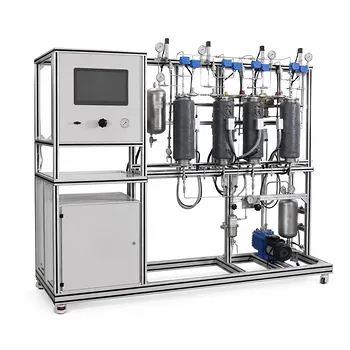
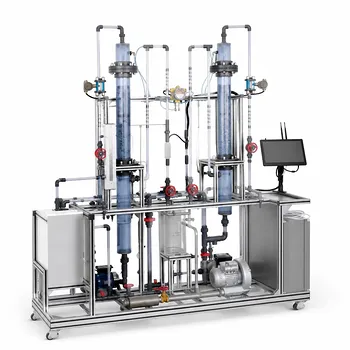
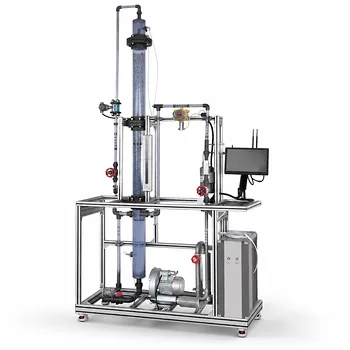
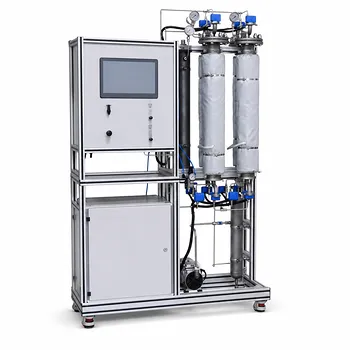
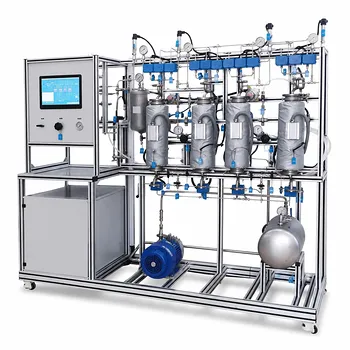
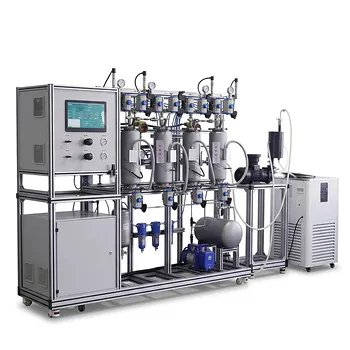
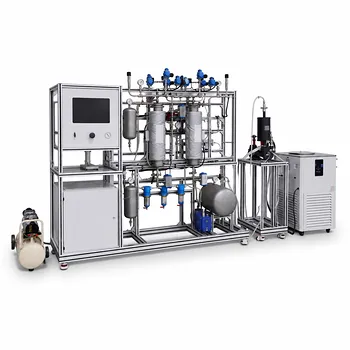
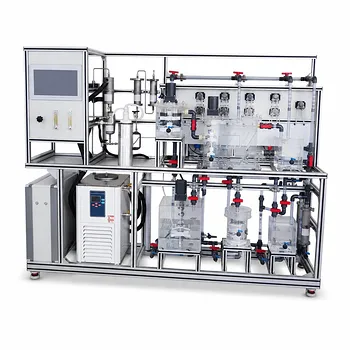
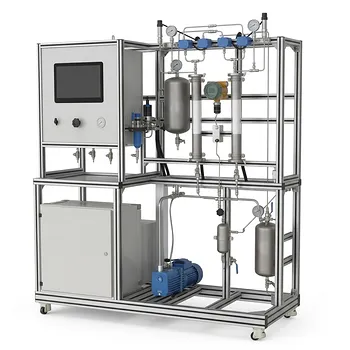
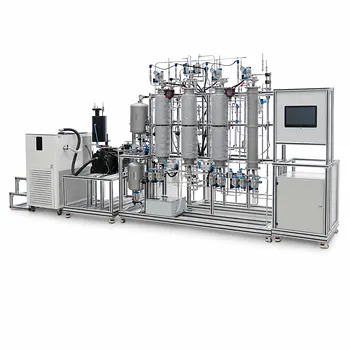
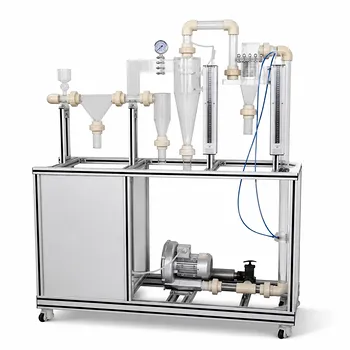
The most effective gas absorption pilot plant for teaching nitrogen dioxide chemistry is one that treats the system not merely as a scrubber, but as an integrated reaction-absorption reactor. The unit must make visible the interplay between the slow gas-phase oxidation of nitric oxide (NO) and the rapid liquid-phase absorption of nitrogen dioxide (NO₂) in water. Key design features therefore include a coolable, pressure-rated absorption column, a variable-residence-time gas phase upstream, and the ability to run in an extended absorption configuration using series columns or adjustable bed height. Together, these allow students to decouple the two rate processes and see how temperature, pressure, and contact time jointly control acid yield and emission levels.
To truly teach the mass transfer and chemical reaction dynamics of NO₂ absorption, the pilot plant must treat the process as a kinetically coupled gas–liquid system. The design must provide students with the tools to manipulate the rate-limiting step—the gas-phase oxidation of NO—while still enabling classical mass transfer measurements (HTU/NTU, flooding, holdup) inside the absorption column itself.
Why This Is a Special Teaching Challenge
Students often learn absorption and reaction separately; nitrogen dioxide absorption forces them to confront a system where the two are inseparable.
The Hidden Rate-Limiting Step
Unlike a simple physical absorption, this process involves NO oxidation in the gas phase before absorption can occur. At typical lab temperatures, this oxidation is slow, so the gas-phase residence time and temperature largely determine how much NO₂ is available to dissolve. If students cannot control and measure this pre-oxidation step, the absorption data becomes confusing—a low acid yield might look like poor mass transfer when it is really due to insufficient NO oxidation.
A Two-Phase Problem That Must Be Made Visible
The pilot plant must make the invisible visible. Students need to see not just the final liquid acid concentration, but also the evolving gas composition at key points along the flow path. Only then can they correctly attribute performance changes to reaction kinetics in the gas phase or to mass transfer limitations in the liquid phase.
Essential Design Features for an Educational Pilot Plant
These features collectively transform a simple absorber into a research-grade teaching tool for nitrogen dioxide–water systems.
A Column That Supports Both Physical and Chemical Absorption Studies
The core of the plant should be either a trayed column (e.g., sieve plate) or a packed column with interchangeable structured or random packings. This flexibility is fundamental: it lets students first run a non-reacting baseline (for instance, CO₂ in water) to learn how to measure Height of a Transfer Unit (HTU) and Number of Transfer Units (NTU) , then switch to the reactive NOₓ system to see how chemistry alters these parameters. Clear, easy-to-change packing also teaches design impacts on flooding limits, pressure drop, and liquid holdup—concepts that scale directly to industrial practice.
Active Temperature Control on the Gas Phase and Column
Low temperatures kinetically favor NO oxidation, so the plant must include a heat exchanger or cooling jacket on the gas inlet line and, ideally, a cooling system for the column itself. Being able to adjust the gas temperature from, say, 5 °C to 25 °C demonstrates a striking concept: physical cooling can dramatically improve absorption efficiency not by changing Henry’s law, but by speeding up the upstream reaction. This feature alone turns a confusing lab observation into a clear lesson on the Arrhenius effect controlling an absorber’s performance.
Pressure Adjustment Capability
Similarly, a back-pressure regulator or valve that allows the column to be operated at elevated pressures (modestly above atmospheric) shows the effect of pressure on NO oxidation rate (a termolecular reaction) and on solubility. Students can quantify how compression reduces the needed column volume, a direct link to industrial plant design economics.
Extended Absorption Configuration as a Modular Tool
The primary reference highlights extended absorption—either by increasing the active column height or by connecting a second column in series. This is a teaching superpower: by adding a second absorption stage, students can watch the diminishing return on NO₂ removal while simultaneously seeing how extra gas-phase residence time (in the interconnecting piping) further oxidizes NO. It turns a static apparatus into a configurable reactor network, making the point that emission compliance often depends on providing enough total gas residence time, not just more liquid contact.
Gas-Side and Liquid-Side Sampling With Multiple Measurement Points
To calculate mass transfer coefficients experimentally, the pilot plant must provide sampling ports at several axial positions along the column (at least top, middle, bottom) for both gas and liquid. Gas analyzers—chemiluminescence or electrochemical cells for NO and NO₂, plus an oxygen sensor—at the inlet and outlet are essential for the reaction side. For the liquid, simple titrations at each tap let students track the acid concentration profile, directly validating the mass transfer gradient. Without mid-column data, the only thing a student can say is “it worked” or “it didn’t”; with it, they can plot the operating line and film theories.
Materials of Construction That Prioritize Safety and Durability
Nitric acid and nitrogen oxides are corrosive, so all wetted parts—column body, packings, gaskets, and piping—must be made from borosilicate glass, PVDF, or 316L stainless steel. The pilot plant should also be enclosed or placed in a fume hood with a gas leak detection system. From a teaching standpoint, using corrosion-resistant materials isn’t just about safety; it’s a live lesson in industrial material selection, showing students why a simple carbon steel scrubber would fail rapidly in this service.
Instrumentation That Bridges Theory and Practice
Beyond the composition measurements, the plant needs high-quality rotameters for liquid and gas flow, differential pressure transmitters across the column (to study loading and flooding), and temperature sensors at multiple points. A programmable data acquisition system that logs all parameters—pressures, temperatures, concentrations—enables students to calculate instantaneous mass transfer rates and dimensionless numbers, moving beyond a single data-point lab to a true process dynamics investigation.
Understanding the Trade-offs in This Design
An education-focused pilot plant must balance teaching depth against cost, complexity, and safety.
Complexity vs. Clarity
The more configurable the plant, the more a student can learn—but also the more time it takes to set up each experiment. Including too many variable elements (six packing types, two columns, varying pressures) can overwhelm a novice unless the lab manual is carefully scaffolded. A wise compromise is to start students on one standard packed column with fixed packing, then introduce the series-column or variable-height options only in advanced courses.
Safety Considerations Limit Operational Envelope
Because NO₂ is toxic and the acid effluent corrosive, the plant’s ability to go to high pressures and temperatures may be limited in a teaching lab. Designers must include rupture discs, relief valves, and an emergency scrubbing system for any vent gas. This is a feature, not a bug: it forces students to confront process safety and inherently safer design decisions, which is a core engineering competency.
Instrumentation Cost vs. Data Density
A full array of online gas analyzers is expensive and requires frequent calibration. A balanced approach is to equip permanent inlet/outlet gas analyzers, but rely on manual liquid sampling points for concentration profiles. This splits the teaching between automated data collection (for kinetic studies) and classic wet chemistry (for a tactile understanding of the process).
Making the Right Choice for Your Teaching Goals
Your specific curriculum should dictate the plant’s features. Start by identifying your primary educational focus.
- If your primary focus is on classical mass transfer principles: Prioritize a packed column with interchangeable packings, robust pressure drop and holdup measurement, and the ability to run non-reactive CO₂ experiments first. Then add NO₂ absorption to show the difference between physical and chemical absorption.
- If your primary focus is on reaction engineering and chemical kinetics: Invest heavily in the cooling system, pressure control, and the extended absorption (series column) configuration. Emphasize gas-phase sampling and analysis to let students isolate the oxidation step.
- If your primary focus is on safety and industrial relevance: Ensure all materials are corrosion-resistant (borosilicate glass/PVDF), include an integrated effluent neutralization system, and design the plant to demonstrate inherently safer process configurations, such as low-temperature absorption versus high-pressure options.
- If your primary focus is a compact, multidisciplinary teaching platform: Build a single, well-instrumented column with variable bed height, basic gas analysis at the ends, and liquid sampling ports. This covers over 80% of the learning objectives without overwhelming complexity.
A thoughtfully designed nitrogen dioxide absorption pilot plant does more than demonstrate a unit operation—it gives students a miniature process development laboratory where they can explore the delicate dance between reaction and separation.
Summary Table:
| Key Design Feature | Educational Purpose & Student Learning Outcome |
|---|---|
| Active Temperature Control | Demonstrates how cooling accelerates gas-phase NO oxidation (Arrhenius effect). |
| Extended/Series Columns | Shows the impact of increased gas residence time on acid yield and emission levels. |
| Multi-Point Sampling Ports | Enables manual and online analysis to calculate local mass transfer coefficients (HTU/NTU). |
| Corrosion-Resistant Materials | Teaches industrial material selection (glass/PVDF/316L) for handling nitric acid. |
| Variable Pressure Control | Illustrates how compression enhances gas-phase reaction rates and solubility. |
Elevate Your Chemical Engineering Lab with LABPARK
Are you looking to provide students and researchers with hands-on experience in complex mass transfer and chemical reaction dynamics?
LABPARK provides state-of-the-art Educational and Vocational Unit Operations Pilot Plants in chemical engineering, bioprocess & biotech, and environmental & water treatment. Designed specifically for universities, research institutes, and enterprises, our pilot plants feature robust process controls, industrial-grade safety standards, and modular designs to bring theoretical kinetics to life.
Contact LABPARK today to discover how we can customize a unit operations pilot plant for your laboratory!
Related Products
- Carbon Dioxide Adsorption and Capture Educational Unit Operations Pilot Plant
- Dual-Mode Gas Absorption and Desorption Unit Operations Training Pilot Plant
- Carbon Dioxide Absorption and Desorption Educational Pilot Plant for Carbon Capture Studies
- Bench Scale Carbon Dioxide Capture Educational Unit Operations Pilot Plant
- Absorption and Desorption Educational Unit Operations Pilot Plant
People Also Ask
- How does operating pressure influence the transition between absorption and desorption in a CO2 pilot plant?
- How do physical vs chemical adsorption impact pilot plant design? Key operational & regeneration strategies.
- How is moisture removal managed in an adsorption unit operations pilot plant? Dew Point Control Guide
- What are the key differences between PSA and TSA? Choosing the Right Adsorption Pilot Plant
- What unit operations are critical for CCUS training pilot plants? Build hands-on engineering expertise.