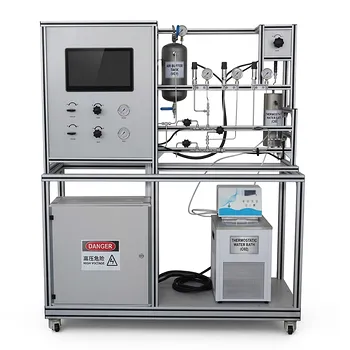
Dispersing hazardous gases safely isn't just about venting them outside; it's about engineering a complete pathway that neutralizes, contains, or dilutes the danger before it ever reaches the atmosphere. For chemical and environmental pilot plants, this means designing a discharge and exhaust system that considers the specific toxicity, corrosivity, flammability, and phase of the gas stream. The primary strategies involve routing toxic effluents through scrubbers, using knockout drums for liquids, ensuring adequate vent dispersion height, and preparing for emergency scenarios with purges and controlled shutdowns. The goal is a fail-safe system that protects personnel, equipment, and the environment across all predictable operating and upset conditions.
Designing a safe pilot plant exhaust system requires looking beyond the "what" - the specific gas being handled - to the "why" - the deep need to preserve equipment integrity and prevent a catastrophic release of hazardous energy or material. The core insight is that a discharge system is a dynamic safety chain, not a static pipe, and it must be tailored to mitigate the most severe potential hazard, whether that's toxicity, corrosivity, flammability, or biological contamination.
Building the Core Discharge Pathway
The fundamental architecture of any hazardous gas exhaust system begins with proper routing, separation, and treatment. These are the non-negotiable baseline requirements derived from the primary reference.
Routing to a Point of Safe Dispersion
The most basic and critical design decision is the location of the vent termination.
The stack must have sufficient height to guarantee safe atmospheric dispersion of the remaining effluent. This height is not arbitrary; it's calculated based on the gas's density, its potential toxicity or flammability, local building geometry, and prevailing wind patterns. The objective is to prevent the unburned or untreated gas cloud from reaching ground-level personnel, air intakes, or ignition sources at a concentration that could cause harm.
Integrating Scrubbers for Toxic and Corrosive Streams
For effluents like chlorine or hydrochloric acid, simple dispersion is not an option. The discharge system must become a chemical treatment loop.
The pilot plant design must integrate a scrubbing system, typically a caustic scrubber for acidic gases, to neutralize the hazard at its source. The contaminated gas stream is contacted with a neutralizing liquid, converting the hazardous agent into a stable, and ideally less volatile, salt solution. The treated, non-toxic carrier gas can then be safely vented. The choice of scrubber construction material—often PTFE or borosilicate glass—is just as critical as the chemical process, ensuring the equipment itself doesn't corrode and fail.
Managing Two-Phase Flow with Knockout Drums
Pilot processes often produce mixed-phase effluents—a gas stream carrying liquid droplets or a dense mist. This is a direct threat to both scrubber efficiency and downstream equipment like flares.
A knockout drum is an essential component in such a two-phase discharge system. It acts as a gravity separator, rapidly slowing the gas velocity within a vertical or horizontal vessel. This allows entrained liquid droplets to coalesce and fall out of the gas stream to a collection sump. The dried gas can then proceed safely to a scrubber or flare, while the separated liquid is retained for safe disposal, preventing liquid carryover that could extinguish a flare or cause a hazardous ground-level rainout.
Addressing Specific Chemical and Biological Hazards
While the core discharge pathway handles general scenarios, specific chemistries demand specialized upstream and downstream safety measures. These work with the exhaust system to create a complete safety envelope.
Countering Extreme Corrosion from Ammonium Carbamate
Processes forming intermediate solutions like ammonium carbamate present a unique and severe corrosion challenge. The exhaust system's physical integrity over time is the primary concern.
The design must begin with a metallurgical strategy. All wetted components in the unit—and by extension, the initial discharge piping—should be constructed from high-grade, corrosion-resistant stainless steel. The safety design goes further by enabling passivation: injecting a controlled, small amount of oxygen into the process feed to maintain a protective chromium oxide layer on the steel's surface. Additionally, a process choice to use stripping instead of liquid recycle minimizes the total volume and residence time of the corrosive solution, inherently reducing the risk of a leak in the first place.
Preventing Nickel Carbonyl Formation in Catalytic Systems
This is a classic hidden hazard. In processes with nickel catalysts and carbon monoxide, the discharge system must prevent the formation of an invisible, extremely toxic gas.
Nickel carbonyl (Ni(CO)4) forms below 430 K, creating a lethal, nearly odorless substance from the reaction of CO with the catalyst. The safety design focuses on thermal and atmospheric control during non-standard operations. The reactor and its connecting discharge lines must be rigorously purged with nitrogen during shutdown and cooling to inert the atmosphere, displacing CO before temperatures drop into the danger zone. During catalyst handling, similar inerting procedures are mandatory for discharge containers to prevent carbonyl formation and any risk of fire from pyrophoric coked catalyst.
Containing Biohazards in Exhaust Streams
Bioreactors handling microorganisms introduce an aerosol risk that chemical-only processes might not. The exhaust system must become a biological barrier.
The containment strategy focuses on high-efficiency particulate air (HEPA) filtration or thermal incineration of the entire exhaust stream. The discharge piping itself must maintain containment, often requiring hermetic valve seals or double mechanical shaft seals to prevent any fugitive emissions of contaminated liquid. The HEPA filter or incinerator acts as the final sterilizing step, neutralizing any biological agents before the gas is released, transforming the exhaust from a potential vector for contamination into a sterile effluent.
Understanding the Trade-offs in Safety System Design
An objective evaluation reveals that perfect safety is a moving target. Each design choice introduces its own set of compromises.
Active treatment systems like scrubbers add complexity. They require their own set of pumps, instruments, and chemical handling procedures, creating new potential failure modes that must be managed. A completely passive solution, like a tall, reinforced stack, is simpler but offers no chemical neutralization, simply diluting and relocating the hazard. Material selection is a trade-off between cost and performance. A high-grade alloy may resist corrosion perfectly but make the pilot plant economically unviable for a research setting. The art of the design is in matching the safety measure's intensity to the hazard's severity, without over-engineering the system into unreliability.
Another critical trade-off lies in emergency shutdown logic. The intuitive action—isolating everything by closing all valves—can be catastrophic. In a highly exothermic reaction, maintaining cooling flow is more critical than stopping the reactant feed. The exhaust system must be designed to handle the "safe state" of the process, which might mean directing a large volume of purge gas and unreacted vapors to a flare or quench vent during a controlled depressurization, a load that must be accounted for in the system's capacity from the start.
Making the Right Choice for Your Goal
Selecting the appropriate discharge system architecture depends on the specific "why" driving your pilot plant's safety case. Match your primary hazard to the core containment strategy.
- If your primary focus is handling acutely toxic, water-reactive gases: Invest in a robust, corrosion-resistant scrubbing system with redundant chemical injection, making the scrubber the heart of your discharge pathway.
- If your primary focus is preventing explosions from flammable mixtures: Your entire exhaust and reactor envelope must be centered on inerting. Design the system for seamless nitrogen purges, install flame arrestors on all vent tips, and ensure all components, including the exhaust blower, are explosion-proof.
- If your primary focus is managing high-temperature, two-phase effluents: The knockout drum is your absolutely critical first line of defense. Size it properly for the maximum credible liquid slug and route its discharge to a secure, often heated, collection system to prevent solidification or further hazard.
- If your primary focus is containing biological agents: Seal the boundary absolutely. Select hermetic seals for rotating equipment and design the exhaust to end at a validated HEPA filter housing or a dedicated thermal oxidizer, making sterility the key performance indicator.
A well-designed pilot plant exhaust system is a custom-tailored safety instrument, not a commodity. By basing your design on the most severe credible hazard and accounting for process upsets, you create a controllable environment where hazardous research can be conducted safely.
Summary Table:
| Hazard Type | Design Mitigation Strategy | Primary Component / Action |
|---|---|---|
| Toxic & Corrosive Gases | Chemical neutralization at source | Caustic scrubbers (PTFE / Borosilicate glass) |
| Two-Phase Flows (Gas/Liquid) | Gravity separation of liquid mists | Knockout drums with coalescing separation |
| Flammable Gas Mixtures | Preventing explosive conditions | Nitrogen purges & explosion-proof blowers |
| Biological Aerosols | Complete physical/thermal barriers | HEPA filtration & thermal incineration |
Build a Safer, Compliant Research Environment with LABPARK
Designing fail-safe discharge systems for hazardous gases requires specialized engineering expertise. LABPARK provides state-of-the-art Educational and Vocational Unit Operations Pilot Plants tailored for chemical engineering, bioprocess & biotech, and environmental & water treatment applications.
We assist universities, research institutes, and enterprises in setting up robust, safe, and highly efficient experimental systems that comply with strict safety standards.
Need to optimize your laboratory or pilot facility exhaust system? Contact LABPARK today to collaborate with our engineering team!
Related Products
- Thermal Desorption Exhaust Gas and Tail Water Treatment Educational Pilot Plant
- Methane Cracking Educational Unit Operations Pilot Plant
- Bench Scale Dual Column Gas Separation and Capture Educational Pilot Plant
- Pressure Swing Adsorption Educational Unit Operations Pilot Plant
- Gas-Solid Heterogeneous Separation Demonstration Educational Unit Operations Pilot Plant
People Also Ask
- How is P, M, and B alkalinity applied in pilot plants? Prevent Boiler Scaling & Corrosion
- What are inline fluorescence sensor risks, and how can they be managed? Key Strategies
- Lime-Soda vs. Cation Exchange Softening: How Do Effluent Characteristics Compare in Pilot Plants?
- How is iron concentration monitored to evaluate corrosion and filtration efficiency in water treatment pilot plants?
- How do anodic & cathodic inhibitors protect heat exchangers? Optimize Your Water Treatment Pilot Plant