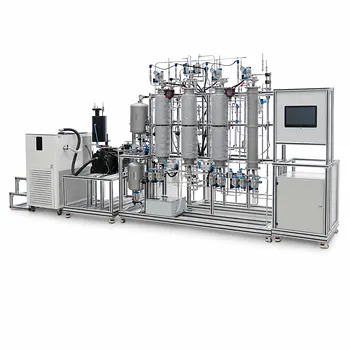
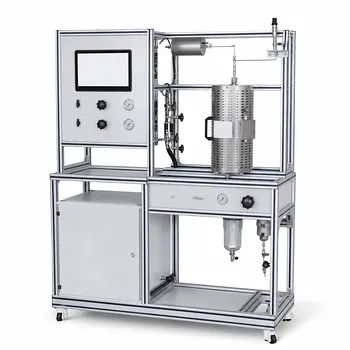
Multi-phase equilibrium in gasification gas cleanup isn't just about temperature and pressure—it's a complex dance where water, hydrocarbons, and reactive acid gases condense together, creating mist, liquid films, and solids that challenge both measurement and separation. In chemical engineering pilot plants, managing these systems means tackling simultaneous vapor-liquid-liquid-solid equilibria where mutual solubility, chemical reactions, and heat transfer are inextricably linked. The primary challenge is that classical thermodynamic models often fail to predict these polar, high-pressure mixtures, so pilot plants become the critical test bed to validate models and retrofit designs before industrial deployment.
The central difficulty is that condensation of water, hydrocarbons, H₂S, CO₂, and NH₃ produces a reactive, multi-phase fog—gas, aqueous liquid, organic liquid, and solid fines—all interacting in ways that defy simple correlations. Pilot plants address this by integrating in‑situ analytics, rapid quenching, countercurrent scrubbing designs, and deliberate trade‑offs between mechanical robustness and thermodynamic fidelity.
Why Multi‑Phase Equilibrium Is So Demanding in Gasification
The Four‑Phase Environment Emerges Early and Stubbornly
As raw syngas cools after gasification, its mix of steam, tars, light oils, and acid gases (H₂S, CO₂, NH₃) crosses dew points at different rates. Water condenses first, dissolving volatile weak electrolytes, while heavier hydrocarbons form a separate organic liquid phase, and fine char or ash particles stay suspended as a solid fourth phase. This isn’t a clean cascade—it’s a simultaneous, coupled process where the presence of one liquid layer alters the solubility and reaction equilibrium in the other, and the solids act as nucleation sites that change mass transfer resistance.
Reaction‑Equilibrium Coupling Disguises the True Picture
In the condensed aqueous phase, H₂S and CO₂ dissociate as weak acids while NH₃ acts as a weak base, so the liquid chemistry shifts the vapor‑liquid equilibrium (VLE) of each species retroactively. The classic Henry’s law approach fails because ion speciation and pH changes feed back into the partial pressures of the acid gases. Pilot plants reveal this coupling by measuring liquid‑phase pH, dissolved ions, and gas‑phase composition side by side, allowing researchers to build electrolyte‑thermodynamic models that predict when, say, ammonium bisulfide will form or when H₂S will be re‑stripped from the condensate.
Mutual Solubility of Water and Organic Liquids Defies Simple Decks
The organic phase (tars, light aromatics) and the aqueous phase are not truly immiscible. A measurable fraction of water dissolves in the oil, and polar oxygenated compounds partition into the water, altering densities, interfacial tension, and the overall phase envelope. In a pilot plant, decanters and sight glasses often show emulsion bands or unexpectedly thin phase splits, which directly inform the design of industrial three‑phase separators and liquid‑liquid extraction steps.
How Pilot Plants Tackle the Measurement Nightmare
In‑Situ and Rapid‑Quench Sampling Preserve Equilibrium State
Extracting a sample from a hot, pressurized, multi‑phase stream will shift its equilibrium the moment it cools. To capture the true high‑temperature composition, pilot plants use in‑situ spectroscopic probes (like Raman or near‑IR) or employ a rapid quench—an immediate cold‑water spray that freezes the composition by cooling the sample faster than reaction kinetics can re‑equilibrate. Students learn that a simple hot tap can give misleading data, while a properly designed quench probe yields the numbers needed to validate the thermodynamic model.
Countercurrent Condensation‑with‑Washing Keeps Equipment Clean
Condensing tars and heavy oils foul heat‑exchanger tubes rapidly, blocking flow and altering the thermal profile that governs the phase distribution. A common pilot‑plant fix is a venturi quench followed by a vertical countercurrent heat exchanger: the condensing liquid film flows downward, washing the tube walls continuously, while the gas flows upward, never letting a stagnant tar layer form. This arrangement demonstrates the trade‑off between maximum heat recovery and mechanical reliability—students can vary the quench water rate to see how condensate composition, steam generation, and fouling severity co‑vary.
Decoupling Carbon Fines from Liquid Phases to Avoid Modeling Chaos
Fluidized‑bed gasifiers produce fine char particles that behave as a fourth solid phase in downstream quench systems. These fines can adhere to cyclone walls, emulsify in the liquid phases, or carry into the scrubber, making it nearly impossible to isolate the true gas‑liquid equilibrium. Pilot plants combat this by staged separation: a hot cyclone first removes the bulk of solids; a second, cooled unit capture finer dust before the main condensation step. Researchers then manipulate fluidization velocity to control the particle size distribution, observing how solid loading influences the apparent VLE.
Understanding the Trade‑offs
Analytical Accuracy vs. Operating Simplicity
The most accurate way to measure multi‑phase equilibrium is to use multiple in‑situ instruments on every stream, but this complicates the pilot plant and makes it harder for students to grasp basic unit operation principles. In education‑focused pilot plants, the design often sacrifices some online analytics in favor of clear, observable phase separation stages, allowing users to build intuition before layering on the instrumentation complexity.
Thermodynamic Model Scope vs. Reaction Reality
A full electrolyte model that captures all ion species is computationally heavy and needs extensive calibration. Pilot‑plant studies must decide whether to invest in the detailed model (suited for optimizing a production plant) or to rely on a simplified pseudo‑component approach (suited for screening process configurations). The plant’s sensor suite and the data‑acquisition system are then tailored accordingly.
Waste Minimization vs. Steady‑State Duration
Running a multi‑phase equilibrium pilot plant long enough to reach steady state can generate large volumes of contaminated water and hydrocarbon waste. Facilities often implement closed‑loop scrubbing or recycle loops, which themselves introduce compositional drift and slow approach to equilibrium, forcing operators to choose between environmental compliance and data quality.
Making the Right Choice for Your Pilot Plant Goal
- If your primary focus is fundamental thermodynamic model development: Invest in multiple in‑situ spectroscopies, rapid‑quench probes, and full analytical support. Accept the higher complexity to capture the electrolyte‑reaction coupling data needed to regress activity‑coefficient parameters.
- If your primary focus is process design for a specific syngas composition: Build a countercurrent wash‑column pilot with the exact quench‑fluid that will be used industrially. Measure gross phase splits and fouling tendencies rather than every trace species, and use the data to size heat exchangers and separators.
- If your primary focus is operator training and education: Design a transparent, glass‑lined condenser‑decanter‑scrubber train where students can see each phase form. Simplify analytics to gas chromatography and titrations, and emphasize the cause‑and‑effect between cooling rate, phase stability, and liquid‑liquid separation quality.
Armed with these strategies, a well‑designed pilot plant turns the chaotic behavior of condensing syngas into a repeatable laboratory that bridges the gap between textbook thermodynamics and the messy reality of industrial gas cleanup.
Summary Table:
| Key Challenge | System Impact | Pilot Plant Solution |
|---|---|---|
| 4-Phase Condensation | Liquid/solid mixtures alter solubility & mass transfer | Staged separation & venturi quench systems |
| Reaction-Equilibrium Coupling | pH & electrolyte chemistry shift acid gas VLE | In-situ spectroscopic probes & rapid-quench sampling |
| Mutual Organic-Water Solubility | Emulsion bands & altered interfacial tension | Clear phase-separation stages & decanters |
Accelerate Your Research and Training with LABPARK
Overcoming complex multi-phase thermodynamic challenges requires robust, high-fidelity equipment. LABPARK provides state-of-the-art Educational and Vocational Unit Operations Pilot Plants in chemical engineering, bioprocess & biotech, and environmental & water treatment.
We help universities, research institutes, and enterprises:
- Validate complex thermodynamic models with precise in-situ instrumentation.
- Train students and operators using transparent, highly visual, and safe process designs.
- Scale up chemical processes with reliable, industrial-grade components.
Ready to design a pilot plant that meets your exact research and educational needs? Contact LABPARK today to consult with our engineering experts!
Related Products
- Fixed-Bed Chemical Reaction and Gas Dust Tar Removal Unit Operations Pilot Plant
- Dual-Mode Gas Absorption and Desorption Unit Operations Training Pilot Plant
- Micro-Scale Gas-Solid Catalytic Reaction Educational Pilot Plant
- Fixed Bed Gas Solid Catalytic Reaction Educational Pilot Plant
- Fluidized Bed Gas Solid Catalytic Reaction Educational Pilot Plant
People Also Ask
- When to transition from PID to adaptive control in pilot plants? Key process indicators.
- How do deviations in estimating latent heat impact pilot plant thermal systems? Avoid hardware mis-sizing.
- Why Compare Predicted and Experimental Excess Enthalpy? Key to Accurate Pilot Plant Scale-up
- Why Use PTFE & Hastelloy in Chemical Pilot Plants? Prevent Corrosion & Ensure Safety
- How to study gasification in pilot plants? Compare exit gas composition & efficiency