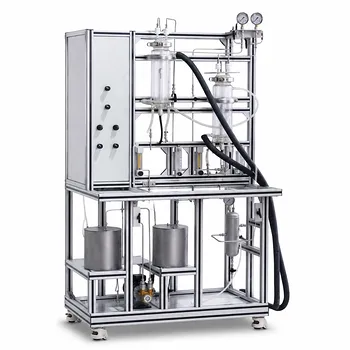
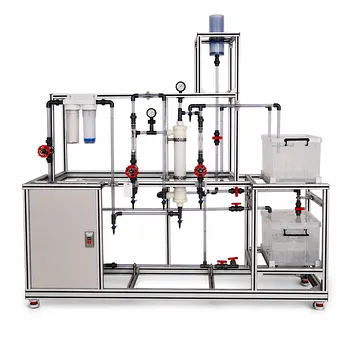
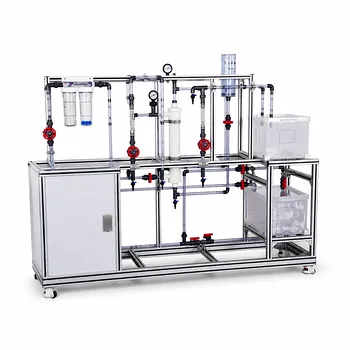
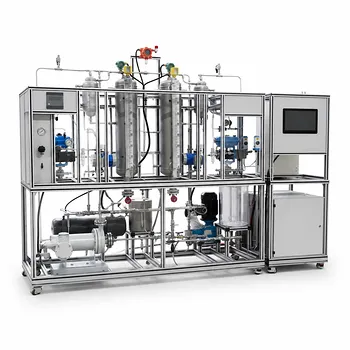
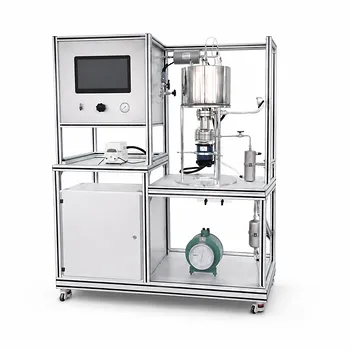
A membrane reactor (MR) pilot plant’s biggest advantage is that it merges hydrogen production and purification into a single, footprint-slashing unit. Instead of the sprawling, sequential setup of a conventional reformer—requiring a reformer, water-gas shift reactors, and a pressure swing adsorption (PSA) system—an MR does the same job in one vessel. This integration delivers three immediate operational wins: a drastically smaller physical plant, continuous equilibrium-driven yield enhancement, and inherently high-purity hydrogen output at the pilot scale.
A membrane reactor pilot plant fundamentally solves the core challenge of pilot-scale hydrogen production by fusing reaction and separation. This intensification eliminates entire unit operations, driving higher yields and purity from a dramatically simpler, more flexible platform than any multi-unit reformer system.
The Integration Advantage: Why One Step Beats Three
A conventional hydrogen production line is a logistics chain. You first generate syngas in a steam methane reformer (SMR), then shift CO to CO₂ in one or two water-gas shift (WGS) reactors, and finally separate the hydrogen using PSA. Each step requires its own vessel, piping, instrumentation, and control loops.
A membrane reactor collapses this chain. The reforming catalyst and a hydrogen-selective membrane (usually palladium-based) coexist within the same housing. As soon as hydrogen molecules form, they permeate through the membrane and are continuously withdrawn. This architectural simplification directly creates the benefits detailed below.
A Compact Footprint and Reduced Capital Complexity
The most immediate, tangible advantage is the elimination of physical hardware. A single MR replaces what was a train of large, interconnected vessels, compressors, and valves.
This directly reduces the pilot plant’s footprint on the laboratory floor or skid. For a research or educational setting, that compactness translates to lower installation costs, simpler permitting, and easier relocation. It also means fewer potential leak points, instruments to calibrate, and process streams to manage—making the system inherently more robust for non-operator-intensive pilot studies.
Continuous Equilibrium Shift for Higher Yields
This is the process-intensification heart of the design. The SMR reaction (CH₄ + H₂O ⇌ CO + 3H₂) and the WGS reaction (CO + H₂O ⇌ CO₂ + H₂) are both equilibrium-limited.
In a conventional multi-unit setup, you push the equilibrium forward by adding excess steam or by removing heat between reactor stages. An MR takes a fundamentally more powerful approach: it removes one of the products—hydrogen—from the reaction zone in real time. By Le Chatelier's principle, the system responds by producing more hydrogen to restore equilibrium. This continuous product removal drives conversion well past the point where a conventional reactor would stall, resulting in significantly higher single-pass yields at a compact scale.
Inherent Hydrogen Purity Right at the Source
A conventional PSA unit is a complex, multi-bed system that swings pressure to adsorb impurities off the hydrogen stream. It works, but it's a separate, capital-intensive process step.
A palladium membrane is infinitely selective for hydrogen. The gas that permeates through it is protonic hydrogen, and it does so with effectively absolute selectivity against other molecules like CO, CO₂, and CH₄. Therefore, the hydrogen produced by an MR pilot plant is inherently ultra-pure. No downstream purification train is needed; the product stream is ready for direct use in fuel cells, chemical synthesis, or other contamination-sensitive research applications.
Reduced Byproduct Formation Through Kinetic Control
The MR concept isn't limited to just removing products; it can also control reactant feed. Modern pilot MR designs can use a membrane to meter a reactant like oxygen along the length of the reactor.
By keeping the local partial pressure of oxygen low and uniform, this technique throttles down unwanted parallel combustion or over-oxidation reactions. The result is a dramatic improvement in selectivity for the desired product. In oxidative dehydrogenation studies, for instance, an MR pilot plant can demonstrate product yields up to three times higher than a conventional co-feed plug flow reactor under identical conditions.
Understanding the Trade-offs
The advantages are significant, but they are not without cost. A trustworthy technical assessment requires acknowledging the limitations that define where and when an MR pilot plant is the right tool.
The Membrane Stability and Cost Barrier
The heart of the MR, the palladium-based membrane, is an expensive and delicate component. It is susceptible to poisoning by sulfur compounds and embrittlement from temperature cycling in a hydrogen atmosphere. This demands extremely rigorous gas pretreatment that a conventional multi-unit system may tolerate without complaint. The membrane itself represents a non-trivial replacement cost.
A Narrower, More Focused Operating Window
A conventional SMR can run at high pressures and temperatures (850°C+) that would damage a PGM membrane. MRs often require careful pressure and temperature balancing to maximize flux without compromising membrane integrity. The process control challenge is more acute because the reaction and separation are thermally and hydraulically coupled. You can't independently tune the reformer and separator; you must manage them as one unified system, which can sacrifice operational flexibility.
Comparing to High-Performance Alternatives: The Microchannel Reactor Insight
It's also important to analyze the limitations of the classic "multi-unit" reference. For highly endothermic reforming, conventional tubular reactor bundles suffer from poor heat transfer. Supplementary data shows that a microchannel reactor—another intensification technology—can achieve a heat transfer area over ten times larger than a tubular reformer of the same volume. This translates to a 4.7X higher allowable heat duty and a massive jump in hydrogen production rate per unit volume. An MR solves the equilibrium problem but may not solve the heat transfer problem with the same brute force as a microchannel architecture. This highlights that the MR's primary win is process simplification via integration, not necessarily raw thermal efficiency, and the ideal future pilot plant might combine the two concepts.
Making the Right Choice for Your Pilot Plant Goal
The decision between a membrane reactor and a conventional multi-unit reformer turns entirely on what you are trying to learn or demonstrate. Your specific pilot plant objective will dictate which architecture delivers the most value.
- If your primary focus is teaching process intensification and demonstrating integrated unit operations: The membrane reactor pilot plant is the clear winner. It physically collapses a multi-step process into one observable, controllable unit, making the thermodynamic and kinetic principles of equilibrium displacement tangible for students.
- If your primary focus is simulating a mature industrial plant and studying the independent optimization of each unit operation: A conventional multi-unit system is essential. It allows you to decouple reformer temperature, shift kinetics, and PSA cycle times, providing the flexibility to mimic a real-world industrial control strategy.
- If your primary focus is R&D for green hydrogen or direct fuel-cell-grade production: The MR pilot plant's ability to deliver inherently pure, low-CO hydrogen from a compact source aligns perfectly with the needs of fuel cell system integration and advanced catalyst research.
The membrane reactor pilot plant isn't a universal replacement for the multi-unit reformer; it's a purpose-built tool that brilliantly solves the specific problem of producing pure hydrogen from a single, efficient platform.
Summary Table:
| Feature | Membrane Reactor (MR) Pilot Plant | Conventional Multi-Unit Reformer |
|---|---|---|
| System Integration | Single-unit (combined reaction & separation) | Multi-unit train (reformer, WGS, and PSA) |
| Physical Footprint | Compact, minimal piping, lower installation cost | Large, sprawling layout with complex piping |
| Hydrogen Purity | Inherently ultra-pure via selective Pd-membrane | Requires downstream PSA purification |
| Reaction Yield | Higher conversion via continuous equilibrium shift | Limited by standard thermodynamic equilibrium |
| Operational Control | Integrated (reaction/separation are coupled) | Decoupled (each unit operation tuned individually) |
Bring Next-Generation Process Intensification to Your Lab
At LABPARK, we help universities, research institutes, and enterprises bridge the gap between theory and industrial reality. We provide state-of-the-art Educational and Vocational Unit Operations Pilot Plants across chemical engineering, bioprocess & biotech, and environmental & water treatment.
Whether you need to demonstrate advanced equilibrium-shifting technologies or train the next generation of engineers, our pilot plants deliver the reliability, safety, and precision your research demands.
Contact LABPARK today to discuss your project requirements and receive a detailed technical proposal.
Related Products
- Photocatalytic Membrane Separation and Degradation Unit Operations Pilot Plant
- Ultrafiltration Membrane Separation Educational Pilot Plant
- Multi Functional Membrane Crystallization Educational Unit Operations Pilot Plant
- Multifunctional Membrane Separation Educational Pilot Plant with Ultrafiltration, Nanofiltration, Reverse Osmosis
- Hollow Fiber Ultrafiltration Membrane Separation Educational Pilot Plant
People Also Ask
- What are the key differences in membrane configurations? Choose the Right Unit Operations Pilot Plant
- How Do Pervaporation, Vapor, and Gas Permeation Differ in Pilot Plants? Key Comparison
- What are the structural & performance trade-offs of flat-sheet, spiral-wound, & hollow-fiber membrane modules?
- How do PEI, PVDF, and PSU membranes compare in pilot plants? Find the best fit.
- Pervaporation vs. Vapor Permeation: Handling Suspended Solids in Membrane Pilot Plants