The two primary approaches to reactor dimensioning are the modeling approach and the experimental approach, and the modeling method begins with two deliberate initial steps.
First, you select trial values for the reactor’s geometric dimensions and key operating parameters—pressure, temperature, feed stream characteristics—to create a starting point. Second, you independently calculate or measure the process‑specific physical and kinetic data (reaction rates, transport properties) that will feed the iterative design calculations. These steps are not arbitrary; they launch the rigorous cycle of material, energy, and momentum balances that ultimately sizes the reactor.
Reactor dimensioning can follow a computational or an experimental route. The modeling route starts with a set of educated guesses for size and operating conditions, followed by the precise determination of the system’s kinetic and physical parameters. This two‑step foundation enables the iterative solution of balance equations that deliver a final, scale‑ready design.
The Two Foundational Approaches to Reactor Dimensioning
Every reactor design project must answer a single question: “How large must this vessel be to achieve the required conversion?” In practice, engineers rely on two distinct philosophies to get that answer.
The Experimental Approach: Direct Scale‑Up from Data
The experimental path relies on physical pilot‑plant or lab‑scale data.
You run the reaction at a smaller scale, measure performance, and apply empirical scale‑up rules—often based on geometric similarity, constant power per volume, or identical residence time.
This method is intuitive but can be costly and time‑consuming, especially when exploring many design variations.
The Modeling Approach: Computationally Driven Dimensioning
The modeling approach replaces physical iteration with mathematical iteration.
You build a set of equations—material balances, equilibrium relations, enthalpy balances—that describe how the reacting system behaves.
By solving these equations under different geometric and operating inputs, you directly compute the size that meets the performance target, without building multiple prototypes.
The modeling route is especially powerful when kinetic and physical data are well understood, allowing rapid exploration of a wide design space.
The Modeling Approach: The First Critical Steps
Even the most sophisticated reactor model is useless without a starting point. The initial steps in the modeling approach are not trivial; they define the design space you will ultimately converge within.
Step 1: Proposing Initial Trial Values for Geometry and Operation
You begin by selecting trial values for the reactor’s geometric dimensions—diameter, length, catalyst bed height, or plate count—and its key operating parameters.
Operating parameters include temperature, pressure, feed rates, and inlet stream compositions.
These numbers are not expected to be final; they are the “first guess” that initializes the iterative solver.
Why trial values are necessary
Reactor design calculations are highly nonlinear and often require iterative numerical solutions.
Without a reasonable starting point, the solver may fail to converge or find a physically meaningless solution.
Trial values come from heuristics, analogous processes, or quick back‑of‑the‑envelope calculations.
What defines a good trial value set
A workable starting point respects realistic constraints—material limits, known reaction thresholds, and achievable flow regimes.
For example, a trial temperature that instantly decomposes the catalyst is obviously unsuitable.
The goal is to place the initial iterate inside the basin of convergence, not to guess the final answer.
Step 2: Acquiring Process‑Specific Physical and Kinetic Data
Once trial geometry and operating conditions are set, you must gather the process‑specific parameters that give the model its predictive power.
These parameters are generally determined independently, through laboratory experiments or reliable correlations, and are not adjustable during the reactor sizing itself.
Kinetic data: the heart of reaction engineering
The rate expression—how fast the key reactions proceed as functions of temperature, pressure, and composition—is the single most influential input.
It is typically obtained from laboratory kinetic experiments, fitted to a rate law, and converted to intrinsic kinetic constants free of transport disguises.
Without accurate kinetics, the model becomes a curve‑fitting exercise with no predictive value.
Physical and transport properties
Equally critical are the physical properties: heat capacities, densities, viscosities, thermal conductivities, and phase‑equilibrium constants.
These feed directly into the energy and momentum balances and influence the calculated pressure drop, heat transfer area, and residence time distribution.
While often found in databases, some must be measured for the specific feed and reaction mixture at process conditions.
Kinetic and physical data enable stagewise nonisothermal models
With trial dimensions, operating parameters, and process‑specific data in hand, you can build the stagewise nonisothermal model equations.
These equations couple material balances, equilibrium relationships (if needed), and enthalpy balances across individual elements or stages of the reactor.
Iterative solution then reveals the self‑adjusting parameters—like hydrodynamics and mass transfer rates—that finalize the reactor’s internal configuration and true size.
Common Pitfalls and Trade‑offs in Modeling
No modeling approach is without risk. Recognizing the trade‑offs early preserves both time and credibility.
The Accuracy–Risk Trade‑off in Trial Value Selection
Conservative trial values (large dimensions, mild temperatures) lead to overdesigned, costly reactors.
Aggressive trial values may cause the solver to diverge or converge to an unsafe operating point.
The only defense is to run multiple case studies and check convergence trajectories, not just final results.
Garbage In, Garbage Out: The Danger of Poor Kinetic Data
If the rate expression is fitted from noisy or transport‑limited data, the entire model will propagate those errors.
A common trap is using apparent kinetics from a different catalyst shape or size without discounting for mass‑transfer limitations.
Always validate kinetic data in a region that matches the anticipated operating window.
The Hidden Complexity of Iterative Convergence
The “initial steps” are simple in description, but the subsequent iteration can be computationally demanding.
Convergence problems can arise from strong exotherms, phase changes, or large recirculation ratios.
In such cases, an experimental pilot‑plant approach may actually be faster, even if it seems less elegant.
Making the Right Choice for Your Project
Your path forward depends on your starting resources and what you need to prove.
- If you have complete, high‑quality kinetic data and are exploring multiple reactor configurations: Lean into the modeling approach. The initial trial values and parameter acquisition steps will accelerate your design cycle and allow you to evaluate dozens of geometries with minimal physical testing.
- If your primary focus is a single well‑defined scale‑up of a known chemistry: A hybrid strategy works best. Use modeling to set the boundary conditions, then verify the final dimensions with targeted pilot‑plant experiments to catch unforeseen transport effects.
- If kinetic data are scarce or the reaction network is poorly understood: The experimental approach may be unavoidable. Begin with a flexible pilot plant to generate rate data, then feed those measurements back into a modeling workflow for the commercial design.
- If you are an educator or researcher demonstrating reactor modeling principles: Start students with simplified mass‑balance or statistical polymerization models that require only basic trial values and easily obtained kinetic constants—this builds intuition before introducing full nonisothermal iteration.
The initial steps of the modeling approach are deceptively simple but lay the foundation for every downstream calculation. Choose your trial values with care, invest in reliable kinetic and physical data, and you transform reactor dimensioning from a guessing game into a disciplined engineering prediction.
Summary Table:
| Approach | Key Characteristics | Initial Steps / Requirements | Best Suited For |
|---|---|---|---|
| Experimental | Direct scale-up from lab/pilot data | Small-scale reaction runs & empirical rules | Scarce kinetic data; single scale-ups |
| Modeling | Iterative mathematical balance equations | 1. Propose trial geometry/operating parameters 2. Gather kinetic & physical data |
Well-understood kinetics; exploring multiple designs |
Optimize Your Chemical Engineering Lab with LABPARK
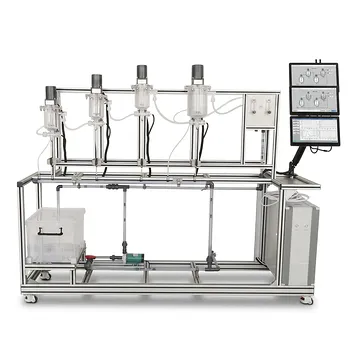
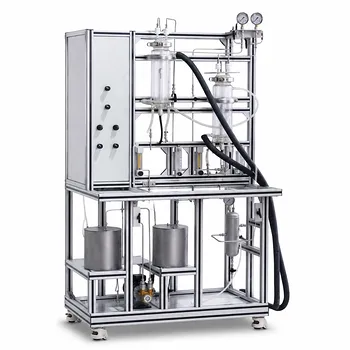
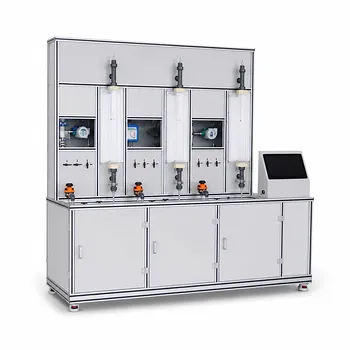
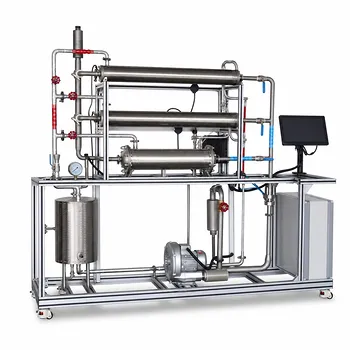
Bridging the gap between reactor modeling theory and physical validation requires robust equipment. LABPARK offers premium Educational and Vocational Unit Operations Pilot Plants in chemical engineering, bioprocess & biotech, and environmental & water treatment.
Designed specifically for universities, research institutes, and enterprises, our pilot plants empower your students and researchers to master reactor dimensioning, mass balances, and scale-up kinetics in a controlled, real-world environment.
Ready to elevate your engineering training and research capabilities? Contact LABPARK today to find the perfect pilot plant solution for your institution!
Related Products
- Multi Functional Catalytic Reaction and Reactor Evaluation Educational Unit Operations Pilot Plant
- Residence Time Distribution and Reactor Flow Characteristics Determination Educational Pilot Plant
- 100L Continuous Loop Hydrogenation Educational Unit Operations Pilot Plant
- Tubular Reactor Flow Characteristics Determination Educational Unit Operations Pilot Plant
- Multi-Stage Stirred Tanks in Series Residence Time Distribution and Mixing Performance Determination Educational Pilot Plant
People Also Ask
- What reaction engineering principles are shown in a catalytic reactor pilot plant? SO2 Oxidation Guide
- Why is FTIR integration in catalytic pilot plants important? Real-Time Student Insights
- How to analyze active metal distribution & identify catalyst poisoning in pilot plants? Expert Diagnostic Guide
- How do temperature limits and WHSV influence catalytic reactor optimization? Scale-Up Guide
- What operational insights do catalyst pellet concentration profiles provide? Optimize Reactor Yield