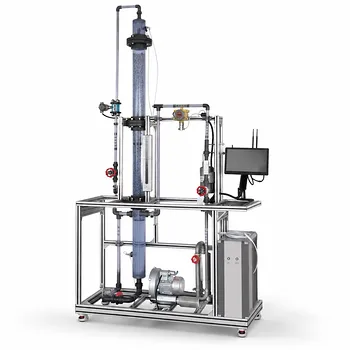
The core advantage of using a three-phase fluidized bed reactor in a biotechnology pilot plant lies in its ability to protect shear-sensitive cultures while preventing operational issues like clogging. The gentle, upward fluid flow suspends cell-immobilized solid particles with minimal mechanical stress, and a built-in liquid recirculation loop can increase fluid velocity to maintain mass transfer without pushing shear forces beyond the cells’ tolerance.
Process development for shear-sensitive cells forces a painful trade-off between delivering oxygen and nutrients (mass transfer) and avoiding physical damage (shear stress). A three-phase fluidized bed pilot plant resolves this by separating the mixing force from the immobilization strategy—using buoyant fluidization, not harsh impellers, to suspend the culture, while granting you independent control over fluid velocity to keep transfer rates high.
Why Shear Protection Is the Linchpin of Pilot Plant Success
The Cost of Shear Damage in Scale-Up Work
Animal and plant cells lack a rigid cell wall. Even moderate agitation can rupture membranes, trigger apoptosis, or strip critical surface proteins. In a pilot plant, where you are running long-duration batches to collect scale-up data, shear-induced damage creates two nightmares: irreproducible results and sudden culture collapse. Reproducibility is everything; a reactor that keeps cells intact from inoculation to harvest gives you trustworthy kinetic and productivity numbers.
How Three-Phase Fluidization Rewrites the Shear Equation
In a stirred-tank reactor, impeller tips generate high local shear gradients. A fluidized bed eliminates the impeller entirely. Gas and liquid flow vertically through a bed of particles on which cells are immobilized. The particles gently levitate and swirl in a well-mixed, low-shear environment. For pilot-plant teams working with primary tissue cultures or sensitive stem cells, this is a game-changer: you get the mixing needed for temperature and pH uniformity without the “kill zone” around a rotating blade.
Solving the Clogging Puzzle and Enhancing Flow Uniformity
Why Fixed-Beds Fail in Extended Bioprocess Runs
Fixed-bed or trickle-bed reactors pack cells in a static matrix. Over days or weeks, biomass accumulation, cell debris, and extracellular matrix components steadily plug the void spaces. Channeling and dead zones emerge, starving sections of the bed and skewing every process measurement. In a pilot plant, where each run costs time and consumables, a clogged bed often means an early, useless termination.
The Anti-Clogging Nature of a Fluidized Bed
Because the support particles are in constant motion, a three-phase fluidized bed essentially self-cleans. The fluidization velocity keeps particles from sticking together or accumulating deposits. Even if some biomass builds up on a carrier, the gentle collisions between particles slough off loosely bound material, preventing blockages. For pilot operations targeting long perfusion cultures or continuous processes, this mechanical robustness cuts downtime dramatically.
Tailoring Fluid Velocity to Outmaneuver the Mass Transfer Limit
The Hidden Danger of “Too Gentle” Operation
Protecting cells is not enough; you must also supply them with dissolved oxygen and remove carbon dioxide and waste. In a purely buoyancy-driven bed, the fluid velocity required to lift the particles might be insufficient to meet the oxygen uptake rate of high-density cultures. A naïve low-flow operation leads to hypoxia and a worthless run.
Liquid Recirculation as a Controllable Lifeline
Three-phase fluidized bed pilot systems are deliberately designed to incorporate a liquid recirculation loop. This lets you decouple the superficial velocity needed for fluidization from the total liquid throughput responsible for mass transfer. You pump liquid at a higher rate through an external loop and return it to the column, increasing the net convective delivery of nutrients while keeping the upflow velocity inside the bed within the cells’ shear tolerance. For pilot-plant process development, this gives you a precise, measurable knob to balance the competing demands of mass transfer and mechanical protection.
Understanding the Trade-offs
Attrition of the Solid Support Material
Constant particle motion does cause friction. Over many days, the immobilized carrier beads or matrices can slowly erode, releasing fine particles into the liquid stream. While this is rarely catastrophic for the cells themselves (the fines can be filtered out), it changes bed inventory and requires monitoring. In a pilot setting, you compensate by choosing mechanically tough carriers (e.g., porous glass, durable polymers) and scheduling periodic top-ups if the run is exceptionally long.
Backmixing and Reactor Productivity
Fluidized beds are inherently backmixed; the residence time distribution of the liquid phase is broad. For a bioprocess with product inhibition or a delicate metabolic cascade, this dilution effect can reduce per-cell productivity compared to a plug-flow fixed bed. However, for shear-sensitive cells where viability trumps pure plug-flow kinetics, the trade is usually favorable. Pilot-plant studies often deliberately exploit this backmixing to demonstrate the reactor’s robustness under varying feed conditions.
Gas Bypassing and Bubble-Induced Shear
In the three-phase (gas-liquid-solid) mode, gas bubbles can coalesce into larger pockets that rise faster and bypass the bed. More critically, the bursting of bubbles at the liquid surface can generate high local shear. Skilled pilot-plant design mitigates this with fine gas spargers and a suitable head space, but the phenomenon must be accounted for. When training operators or planning protocols, you explicitly teach that bubble management is just as important as liquid flow control.
Making the Right Choice for Your Pilot Plant Goal
Your decision to incorporate a three-phase fluidized bed reactor should be driven by the biological system and the data you need to generate. Use the following guideposts to align the hardware with your objectives:
- If your primary focus is maintaining high viability in highly shear-sensitive mammalian or insect cells: Prioritize the fluidized bed. The gentle fluidization and immobilization strategy give you the longest, most stable cultures without genetic drift or membrane damage.
- If your primary focus is mapping mass transfer–shear trade-offs for a scale-up filing: Select a pilot reactor with an independent liquid recirculation loop. This setup yields clean experimental data on how increasing oxygen transfer impacts cell health, which is exactly what regulatory reviewers want to see.
- If your primary focus is running continuous, clog-free perfusion processes: The self-cleaning motion of the fluidized bed makes it superior to fixed-bed alternatives. You can maintain a constant biomass inventory and harvest product for weeks without manual intervention.
- If your primary focus is training operators on advanced bioreactor hydrodynamics: The transparent column of a pilot-scale fluidized bed, combined with tracer and dissolved-oxygen probes, makes flow patterns, mixing time, and mass transfer coefficients visible and measurable in a way that opaque stirred tanks cannot match.
In the universe of pilot-scale bioprocessing, the three-phase fluidized bed is not just a reactor—it is an experimental platform that gives you the power to handle the most fragile cells while maintaining the mass transfer rigor demanded by real-world process development.
Summary Table:
| Key Feature | How it Works | Primary Benefit |
|---|---|---|
| Low-Shear Mixing | Gentle fluidization replaces mechanical impellers | Protects fragile animal, plant, and stem cells |
| Anti-Clogging Design | Constant particle motion prevents biomass accumulation | Minimizes downtime in long-run perfusion cultures |
| Recirculation Loop | Decouples mass transfer from fluidization velocity | Maximizes oxygen delivery without cellular damage |
Accelerate your process scale-up and hands-on learning with LABPARK. We provide advanced Educational and Vocational Unit Operations Pilot Plants in chemical engineering, bioprocess & biotech, and environmental & water treatment tailored for universities, research institutes, and enterprises. Contact us today to discuss your pilot plant needs and get a custom quote!
Related Products
- Fluidized Bed Gas Solid Catalytic Reaction Educational Pilot Plant
- Multi Functional Catalytic Reaction and Reactor Evaluation Educational Unit Operations Pilot Plant
- Multi-Reactor Educational Pilot Plant for Reaction Engineering Unit Operations
- Two-Dimensional Fluidization Hydrodynamics Educational Pilot Plant for Unit Operations Training
- Micro-Scale Gas-Solid Catalytic Reaction Educational Pilot Plant
People Also Ask
- Why is the bed height-to-diameter ratio (L/dt) critical? Fluidized bed pilot plant selection guide.
- How do dimensionless numbers guide heat transfer in pilot plants? Optimize Scale-Up
- How is the minimum fluidization velocity (U_mf) determined and utilized? A Unit Operations Guide
- Fixed-Bed vs. Fluidized-Bed Reactor: How to Choose the Right Pilot Plant for Gas-Solid Catalytic Reactions
- How to determine catalyst pore radius & porosity? Optimize your chemical engineering pilot plant.