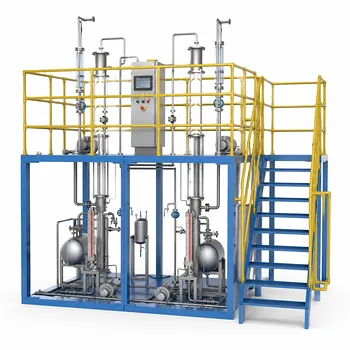
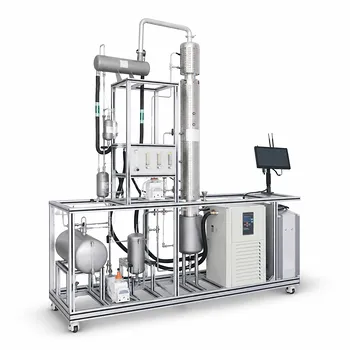
The core difference lies in how the two liquid phases meet.
Nondispersive membrane solvent extraction keeps immiscible organic and aqueous phases physically segregated on opposite sides of a microporous hollow fiber membrane. One phase wets the pores, while the other is prevented from dispersing by a carefully controlled pressure difference. This eliminates the stable emulsions that frequently cripple conventional mixer‑settlers, grants independent control of each phase’s flow rate, and makes pilot‑scale results directly translatable to larger systems.
Nondispersive membrane extraction avoids the single biggest operational headache of mixer‑settlers—stable emulsion formation—by replacing turbulent dispersion with a clean, membrane‑stabilized interface. The payoff is a system that offers predictable scale‑up, decoupled flow control, and a far more transparent window into the fundamentals of liquid‑liquid mass transfer.
The Principle of Phase Contact Without Dispersion
Conventional liquid‑liquid extraction violently mixes two phases to create a large interfacial area, then relies on density differences to separate them. A membrane system takes a radically different approach.
How the Membrane Maintains Separation
A microporous hollow fiber membrane acts as a permanent, fixed interface. One phase—typically the organic—wets the hydrophobic pores and fills them. The aqueous (non‑wetting) phase flows on the opposite side.
A critical operational rule applies: the non‑wetting phase must be held at a pressure equal to or slightly higher than the wetting phase. This pressure balance keeps the liquid‑liquid interface pinned exactly at the pore openings. No droplets form, and no bulk mixing occurs.
Solving the Emulsion Challenge
Mixer‑settlers and centrifugal extractors intentionally create fine dispersions. When phase separation is rapid, this works well. But if stable emulsions form—for example, due to surfactants, high viscosity, or density‑matched phases—the settler stops working.
A membrane prevents this entirely. Because the phases never disperse into each other, stable emulsions cannot form. This turns a common process‑failure point into a non‑issue, particularly valuable in a pilot plant where you test diverse feedstocks and may encounter unexpected surface‑active contaminants.
Operational Advantages in a Pilot Plant
The absence of dispersion transforms how you run experiments and interpret data.
Independent Phase Flow Rates
In a mixer‑settler, the maximum phase flow ratio is limited by the need to maintain a coherent dispersion and avoid flooding or entrainment. One phase usually becomes the continuous phase, and the other’s flow is constrained.
A membrane module imposes no such coupling. You can run the aqueous phase at a trickle and the organic at a torrent—or vice versa—independently. This freedom lets you map mass transfer performance across a much wider range of operating conditions, directly testing how flow ratio influences extraction efficiency.
Predictable Scale‑Up for Research and Education
A perennial challenge with mixer‑settlers is that mixing and settling times do not scale linearly. A pilot‑scale unit’s hydrodynamic behavior often diverges from the production unit, forcing costly empirical tuning.
Membrane modules scale by adding more fiber area—a fundamentally linear, geometry‑based scale‑up. The interfacial area per unit volume stays constant, and so does the mass transfer coefficient. For educational and research pilot plants, this makes extrapolation from lab‑scale to pilot‑scale unusually trustworthy, letting students and operators focus on the separation science rather than on device‑specific hydrodynamics.
Understanding the Trade‑offs
No technology is universally superior. Recognizing what you give up clarifies when a membrane system is the right choice.
The Demand for Precise Pressure Control
The membrane’s anti‑dispersion magic relies on maintaining that non‑wetting phase over‑pressure. If pressure fluctuates and the non‑wetting phase enters the pores, the entire separation fails through flooding. If the wetting phase pressure rises too high, it breaks through into the non‑wetting channel.
This adds an extra control loop that mixer‑settlers don’t need. You trade the simplicity of “mix and let settle” for a pressure‑managed interface that requires vigilant monitoring and reliable pressure hardware.
When Conventional Mixer‑Settlers Excel
Mixer‑settlers remain the workhorse for good reason. They are mechanically simple, tolerate a wide range of foulants and suspended solids (which would rapidly clog a membrane), and can handle extremely high throughputs in a compact footprint once the dispersion/settling envelope is known.
In a pilot plant where the goal is to demonstrate a rugged, high‑capacity industrial process—and where the feed system is relatively clean and well‑defined—the low cost and brute‑force reliability of a mixer‑settler often outweigh the membrane’s precision. The membrane system shines instead when the prime directive is fundamental research, rapid condition screening, or feedstock that is notoriously prone to emulsification.
Making the Right Choice for Your Goal
Your pilot plant’s purpose dictates which approach fits best.
-
If your primary focus is studying intrinsic mass transfer kinetics and fluid‑fluid equilibria: A membrane system’s fixed interfacial area and independent flow control give you the cleanest, most repeatable data.
-
If your primary focus is demonstrating a robust industrial extraction process at high throughput: A conventional mixer‑settler or column likely better reflects the production environment and handles the volumetric flows with proven simplicity.
-
If your primary focus is scaling up from micro‑to pilot‑scale with minimal performance surprises: The linear, area‑based scale‑up of a membrane module gives you a highly predictable path that an agitated unit cannot match.
Choose the tool that matches the question you’re asking, and your pilot plant will deliver answers you can trust.
Summary Table:
| Feature | Membrane Solvent Extraction | Conventional Mixer-Settler |
|---|---|---|
| Phase Contact | Nondispersive (membrane-stabilized) | Dispersive (violent mixing) |
| Emulsion Risk | Eliminated | High (frequent settling bottlenecks) |
| Flow Control | Independent phase flow rates | Coupled/limited flow ratio |
| Scale-Up | Predictable & linear (fiber area based) | Complex & non-linear (empirical) |
| Key Challenge | Requires precise pressure control | Clogging from suspended solids |
Optimize Your Extraction Processes with LABPARK
Are you looking to enhance your laboratory or pilot plant capabilities? LABPARK provides premium Educational and Vocational Unit Operations Pilot Plants in chemical engineering, bioprocess & biotech, and environmental & water treatment designed specifically for universities, research institutes, and enterprises.
Whether you need advanced membrane extraction systems for fundamental research or robust mixer-settlers for scale-up training, we deliver tailored solutions to meet your exact academic and industrial needs. Contact us today to request a customized quote and receive expert technical guidance!
Related Products
- Multifunctional Membrane Separation Educational Pilot Plant with Ultrafiltration, Nanofiltration, Reverse Osmosis
- Ultrafiltration Membrane Separation Educational Pilot Plant
- Multi-Functional Membrane Separation Educational Pilot Plant for Unit Operations Lab
- Hollow Fiber Ultrafiltration Membrane Separation Educational Pilot Plant
- Photocatalytic Membrane Separation and Degradation Unit Operations Pilot Plant
People Also Ask
- How do PEI, PVDF, and PSU membranes compare in pilot plants? Find the best fit.
- Pervaporation vs. Vapor Permeation: Handling Suspended Solids in Membrane Pilot Plants
- What are the trade-offs of polymer vs inorganic membranes in teaching pilot plants? Key laboratory comparison.
- What are the advantages of membrane separation in pilot plants? Efficient Organic Vapor Recovery
- How can operators optimize operating conditions and cleaning protocols in membrane separation pilot plants to mitigate fouling?