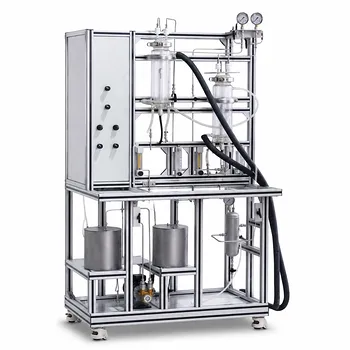
Operational mode defines the control challenge. In chemical engineering pilot plants, batch reactors operate with all reactants charged at once, reacted over time, and discharged—creating an unsteady-state process. Continuous reactors constantly feed reactants and withdraw product under steady-state conditions. Semi-continuous systems blend these by holding one reactant while another is fed continuously. For process control training, these differences mean students learn time-dependent temperature and concentration profiling in batch, steady-state flow control with residence time distribution in continuous, and the art of metered feed to steer reactions in semi-continuous.
A pilot plant’s reactor mode is not just a hardware choice—it is the curriculum for process control training. Each operational pattern teaches a fundamentally different mental model: dynamic recipe execution (batch), system equilibrium maintenance (continuous), and the delicate art of feeding to steer reactions (semi-continuous). Mastering all three builds a complete control engineer.
The Operational DNA of Batch, Continuous, and Semi-Continuous Systems
Batch Reactors: All-at-Once, Time-Driven
In batch operation, all reactants are loaded into the vessel simultaneously. The reaction proceeds under controlled conditions (temperature, pressure, agitation) for a defined cycle time. Once complete, the product is discharged and the reactor is cleaned.
This unsteady-state nature offers maximum flexibility. It is ideal for low-volume, multi-product production like pharmaceuticals or specialty chemicals. The downside is higher labor demand and inherent batch-to-batch variation.
Pilot plants using batch mode expose students to time-dependent control profiles. Operators must manage heating/cooling ramps, hold steps, and concentration changes over time. Every run is a discrete recipe that demands precise sequencing.
Continuous Reactors: The Steady-State Stream
Continuous reactors (such as plug flow reactors or CSTRs) receive a constant feed of reactants while product is simultaneously withdrawn. The system aims for a steady state where temperature, pressure, and composition remain constant over time.
This mode delivers stable product quality and high throughput, making it the backbone of large-scale commodities production. Automation potential is high, and operating costs per unit are lower.
Training on continuous systems focuses on maintaining equilibrium. Students learn flow control, residence time distribution management, and the critical dynamics of startup and shutdown—transitioning the reactor in and out of steady state is often the hardest part.
Semi-Continuous Reactors: The Controlled Feed Hybrid
Semi-continuous operation starts with one reactant in the reactor while another is added gradually, or product is continuously removed. It is a targeted compromise that manipulates reaction kinetics through feed strategy.
The primary driver is thermal control or selectivity optimization. For example, feeding a reactant slowly limits the instantaneous concentration, preventing dangerous heat accumulation in exothermic reactions.
In pilot plant training, this mode teaches feed-forward and feedback interplay. Students learn to adjust addition rates in real time to manage temperature profiles and reaction progress, directly linking pump control to reaction safety and product distribution.
The Impact on Process Control Training
From Recipe Execution to System Equilibrium
Batch control is narrative. The operator guides the reaction through a timeline—ramp to 80°C, hold for 2 hours, cool to 25°C. Training emphasizes adherence to the recipe and diagnosis of deviations. The mental model is one of sequential steps.
Continuous control is a balancing act. The operator watches a dashboard of steady-state indicators. Disturbances in feed flow or temperature must be corrected to bring the system back to a setpoint. This instills a philosophy of steady-state vigilance and loop tuning.
Semi-continuous control is tactical. Operators actively use feed rate as a lever to shape reaction conditions. The training ingrains the cause-and-effect relationship between addition rate, heat release, and safety limits. It’s a more dynamic, feed-forward mindset.
Learning Safety Through Reactor Dynamics
Safety training is inseparable from reactor mode. Batch reactors are generally unsuitable for fast, highly exothermic reactions because they cannot effectively limit reactant accumulation. Pilot plant exercises with batch demonstrations of runaway risks teach the crucial lesson of thermal mass and early detection.
Semi-continuous operation is the textbook solution for hazardous reactions. By limiting the feed, it prevents high concentrations of unreacted material. Students learn that feeding rate is the ultimate safety parameter—slow addition keeps the reaction rate under direct control and avoids thermal runaway.
Continuous reactors offer the highest inherent safety for rapid, energetic chemistry because the inventory of reacting material is small and heat transfer is steady. Training focuses on maintaining the safe operating window, understanding minimum flow rates, and executing emergency shutdown sequences.
Understanding Product Quality and Reproducibility
Batch-to-batch variation is a core learning point. Trainees see how small timing or temperature differences change product purity or yield. This drives home the importance of precise execution and standard operating procedures.
Continuous systems demonstrate how steady flow and consistent residence time produce uniform output. Students correlate flow meter accuracy and mixer speed directly to quality metrics, learning that product consistency is a process control achievement.
The semi-continuous mode teaches that product distribution is fed by the profile of addition. For example, in polymerization, the way a monomer is dosed into a catalyst solution alters the chain length distribution. Students connect a pump ramp to final polymer properties—a powerful lesson in reaction engineering and control.
Understanding the Trade-offs in a Training Environment
Flexibility vs. Industrial Realism
Batch reactors are the workhorses of educational flexibility. A single vessel can run dozens of different experiments quickly, exposing students to diverse chemistry. The trade-off is that this doesn’t represent the continuous flow reality of a commodity chemicals plant.
Continuous reactors offer true industrial realism, especially for petroleum or bulk polymer training. However, they are less forgiving of quick recipe changes and require longer stabilization times between experiments, limiting the number of distinct lessons per lab session.
Complexity and Operator Workload
The perceived simplicity of steady-state continuous operation can be deceptive. Startup and shutdown procedures are complex, often involving sequential pre-heating, purging, and ramping flows. Training on these transient phases is critical and can be more intricate than a batch cycle.
Semi-continuous systems add a layer of control strategy. Coordinating a feed pump with a temperature controller demands greater situational awareness. The training curriculum must step carefully through cascade-control concepts to avoid overwhelming novice operators.
Safety and Infrastructure Considerations
Each mode demands different support systems. A pilot-scale batch reactor for exothermic demos might need high-capacity cooling and pressure relief. A continuous setup requires robust flow control with interlocked emergency valves. Semi-continuous operation insists on ultra-reliable metering pumps. The available infrastructure often dictates which mode is most viable for a training program, and thus which control skills are most emphasized.
Making the Right Choice for Your Training Goals
The ideal pilot plant aligns the reactor mode with what you need your operators to learn.
- If your primary focus is teaching fundamental chemical engineering principles with high experimental variety: Prioritize a batch reactor. Its unsteady-state operation forces students to master time-based control and gives you the freedom to test many formulas cost-effectively.
- If your goal is to prepare operators for modern, automated, large-scale production: Invest in a continuous reactor with full instrumentation. The training will build deep expertise in steady-state flow control, residence time distribution, and the startup/shutdown sequences critical to industrial plants.
- If your training must emphasize reaction safety and advanced process control for exothermic or selectivity-sensitive reactions: Integrate a semi-continuous reactor. Here, students learn that manipulating feed profiles is the key to preventing thermal runaways and engineering product quality.
The most comprehensive training programs combine all three modes, ensuring that operators emerge with the adaptive expertise to handle any reactor dynamic they will encounter in industry.
Summary Table:
| Reactor Mode | Operational State | Control Focus | Key Safety Strategy |
|---|---|---|---|
| Batch | Unsteady-state (time-driven) | Time-dependent temperature & concentration profiling | Thermal mass monitoring & runaway detection |
| Continuous | Steady-state (equilibrium) | Flow control & residence time distribution | Steady-state boundary preservation & automated ESD |
| Semi-Continuous | Hybrid (controlled feed) | Feed rate adjustments & feed-forward loop control | Dosing limitations to control exothermic heat release |
Equip your operators and students with hands-on mastery of complex reactor dynamics. LABPARK designs and delivers state-of-the-art Educational and Vocational Unit Operations Pilot Plants in chemical engineering, bioprocess & biotech, and environmental & water treatment tailored for universities, research institutes, and enterprises.
Whether you want to demonstrate dynamic recipe sequencing, steady-state equilibrium, or critical thermal runaway prevention, our customized pilot plants provide the realistic, highly instrumented environments your curriculum needs. Ready to upgrade your laboratory? Contact LABPARK today to explore our pilot plant solutions.
Related Products
- Multi-Reactor Educational Pilot Plant for Reaction Engineering Unit Operations
- 100L Continuous Loop Hydrogenation Educational Unit Operations Pilot Plant
- Crude Benzene Hydrogenation Educational Unit Operations Pilot Plant
- Carbon Dioxide Hydrogenation Methanol Synthesis Educational Unit Operations Pilot Plant
- Gas Phase Mixing and Residence Time Distribution Determination Educational Unit Operations Pilot Plant
People Also Ask
- How do educational unit operations pilot plants address safety and waste management when scaling up?
- How do educational unit operations pilot plants bridge theory and design? Bridge the Engineering Gap
- Why Compare Predicted and Experimental Excess Enthalpy? Key to Accurate Pilot Plant Scale-up
- How to study gasification in pilot plants? Compare exit gas composition & efficiency
- Why Use PTFE & Hastelloy in Chemical Pilot Plants? Prevent Corrosion & Ensure Safety