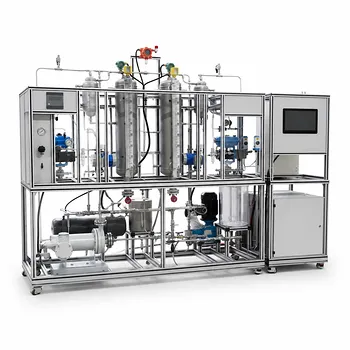
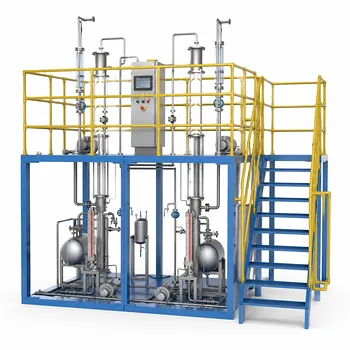
The heart of any wet oxidation desulfurization pilot plant is a deceptively simple cycle: absorb, oxidize, and regenerate.
The key unit operations are gas-liquid absorption of H₂S in an alkaline, catalyst-laden column, followed by catalytic oxidation of the dissolved sulfide to elemental sulfur, and then catalyst regeneration by blowing air through the solution—often via a venturi ejector in lab-scale settings. Safety considerations must center on rigorous ventilation to avoid toxic H₂S exposure, continuous monitoring of solution pH and catalyst activity, and controlled handling of the recovered elemental sulfur cake. Getting these elements right is what transforms a hazardous chemical process into a reliable, educational research platform.
The true value of a wet oxidation desulfurization pilot plant in an environmental engineering lab lies not just in replicating the chemistry, but in how cleverly the unit operations are integrated with upstream safety and downstream material management. The choice of regeneration method and the materials you select directly determine operator protection, experimental repeatability, and the long-term integrity of the system.
Unit Operations of a Wet Oxidation Desulfurization Pilot Plant
Gas-Liquid Absorption: Capturing the H₂S
The first step brings the contaminated gas into intimate contact with an alkaline scrubbing solution containing a dissolved catalyst.
This typically happens in an absorption column—packed, trayed, or spray column—where the H₂S transfers from the gas phase into the liquid.
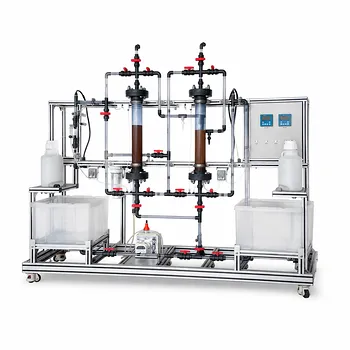
In a teaching lab, a borosilicate glass column is particularly valuable because it lets students visually track hydrodynamics like liquid distribution, wetting, and any onset of flooding.
Catalytic Oxidation: Turning Poison into Product
Once absorbed, the dissolved sulfide ions react with the catalyst to form elemental sulfur.
This is an exothermic reaction, so the reactor vessel must allow for adequate heat dissipation and temperature monitoring to avoid hotspots that could deactivate the catalyst.
The oxidation step is effectively the heart of the plant, determining not only desulfurization efficiency but also the quality and settleability of the sulfur particles produced.
Catalyst Regeneration: The Critical Recovery Step
After oxidation, the catalyst is in a reduced state and must be re‑oxidized to maintain its activity.
Regeneration is accomplished by introducing air into the solution. At pilot scale you have two primary options: a dedicated regeneration tower or a venturi ejector.
A regeneration tower uses a packed column counter-currently contacted with air; it provides excellent mass transfer but requires a high-pressure air blower and separate vessel.
A venturi ejector draws in air through the high-velocity flow of the recirculating liquid itself. It eliminates the need for a compressor, reduces energy consumption, and is mechanically simpler—a major advantage in a crowded university laboratory.
Essential Safety Considerations for Lab‑Scale Operation
Containment and Ventilation: The First Line of Defense
H₂S is toxic even at trace concentrations, so the entire pilot plant must operate under effective fume extraction or inside a ventilated enclosure.
Dedicated H₂S gas sensors linked to an alarm system and an automated emergency shutdown valve are non‑negotiable; they must trigger an immediate inert purge (e.g., nitrogen) if levels rise.
Excess treated gas should pass through a secondary scrubber or burn‑off before release, ensuring no untreated H₂S ever escapes into the lab atmosphere.
Material Selection and Chemical Compatibility
The alkaline catalyst solution and the generated sulfur slurry are chemically aggressive.
For wetted parts, choose high‑grade stainless steel (316) or PTFE‑lined components; borosilicate glass is excellent for non‑pressurized absorbent lines and visual sections but must have pressure ratings matched to the system.
Carbon steel should be avoided—it will corrode quickly, compromising both safety and data integrity.
Monitoring and Process Control
Continuous pH monitoring is essential because the absorption chemistry strongly depends on alkalinity; a drop in pH signals a loss of scrubbing capacity and potential H₂S breakthrough.
Catalyst activity can degrade over time due to poisoning or sintering; periodic sampling and spectrophotometric checks, combined with in‑line temperature sensors, let you detect process upsets early.
If using a regeneration tower, install a pressure relief valve and check valve to prevent over‑pressurization or backflow of liquid into the air supply.
Safe Handling of Elemental Sulfur Byproduct
Oxidized sulfur leaves the reactor as a fine slurry that must be filtered to recover the solid cake.
Even at small laboratory scale, this cake can carry residual H₂S and catalyst traces.
Perform filtration inside a fume hood, wear chemical‑resistant gloves, and store the filtered sulfur in a sealed, labeled container until it is disposed of via your hazardous waste program.
Understanding the Trade‑offs and Common Pitfalls
Venturi Ejector vs. Regeneration Tower
A venturi ejector simplifies the lab setup and eliminates rotating equipment, but it offers less independent control over air‑to‑liquid ratio than a tower.
If your research requires precise kinetic measurements of regeneration, the tower’s ability to set and log air flow independently may be worth the extra complexity and cost.
For most teaching‑focused labs, the ejector’s robustness and lower maintenance burden outweigh the loss of granularity.
Glass Visibility vs. Pressure Safety
Transparent columns are a tremendous educational tool—students can instantly see maldistribution or foaming.
However, glass has inherent pressure limitations. If your regeneration loop or absorption column will operate above 2‑3 bar, you must switch to a metal column with sight‑glass windows rather than a full glass assembly, and you must still implement certified overpressure protection.
Catalyst Longevity vs. Practical Simplicity
Running at higher temperatures speeds up oxidation but can sinter the catalyst and degrade structural materials faster.
A common pitfall is chasing faster throughput without matching the cooling capacity and metallurgy. A conservative operating window that respects the manufacturer’s temperature limits will prolong both catalyst life and equipment integrity.
Making the Right Choice for Your Laboratory Goals
How you configure your wet oxidation desulfurization pilot plant should be dictated by what you most need it to teach or prove.
- If your primary focus is student training and visual demonstration: Choose a column with borosilicate glass sections, a venturi ejector regeneration loop, and a clearly visible pH/flow indicator. This configuration minimizes mechanical complexity while maximizing the “see‑through” learning experience.
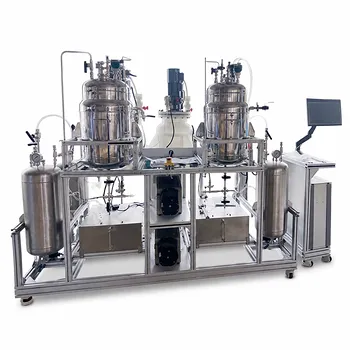
- If your primary focus is rigorous kinetic research and catalyst evaluation: Invest in a stainless‑steel absorption and reaction system, a dedicated regeneration tower with mass‑flow‑controlled air, and integrated online gas analyzers. You will gain the reproducible data needed for reaction modeling and scale‑up calculations.
- If your primary focus is hands‑on safety culture and operator discipline: Build the plant around a comprehensive interlock system—gas sensors, emergency shutdown, inert purge—and use a metal or PTFE‑rich wetted path to eliminate fragility. This setup teaches future engineers how to design inherently safer processes, not just how to run a chemical reaction.
Every experiment in your lab is a miniature version of an industrial environmental control unit. By deliberately matching the unit operations to the safety envelope and the educational objective, you turn a simple desulfurization run into a lasting lesson in responsible process engineering.
Summary Table:
| Feature | Venturi Ejector | Regeneration Tower |
|---|---|---|
| Mass Transfer Control | Low (dependent on liquid flow) | High (independent air control) |
| Equipment Footprint | Small & compact | Large (needs separate tower & blower) |
| Energy Consumption | Low (no separate air compressor) | High (requires high-pressure blower) |
| Ideal Application | Teaching & space-constrained labs | Advanced kinetic & catalytic research |
Elevate Your Environmental Engineering Lab with LABPARK
Looking to integrate a safe, high-performance desulfurization pilot plant or other unit operations into your curriculum or research?
LABPARK provides premium Educational and Vocational Unit Operations Pilot Plants in chemical engineering, bioprocess & biotech, and environmental & water treatment for universities, research institutes, and enterprises. We help you transform complex chemical processes into safe, highly visual, and reliable research platforms.
Ready to upgrade your laboratory equipment? Contact LABPARK today to discuss your customized pilot plant needs!
Related Products
- Electrochemical Water Treatment Educational Unit Operations Pilot Plant
- O-Xylene Oxidation to Phthalic Anhydride Educational Unit Operations Pilot Plant
- Carbon Dioxide Hydrogenation Methanol Synthesis Educational Unit Operations Pilot Plant
- Carbon Dioxide Absorption and Desorption Educational Pilot Plant for Carbon Capture Studies
- Methane Cracking Educational Unit Operations Pilot Plant
People Also Ask
- What design features do educational electrochemical pilot plants utilize to manage gas liberation and water loss?
- How can unit operations pilot plants show lead-acid concentration vs state of charge? Real-time monitoring guide.
- How do educational electrochemical pilot plants scale up electrolysis? Master industrial engineering.
- How to Estimate Sulfate in Water Treatment Pilot Plant Deposits: Gravimetric Guide
- How can foaming be managed during steam generation experiments in water treatment unit operations pilot plants? Tips