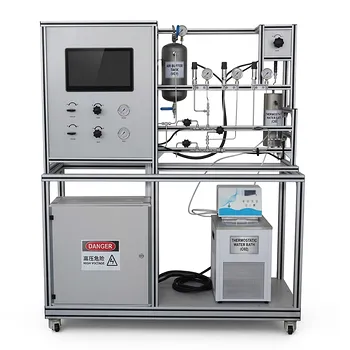
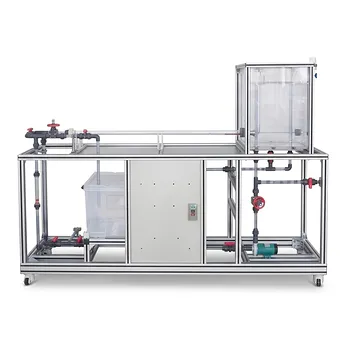
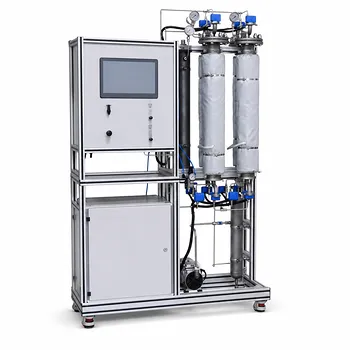
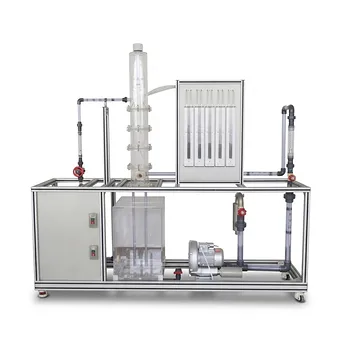
At its core, the difference comes down to how ions are separated from the reacting fluid. In a diaphragm cell, a porous barrier allows bulk liquid flow, producing a dilute, salt-contaminated caustic soda that requires multiple downstream purification steps. A membrane cell, by contrast, uses a dense, ion-selective barrier to block that flow, delivering a high-purity, high-concentration NaOH product directly from the reactor, at the cost of far more stringent brine pretreatment.
For a training pilot plant, the critical demonstration is not just two cells, but two entirely different process philosophies: the diaphragm route couples the reactor to an energy-intensive evaporation and crystallization train, while the membrane route shifts the purity burden upstream into brine polishing and uses a single-step, selective separation to achieve commercial-grade product directly.
The Separation Mechanism: Convection vs. Ion Exchange
The fundamental scientific principle each cell illustrates is different. One shows bulk mass transfer, the other selective ion transport.
Diaphragm Cell: Porous Barrier and Bulk Flow
A microporous diaphragm (often asbestos historically) separates the anode and cathode compartments. It restrains gas mixing but permits convective flow of the anolyte into the catholyte.
This means the sodium hydroxide forming at the cathode is inevitably mixed with a stream carrying dissolved sodium chloride. The product is a dilute, impure brine-caustic mixture—typically 10–12% NaOH with 1–2% NaCl (roughly 10,000–20,000 mg/L of salt).
Membrane Cell: Selective Cation Transport
Modern ion-exchange membranes contain fixed ionic groups (e.g., sulfonate groups) that exclude anions while permitting only sodium ions to migrate. Convective flow of liquid through the membrane is virtually eliminated.
The cathode compartment receives almost only Na⁺ ions that combine with OH⁻, producing a clean, concentrated NaOH solution (30–36 wt%) with negligible salt carry-over—around 30 mg/L NaCl.
Visualizing Mass Transfer in a Pilot Plant
Students can see the difference by measuring conductivity or performing a simple silver nitrate test on the catholyte. The diaphragm cell output shows heavy white precipitate of AgCl, while the membrane cell output remains clear, a dramatic demonstration of the membrane’s exclusion efficiency.
Product Purity and Concentration: The Outputs
The disparity in product quality is the most commercially and operationally significant distinction.
NaOH Purity and Contaminant Levels
- Diaphragm caustic: Contains 1–2% NaCl as the major impurity. This rules out direct use in applications requiring high-purity caustic, such as rayon manufacture or pharmaceutical synthesis.
- Membrane caustic: Boasts salt levels as low as 0.003% (30 mg/L). It meets most high-purity specifications without additional treatment, aligning with modern “green chemistry” standards.
Initial Concentration and Energy Demands
The diaphragm cell yields a dilute 10–12% NaOH stream. To reach the tradable 50% concentration, you must evaporate a huge amount of water, consuming about 5 tons of steam per ton of 30% caustic soda—a massive energy penalty.
The membrane cell produces at 32–35% NaOH right away. Less water to boil off means far lower thermal energy use, and overall electrical consumption is reduced to roughly 75–80% of the diaphragm process.
Downstream Unit Operations: From Product to Pure Chemical
A pilot plant must show the complete flowsheet, not just the electrolyzer. These two technologies spawn very different unit operation trains.
Diaphragm’s Purification Train
The impure, weak caustic stream forces you to add:
- Multi-effect evaporation to concentrate NaOH.
- Crystallization and centrifugation to separate NaCl that precipitates as the concentration rises.
- Salt recovery and recycling back to the brine system.
This chain illustrates critical heat and mass balances, solid-liquid separation, and energy integration.
Membrane’s Simplified Path
The high-purity, high-concentration catholyte requires only a finishing evaporator to reach final product concentration. No crystallizer or salt separation is needed, dramatically simplifying the downstream process. However, the unit teaches ultra-pure brine preparation—using ion exchange softeners or brine polishing filters to remove Ca²⁺ and Mg²⁺, which would otherwise foul the costly membrane.
Understanding the Trade-offs
No technology is universally superior. The pilot plant is the ideal setting to examine these compromises objectively.
Energy and Operating Costs
While membrane cells slash electrical energy and eliminate steam-intensive concentration, they require strict, continuous brine polishing and higher initial capital for the membrane itself. The diaphragm process is less energy-efficient but more forgiving of brine quality, with lower upfront investment for the cell.
Environmental and Safety Considerations
Diaphragm cells historically used asbestos-based diaphragms, posing both worker and environmental exposure risks. Modern membrane cells eliminate this hazard entirely, a key talking point when discussing sustainable industrial transitions.
Process Complexity and Brine Quality
A membrane cell will fail rapidly if trace hardness ions precipitate inside the membrane structure. This gives students a practical lesson in how a high-performance separation device demands a meticulously controlled feed. Conversely, the diaphragm cell demonstrates how a robust, less selective barrier can operate with a simpler feed system, but at the expense of product purity.
Making the Right Choice for Your Pilot Plant
The selection depends entirely on the core learning objectives of the unit operations lab.
- If your primary focus is teaching classical process integration: Choose the diaphragm cell to demonstrate a multi-step separation train—evaporation, crystallization, and salt handling. It provides a richer variety of unit operations in one flowsheet.
- If your primary focus is modern industrial relevance and energy efficiency: Install a membrane cell to show how a single, highly selective separation step can surpass the performance of an entire downstream purification sequence, while highlighting life-cycle and green-chemistry principles.
- If your primary focus is combined mass transfer and process control: Use both technologies side-by-side so students can directly measure the purity gap, calculate energy ratios, and observe how upstream brine quality dictates the success or failure of the ion-exchange membrane.
A well-designed pilot plant doesn't just teach electrolysis—it uses these two cells to illuminate the core chemical engineering truth that purity obtained in the reactor is almost always far cheaper than purity obtained later in the sequence.
Summary Table:
| Feature | Diaphragm Cell | Membrane Cell |
|---|---|---|
| Mechanism | Porous barrier / convective flow | Cation-exchange / selective transport |
| NaOH Purity | Low (1-2% NaCl impurity) | High (only ~30 mg/L NaCl) |
| NaOH Concentration | 10-12 wt% | 30-36 wt% |
| Downstream Train | Multi-effect evaporator + crystallizer | Simple evaporator (requires brine polishing) |
| Energy Efficiency | Low (high steam consumption) | High (20-25% lower energy use) |
Elevate Your Chemical Engineering Lab with LABPARK
Are you looking to provide hands-on training for modern industrial processes? LABPARK offers premium Educational and Vocational Unit Operations Pilot Plants tailored for universities, research institutes, and enterprises.
Our advanced systems cover chemical engineering, bioprocess & biotech, and environmental & water treatment, helping your students and researchers master real-world separation and purification technologies.
Ready to upgrade your lab? Contact LABPARK today to receive a customized pilot plant proposal!
Related Products
- Cavitation Phenomenon Demonstration and Analysis Educational Unit Operations Pilot Plant
- Orifice and Venturi Flowmeter Calibration Educational Pilot Plant for Fluid Mechanics Laboratory
- Bernoulli Equation Demonstration Unit Operations Pilot Plant
- Constant Pressure Filtration Educational Unit Operations Pilot Plant
- Centrifugal Pump Performance and Orifice Flowmeter Calibration Educational Pilot Plant
People Also Ask
- How do pilot plants teach U-tube manometers? Master Differential Pressure Calculations
- How to teach pump cavitation vs. gas binding? Interactive pilot plant teaching guide.
- What factors should be considered when selecting float valve types? F1 vs. V-4 vs. T-type Guide
- How does an FIA biosensor improve fermentation monitoring compared to HPLC? Speed & automation.
- What are key parameters for stable biosensor FIA in bioprocess training? Achieve optimal performance.