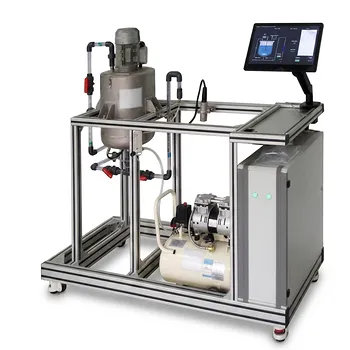
The heating magnetic stirrer water bath is a deceptively simple tool—but its ability to deliver reproducible bench-scale data relies entirely on a tight discipline around a few critical parameters. Water level, stirring speed initiation, temperature sensor positioning, and fluid characteristics directly determine both the safety and the scientific validity of your experiment. Get them wrong, and you risk anything from ruined kinetics to a serious fire hazard.
While heating and stirring are the obvious functions, the real art lies in mastering the three-way balance between the bath liquid level, the reaction vessel placement, and the temperature-sensing method. The core operational precaution is that a misplaced or dry external sensor can cause uncontrolled heating, while poor stirring control leads to inconsistent mixing and decoupling. The following breakdown turns these hidden risks into manageable parameters.
Critical Operational Parameters
Water Level: The Invisible Architect of Heat Transfer
The bath water must always be higher than the liquid level inside your reaction vessel. This ensures the entire vessel jacket is surrounded by a uniform-temperature fluid, preventing cold spots and uneven reaction rates. However, do not exceed two‑thirds of the bath’s total capacity. Overfilling risks boiling over, especially as the liquid expands or if you introduce a vessel that displaces water.
Stirring Control: Taming the Magnetic Bar
Always turn the speed adjuster slowly from zero. Starting at high speed suddenly causes the magnetic stir bar to decouple from the drive magnet—it will jump erratically, hit the vessel wall, and fail to mix the reactants. Once the bar is stable and centered, gradually increase the speed to the target RPM. For viscous media, a slower, more controlled ramp is essential to maintain coupling.
Temperature Sensor Placement: The Gatekeeper of Safety
An external temperature sensor must be fully submerged in the reaction liquid, not just dangling in the water bath or touching air. If the sensor is dry or misplaced, it reports a falsely low temperature. The heater then runs continuously, trying to reach the setpoint—a scenario that can lead to runaway heating, fire, and equipment destruction. Even when using the bath’s built‑in sensor, verify that the bath liquid level has not dropped below the sensor during long runs.
Viscosity and Solids: Know Your Fluid Boundaries
Magnetic stirrers excel with low‑to‑moderate viscosity fluids. As fluid viscosity increases or solid content builds up, you will see stirring speed fluctuations and incomplete mixing. The bar may stall or create a narrow vortex while the bulk of the fluid stays stagnant. For slurries or high‑viscosity systems, a magnetic stirrer alone cannot guarantee concentration uniformity—plan to use an overhead stirrer or verify mixing performance with a tracer before relying on the data.
Essential Safety Precautions
Never Dry Heat—Add Water First
The bath must be filled with water before powering on the heater. Running a heating bath without liquid (or letting the water boil away completely) exposes the heating elements to air, causing them to overheat, warp, and potentially ignite. This rule applies even during quick cleaning cycles.
Support Your Vessel—Never Rest It on the Bath Bottom
Placing a glass vessel directly on the bottom of the bath creates severe localized overheating, poor water circulation, and a high risk of thermal stress fracture. Always use a support rack or external clamps to suspend the vessel so that bath water can flow freely around it.
Manage Spills Immediately
Any water or chemical spill inside the bath housing can corrode heating elements, corrode electronic contacts, and create a short‑circuit hazard. Wipe down the interior and exterior after every use, especially after boil‑overs or splash events.
Redundancy for the External Sensor
Do not trust a single temperature probe blindly. When using an external sensor for process‑critical reactions, periodically cross‑check its reading with a calibrated thermometer in the bath or set a high‑limit cut‑off on the bath’s own controller as a backup. This catches the “sensor slipped out while you weren’t looking” failure mode.
Understanding the Trade-offs and Pitfalls
Speed vs. Stability
Higher RPM can improve mass transfer, but every magnetic stirrer has a limit where the bar decouples. Small stir bars, worn coatings, or irregular vessel bottoms all lower that limit. The trade‑off: push too hard for rapid mixing and you lose it entirely. Always start slow, then step up.
Internal vs. External Temperature Control
Using the bath’s built‑in sensor controls the water temperature, which may lag the actual reaction temperature significantly—especially during exothermic events. An external sensor placed directly in the reaction liquid gives tighter control. The downside is the safety risk if that sensor becomes displaced. Choose based on your tolerance for temperature error versus the need for a fail‑safe setup.
Magnetic Drive Limitations
Magnetic stirrers are quiet, compact, and seal‑free—ideal for closed systems. But high viscosity or high solids loading defeats the coupling. The trade‑off is clear: if your reaction involves a paste‑like consistency or dense particulates, magnetic agitation fails, and you must switch to a mechanical overhead stirrer, sacrificing simplicity and hermetic closure.
Evaporation Loses More Than Water
Long experiments at elevated temperature cause gradual water evaporation from the bath. The water level drops, eventually falling below the vessel’s liquid level, making heat transfer uneven. Monitor the bath level every hour for runs longer than 2–3 hours, and top up with pre‑warmed water to avoid thermal shock.
Making the Right Choice for Your Bench‑Scale Experiment
- If your primary focus is experimental safety: Treat the external temperature sensor as the most critical single point of failure—verify its immersion before every run, and set a hard over-temperature shutoff on the bath. Never leave the rig unattended without redundant protection.
- If your primary focus is data reproducibility: Standardize the precise water‑to‑vessel level ratio, the stirring speed ramp‑up procedure, and the vessel positioning (clamp height, centering). Use an external sensor and document its exact insertion depth so another operator can replicate the thermal history.
- If your primary focus is time efficiency: Pre‑heat the bath before clamping in the reaction vessel, and use a rack to quickly swap between identically sized flasks. However, never shortcut the slow stirrer ramp‑up—rushing this step can waste more time in failed mixing than you saved.
- If your primary focus is process scale‑up insight: Pay close attention to viscosity‑induced mixing limitations. Data collected while the bar is stalling will mislead you about mixing time and heat transfer—two parameters that matter enormously in larger vessels.
By treating water level, stirring initiation, and sensor discipline as non‑negotiable parameters, the heating magnetic stirrer water bath becomes a predictable, trustworthy foundation for your chemical engineering experiments.
Summary Table:
| Parameter | Critical Action | Key Risk of Failure |
|---|---|---|
| Water Level | Keep above vessel liquid; max 2/3 bath capacity | Uneven heat transfer / boiling over |
| Stirring Control | Increase RPM slowly from zero | Stir bar decoupling & poor mixing |
| Sensor Placement | Submerge external sensor fully in reaction fluid | Runaway heating & fire hazard |
| Vessel Support | Suspend vessel; never rest on the bath bottom | Localized overheating & glass fracture |
Ready to transition from bench-scale success to pilot-scale precision? LABPARK provides premium Educational and Vocational Unit Operations Pilot Plants in chemical engineering, bioprocess & biotech, and environmental & water treatment. We help universities, research institutes, and enterprises achieve safe, reproducible, and scalable process data.
Contact LABPARK today to discover how our custom pilot plants can elevate your research and training capabilities!
Related Products
- Shell and Tube Heat Exchanger Heat Transfer Coefficient Determination Educational Pilot Plant
- Rising and Falling Film Evaporation Educational Unit Operations Pilot Plant
- Solid Spherical Heat Transfer Coefficient Determination Educational Chemical Engineering Pilot Plant
- Comprehensive Heat Transfer Coefficient Determination Educational Unit Operations Pilot Plant
- Hot Filtration Educational Unit Operations Pilot Plant Laboratory System
People Also Ask
- Why Apply LMTD Correction in Shell-and-Tube Pilot Plants & How to Determine It
- Why adjust baffle spacing in shell-and-tube heat exchanger pilot plants? Master heat transfer & pressure drop.
- How to Estimate Shell-Side Pressure Drop in a Shell-and-Tube Heat Exchanger Pilot Plant: Key Parameters Explained
- How is the fouling factor (Rd) evaluated? Key Pilot Plant Insights for Students
- How is fouling factor demonstrated using shell and tube pilot plants? Practical Lab Guide