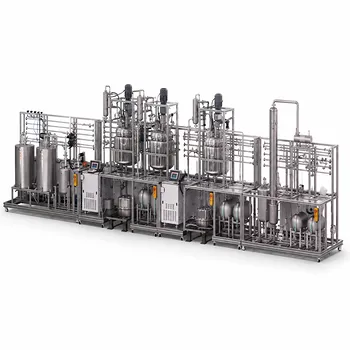
Simply put, homogeneous assays run the entire reaction in a single liquid phase with no separation steps, while heterogeneous assays anchor one reactant on a solid support and require a precise sequence of binding, washing, and elution. For educational bioprocess monitoring, this means you’re choosing between a straightforward “mix-and-measure” workflow and a more complex, multi-step automation that mimics industrial downstream processing.
In an educational bioprocess system, homogeneous assays minimize fluidic complexity to make basic monitoring accessible, while heterogeneous assays trade simplicity for reusability and sensitivity—turning the assay itself into a powerful teaching tool for advanced automation and analytical method development.
Unpacking the Operational Workflows
The fundamental operational split comes from how the sample and detection reagents are brought together and cleaned up before measurement.
Homogeneous: Merge and Measure
In a homogeneous automated assay, the sample and reagent are combined into a single phase—often using a merging-zone technique. No physical separation of bound and unbound reaction partners occurs.
The instrument simply monitors the change in a bulk property like turbidity or a direct signal, skipping the wash step entirely. This radically simplifies the fluidic path and reduces the number of valves and pumps needed.
Heterogeneous: Bind, Wash, Elute, Equilibrate
A heterogeneous assay uses a two-phase system. One binding partner is immobilized on a solid support, typically a cartridge or column.
The automated sequence is rigid: the sample is injected to capture the analyte, a wash step removes non‑specific impurities, an elution step releases the purified analyte for detection, and an equilibration step regenerates the surface. Each phase demands precise timing and valve coordination.
Fluidic Design and Automation Demands
The choice between assay types directly determines the mechanical and control complexity of your teaching platform.
Simplicity in Homogeneous Systems
Because there are no separation steps, the fluidic design stays lean. A basic pump-and-mix layout is often sufficient, making it easier for students to grasp the core concept of bioprocess monitoring without getting lost in automation hardware.
This simplicity also means faster cycle times and fewer opportunities for leaks or mis‑timed injections, which is a practical advantage in a shared teaching lab.
Complexity in Heterogeneous Setups
Heterogeneous assays demand a much more sophisticated automation layer. You must synchronize multiple reagents (binding buffer, wash buffer, elution buffer) with precise flow paths and column-switching logic.
Teaching with these systems exposes students to the reality of industrial‑grade analytical automation, where understanding the control software and maintenance of the flow path is just as important as the biochemical reaction itself.
Reagent Economy and Reusability
Operational cost and resource management take on different shapes depending on which phase carries the binding partner.
Disposable Phase in Homogeneous Reactions
In a homogeneous assay, all reagents are consumed in the run. If you are using expensive antibodies or enzymes, that cost is incurred every time you run a sample.
For an educational setting with limited budgets, this can either limit the number of experiments or force you to use less selective, cheaper reagents that may not illustrate the desired bioprocess concept as clearly.
Regenerable Cartridges in Heterogeneous Systems
The immobilized phase in a heterogeneous assay can be regenerated and reused across dozens or hundreds of runs. You preserve the costly binding partner, dramatically reducing the per‑student cost after the initial investment in the cartridge.
This promotes a sustainable lab operation and teaches a critical principle of downstream processing: how to maximize the lifetime of chromatography media.
Sensitivity and Analytical Performance
The presence—or absence—of a wash step creates a clear divergence in signal quality.
Signal‑to‑Noise in Single‑Phase Detection
Without a wash, the detector reads both the specific signal and any background from unreacted matrix components. This can elevate baseline noise and limit the achievable lower detection limit.
For many educational bioprocess scenarios, however, this reduced sensitivity is a fair trade for a robust, easy‑to‑troubleshoot system.
Enhanced Sensitivity via Washing
The wash step in a heterogeneous assay actively removes interfering substances, slashing background noise. This yields higher sensitivity and a lower limit of detection, allowing students to measure subtle changes in product titer or contaminant levels.
That sensitivity makes heterogeneous workflows the preferred choice when teaching regulatory‑oriented analytics or process analytical technology (PAT) concepts.
Understanding the Trade‑offs
A purely feature‑by‑feature comparison misses the educational constraint: you are not just building an instrument; you are building a curriculum.
The Cost of Simplicity
A homogeneous system’s lean workflow can hide the intricacies of real‑world process monitoring. Students may never encounter the critical automation challenges of multi‑column switching, buffer selection, or regeneration cycles.
If the learning objective stops at “sample‑to‑result in minutes,” this simplicity is a strength. If the objective includes designing a monitoring strategy for a fully automated facility, it becomes a significant gap.
The Complexity Premium
Heterogeneous systems carry a steep learning curve. A single mis‑timed switch or imperfect wash can ruin a run, frustrating students and extending lab sessions.
You must invest time in training students on the automation sequence before they can get meaningful bioprocess data. The payoff is a deep, practical understanding that translates directly to industry.
Choosing the Right Assay for Your Educational Lab
The best operational profile isn’t absolute; it depends on what you need your students to walk away with.
- If your primary focus is introducing basic bioprocess monitoring principles to a large class: A homogeneous system minimizes hardware overhead and lets students immediately see reaction kinetics without wrestling with multi‑step protocols.
- If your primary focus is training students on advanced analytical automation and downstream processing: A heterogeneous system is the better fit, despite the complexity, because it teaches column regeneration, wash optimization, and the engineering mindset required in industrial environments.
Match the assay’s operational signature to your true educational goal, and you’ll turn every run into a lasting lesson.
Summary Table:
| Feature | Homogeneous Assays | Heterogeneous Assays |
|---|---|---|
| Workflow | Mix & measure (single liquid phase) | Bind, wash, elute, & equilibrate (two-phase) |
| Fluidic Path | Simple (few valves and pumps) | Complex (requires multi-port switching) |
| Reagents | Consumable (higher per-run cost) | Reusable immobilized phase (lower run cost) |
| Sensitivity | Lower (higher background noise) | Higher (impurities washed away) |
| Best For | Basic kinetics & large class sizes | Advanced automation & downstream PAT training |
Elevate Your Bioprocess Education with LABPARK
Ready to bring real-world industrial workflows into your training labs? LABPARK designs and delivers state-of-the-art Educational and Vocational Unit Operations Pilot Plants in chemical engineering, bioprocess & biotech, and environmental & water treatment.
Whether your curriculum focuses on simple homogeneous assay kinetics or complex heterogeneous chromatography sequences, our pilot plants provide universities, research institutes, and enterprises with the ultimate hands-on learning environment.
Help your students bridge the gap between theory and industrial automation. Contact LABPARK today to customize your pilot plant!
Related Products
- Quantitative Dosing and Liquid Flow Control Educational Unit Operations Pilot Plant
- Multifunctional Membrane Separation Educational Pilot Plant with Ultrafiltration, Nanofiltration, Reverse Osmosis
- Multi-Functional Membrane Separation Educational Pilot Plant for Unit Operations Lab
- Continuous Batch Extractive Distillation Educational Pilot Plant
- Methanol Synthesis and Catalyst Performance Evaluation Educational Unit Operations Pilot Plant
People Also Ask
- How do educational unit operations pilot plants bridge theory and design? Bridge the Engineering Gap
- How do educational unit operations pilot plants address safety and waste management when scaling up?
- How do conservation equations guide fluid flow pilot plants? Key Scale-Up Principles
- Why is the attenuation path length (lA) critical when positioning pressure sensors in a fluid flow unit operations pilot plant?
- What are the key differences in process analytics requirements from R&D to production?