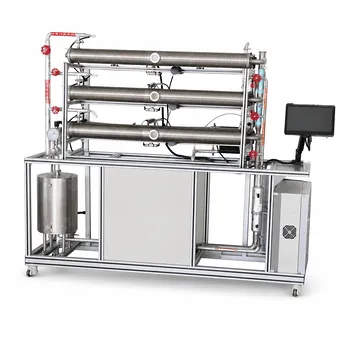
The language of process scale-up is written in the laws of conservation.
In fluid flow unit operations pilot plants, the fundamental equations of mass, momentum, and energy are not just theory—they are the engineering backbone that dictates design choices, validates performance, and ensures safe, efficient operation. Mass conservation ensures that every stream entering and leaving the system is accounted for; momentum conservation determines the pressure drops and forces that drive pump selection and piping design; and energy conservation quantifies every thermal and mechanical exchange, enabling accurate scale-up from the bench to the pilot scale.
Before a single flow measurement can be trusted or a pump can be sized, the conservation equations transform a collection of pipes and sensors into a coherent, predictive model. They guide the design by setting physical constraints, and they govern operation by turning raw pilot plant data into validated insights for scale-up and optimization.
Mass Conservation: The Ledger of Fluid Flow
At its core, mass conservation is simple: what goes in must either come out or accumulate. In a pilot plant, this principle becomes the ultimate auditing tool.
Establishing Accurate Mass Balances
The continuity equation forces you to reconcile every stream. By measuring flow rates at multiple points and checking that total mass in equals total mass out (plus any accumulation), you immediately verify that sensors are calibrated and that no hidden leaks or hold-ups distort your data.
This is the first step to trust. A pilot plant that does not close its mass balance cannot produce reliable data for scale-up. Every subsequent momentum or energy calculation depends on knowing exactly how much fluid is moving.
Detecting Inefficiencies and Leaks in Real Time
When a mass balance fails to close, the equation doesn’t just tell you an error exists—it points you toward the cause. A persistent discrepancy may indicate an unaccounted vaporization, a dead leg in the piping, or a malfunctioning flow meter.
This real-time diagnostic capability lets operators troubleshoot quickly. Instead of guessing why product yield is low, you follow the mass deficit to its source, turning conservation from a calculation into a troubleshooting guide.
Guiding Operational Choices for Fluid Bed and Granulation Systems
In more complex pilot units like fluidized beds or wet granulators, mass conservation links solid and gas phases. You track the humid air mass entering and exiting the bed, while simultaneously monitoring the granule moisture content. The continuity equation helps you determine the maximum allowable drying air flow rate that won’t entrain fine particles, directly tying conservation to product quality.
Momentum Conservation: The Blueprint for Flow Resistance
Momentum conservation governs how fluids push back against pipes, fittings, and machines. It translates physical geometry into pressure drop, and pressure drop into pump requirements.
Predicting Pressure Drops for Pump and Piping Selection
Every bend, valve, and heat exchanger in a pilot plant adds resistance. The momentum equation—accounting for convective acceleration, viscous stresses, and pressure forces—allows you to calculate the exact pressure loss from friction and form drag. Without this, you would be blindly specifying a pump.
For example, when scaling a laboratory reactor to a pilot distillation column, you use momentum balances to size the feed pump and ensure it can overcome the increased static head and frictional losses. Underestimated pressure drop leads to insufficient flow; overestimation wastes capital and energy.
Validating System Curves and Pump Performance
Pilot plants often use two control strategies: throttle valve control and variable speed control (VFD). The momentum equation explains their profound difference. Throttling a valve artificially increases system resistance, shifting the system curve to match a fixed pump curve—but this dissipates mechanical energy as heat across the valve.
A variable speed drive, however, adjusts the pump’s own characteristic curve, matching the impeller speed to the flow demand. Momentum conservation shows that VFD control operates closer to the fluid’s natural energy requirement, making it significantly more efficient. By measuring actual flow, pressure, and power, operators can plot system and pump curves to confirm that the pilot plant’s hydraulic design matches the momentum calculations, and then use that validated data to make informed decisions about full-scale pump control strategy.
Using Nondimensional Numbers to Scale Up
Momentum transfer principles underpin critical scaling parameters like the Reynolds number. In a pilot fluidized bed, you might need to maintain a specific fluidization regime. The momentum equation, reduced to the Reynolds number, tells you how to adjust the superficial velocity and particle size when moving from a lab tube to a pilot column, preserving dynamic similarity and avoiding defluidization or excessive entrainment.
Energy Conservation: The Thermal and Mechanical Compass
Energy conservation extends the picture to include heat, work, and internal energy changes. For any thermal operation or pump-driven loop, it is the final arbiter of feasibility and efficiency.
Quantifying Heat Exchange and Thermal Losses
In a pilot heat exchanger, the energy equation accounts for the enthalpy change of both streams, the conductive and convective heat transfer, and the inevitable heat loss to the environment. By measuring inlet and outlet temperatures and flow rates, you can calculate an experimental overall heat transfer coefficient.
Comparing that value to theoretical predictions (which often assume ideal flow patterns and perfect insulation) reveals gaps in your model. The energy equation thus becomes a calibration tool: the pilot plant’s temperature data directly refines your heat transfer correlations before full-scale design.
Calculating Mechanical Work and System Efficiency
The general energy equation includes a term $M$ representing the mechanical energy added (or extracted) by machines like pumps or turbines. In a pilot loop, you measure pressure rise, velocity change, and elevation difference across a centrifugal pump. Solving the equation for $M$ gives the actual hydraulic power delivered to the fluid.
Comparing this to the electrical power input yields the pump’s mechanical efficiency at that operating point. Such data is invaluable: it tells you whether a VFD is really saving energy, or if the pump is sized correctly for the process. The energy equation transforms a simple flow reading into a performance metric that directly influences operational cost and reliability decisions.
Integrating Equations of State for Real Fluids
Energy balances in pilot distillation or gas absorption columns require accurate enthalpy calculations. Here, the conservation principle remains the same, but the property package must reflect reality. An equation of state (EOS) provides a self-consistent way to describe both vapor and liquid properties, linking pressure‑volume‑temperature behavior to enthalpy and phase equilibrium. Without a rigorous EOS feeding the energy balance, your energy‑based scale‑up predictions for boiling points and condenser duties would be unreliable.
Bridging Theory and Reality: Data-Driven Model Refinement
Conservation equations are the starting point of any process simulation, but they rely on assumptions. The pilot plant’s greatest value is in testing those assumptions.
Using Pilot Data to Close the Loop
Simulations often assume perfect mixing, negligible heat loss, or fully developed flow. When you run the pilot plant and measure actual flow, temperature, and pressure profiles, you can back‑calculate friction factors, heat transfer coefficients, and mass accumulation terms. Every deviation between the conservation‑based prediction and the real data is a signal that your model needs refinement.
This iterative loop—predict with mass/momentum/energy, experiment, compare, refine—is how unit operations pilot plants reduce scale‑up risk. The conservation equations give you a structured language for interpreting data, turning raw sensor outputs into physically meaningful corrections to your design model.
Understanding the Trade-offs and Pitfalls
No set of equations can capture every nuance, and applying conservation in a pilot plant requires recognizing where simplifications can mislead.
Steady-State Assumptions vs. Transient Reality
Classroom conservation balances often assume steady state. But real pilot startups, pump trips, or thermal cycling involve accumulation terms. Ignoring transients can make a mass balance appear to fail or hide temporary inefficiencies. The equations guide you correctly only if you honestly account for time‑dependent terms.
Throttle Valve Efficiency vs. Control Simplicity
Momentum conservation reveals the energy waste of throttling valves, yet they remain common in pilot plants because they are simple and offer fast response. The trade‑off is a design decision: a VFD provides higher energy efficiency but adds cost and complexity. Understanding the energy equation helps you quantify the long‑term operating cost difference, rather than making a blind choice.
Measurement Uncertainty Affects All Balances
Even perfect conservation equations can’t save you from poor data. A flow meter error of 2% might cause a mass balance that appears to close while masking a real leak, or it might make a tight balance look open. The equations then guide you to install redundant measurements and perform sensitivity checks, illustrating that conservation is as much about experimental discipline as mathematics.
Making the Right Choice for Your Pilot Plant Goal
How you leverage mass, momentum, and energy equations depends on what you are trying to achieve. Use them as a strategic tool, not a checkbox.
- If your primary focus is scaling a new process: Prioritize momentum and energy balances to preserve dynamic similarity and thermal regimes. Use nondimensional numbers derived from momentum conservation and validated heat transfer coefficients from the energy equation to ensure the pilot directly informs industrial design.
- If your primary focus is operational efficiency and cost reduction: Apply momentum conservation to evaluate pump control strategies (VFD versus throttling) and use energy balances to pinpoint heat recovery opportunities or insulation gaps. Let the equations reveal where money is literally being dissipated.
- If your primary focus is model validation and research: Enforce strict mass and energy closures as a prerequisite before trusting any data. Use the conservation framework to back‑calculate unknown parameters (friction factors, heat transfer coefficients) and rigorously compare them against literature correlations, refining your fundamental understanding.
- If your primary focus is education and workforce training: Construct experiments where students directly measure all terms in the general energy equation, compare theoretical pressure drops to real data, and confront common pitfalls like unaccounted heat loss. The conservation laws become a discovery platform, not just a formula.
In the end, the conservation equations are the immortal skeleton of every fluid flow pilot plant—constant regardless of the process or scale. By using them to design intelligently, troubleshoot systematically, and scale confidently, you transform a collection of hardware into a genuine, predictive tool for process development.
Summary Table:
| Conservation Law | Key Pilot Plant Application | Operational & Design Benefit |
|---|---|---|
| Mass | Establish mass balances & detect leaks | Ensures reliable data validation for scale-up |
| Momentum | Predict pressure drops & analyze system curves | Optimizes piping design and pump selection (VFD vs. throttling) |
| Energy | Quantify heat transfer & evaluate mechanical work | Calibrates thermal models and measures pump efficiency |
Bring Theory to Life with LABPARK Pilot Plants
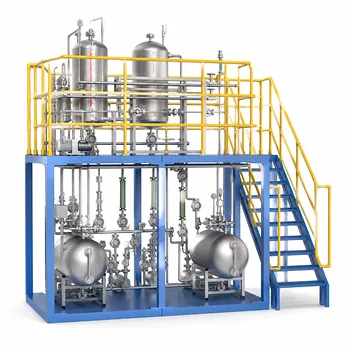
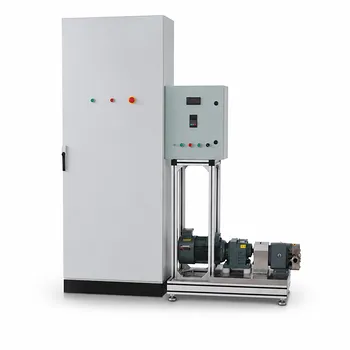
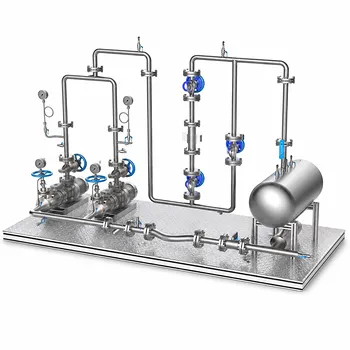
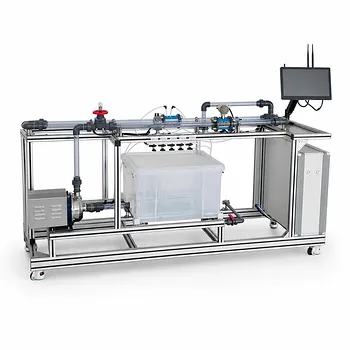
Are you looking to bridge the gap between fundamental engineering theory and practical industrial application? LABPARK designs and manufactures world-class Educational and Vocational Unit Operations Pilot Plants in chemical engineering, bioprocess & biotech, and environmental & water treatment.
Engineered specifically for universities, research institutes, and enterprises, our pilot systems enable you to:
- Validate Conservation Laws: Get hands-on experience calculating real-world mass, momentum, and energy balances.
- Bridge Scale-Up Gaps: Generate high-fidelity process data to refine mathematical models and scale up with confidence.
- Train Future Engineers: Access robust, safe, and industrial-grade equipment tailored for vocational training and research.
Ready to elevate your laboratory capabilities? Contact LABPARK today to request a custom consultation!
Related Products
- Fluid Transport and Piping Dynamics Practical Training Unit Operations Pilot Plant
- Quantitative Dosing and Liquid Flow Control Educational Unit Operations Pilot Plant
- Comprehensive Fluid Mechanics Educational Unit Operations Pilot Plant
- Multi Pump Fluid Transport Process Piping Unit Operations Training Pilot Plant
- Two-Dimensional Fluidization Hydrodynamics Educational Pilot Plant for Unit Operations Training
People Also Ask
- Gear vs Centrifugal Pumps in Pilot Plants: How do operating characteristics and power requirements differ?
- How is shaft work (We) used to determine pump specifications? Optimize pilot plant fluid transport design.
- Why distinguish Newtonian & non-Newtonian fluids in pilot plants? Prevent design errors.
- How does active time pulsing mixing enhance fluid homogenization? Configuration Guide for Educational Pilot Plants
- Why is the attenuation path length (lA) critical when positioning pressure sensors in a fluid flow unit operations pilot plant?