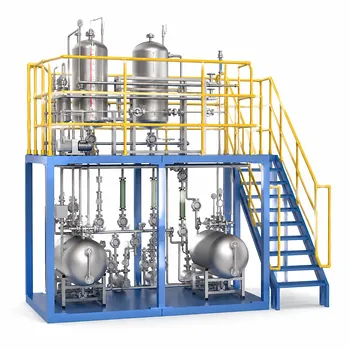
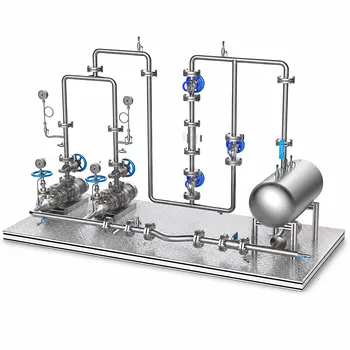
For pilot plant fluid transport, the two primary flow regulation methods are throttle valve control and variable speed control. Throttle valves are simple and low-cost, but they force the pump to work against added resistance, converting excess energy into heat and wasting power. Variable speed drives (VFDs) electronically adjust the pump’s motor speed, delivering only the flow and pressure the process actually requires—this makes them dramatically more energy-efficient, often cutting energy consumption by over 20% compared to throttling.
The core conflict in pilot plant flow control is simplicity versus efficiency. Throttle valves offer easy, familiar control but are fundamentally wasteful. VFDs align pump output with true demand, exemplifying modern green engineering practices, though they require higher upfront investment. Educational pilot plants often include both—and sometimes a bypass loop—precisely so operators can quantify and internalize these trade-offs.
The Two Core Flow Regulation Methods in Pilot Plants
How Throttle Valve Control Works at the Discharge
Throttle valve control is the most straightforward method. You install a control valve on the pump’s discharge and adjust its opening.
Closing the valve increases the frictional resistance of the piping system, effectively shifting the system resistance curve upward. The pump responds by climbing its own curve to a new operating point with lower flow and higher head.
The Hidden Energy Cost of Throttling
The price of this simplicity is energy loss. A partially closed valve creates a permanent pressure drop. The pump must generate that extra head just to overcome the valve, and that pressure energy is dissipated as heat in the fluid.
In pilot plant settings, this makes throttling an excellent teaching tool for inefficient process design. Students can directly measure the power draw and see that the pump is working harder than necessary for the achieved flow rate.
How Variable Speed Control (VFD) Operates
Variable speed control focuses on the pump itself, not the piping. A variable frequency drive (VFD) alters the frequency of the electricity supplied to the motor, changing the pump’s rotational speed.
Lowering the speed shifts the pump’s performance curve downward according to the affinity laws. Both the generated head and flow decrease, and crucially, the power consumed drops with the cube of the speed. This means a small speed reduction yields a large energy saving.
Why VFDs Are the Benchmark for Energy Efficiency
Because the VFD changes the pump’s capability rather than throttling its output, the system wastes almost no energy through artificial resistance. The pump produces only the hydraulic energy demanded by the process at that moment.
For an educational pilot plant, the VFD demonstration directly ties pump theory to real-world sustainability metrics. You can observe the power meter drop significantly as speed is trimmed, making the efficiency advantage immediately tangible.
Understanding the Third Option: Bypass Regulation
The Role of Recirculation in Pilot Plants
A third flow regulation method commonly demonstrated in educational pilot plants is bypass regulation. This sends a portion of the pump’s discharge back to the suction tank through a parallel line and valve.
It is inherently inefficient. The pump continuously runs at full output, pressurizing fluid only to have much of it recycle to the low-pressure side. Every joule of energy used to pressurize the bypassed fluid is wasted as frictional heat.
Where Bypass Control Actually Belongs
In pilot plants, bypass regulation is seldom a primary flow control strategy for a continuous process. Instead, it serves as a teaching tool to illustrate dangerous operating regimes, such as protecting a pump from running at shutoff (zero flow) or demonstrating pressure relief dynamics.
It is a valuable learning point, but not an energy-efficient control method. Its presence in a curriculum contrasts sharply with VFD control to drive the efficiency lesson home.
Understanding the Trade-offs
Capital Cost vs. Operational Savings
Throttle valves are cheap to install. A simple manual or actuated valve is an off-the-shelf component. VFDs add significant upfront cost for the drive hardware and often a more expensive inverter-duty motor.
The trade-off is stark: a lower capital investment with permanently higher electrical bills versus a higher initial cost that pays back rapidly through energy savings, especially in a pilot plant that runs continuously for experiments.
Control Response and Complexity
Throttle valve loops are familiar to any process control engineer. VFDs introduce an additional layer of electronics and potential electromagnetic noise, though modern drives are robust.
In a pilot plant built for student learning, this complexity is an advantage. The plant can compare the sluggish pressure response of a throttled line with the smooth, precise flow achieved by speed trimming, teaching both classical and modern control strategies in one unit.
The Educational Value of Inefficiency
From a pure production standpoint, throttling and bypass regulation are wasteful. But an educational pilot plant’s core product is knowledge, not chemicals. Incorporating all three methods side-by-side lets students directly measure power consumption curves, calculate the cost of throttling losses, and validate affinity laws.
The inefficiency becomes a vivid, data-backed lesson in why modern industry is rapidly switching to speed-based flow regulation.
Making the Right Choice for Your Pilot Plant Design
Your choice of flow regulation method must align with the plant’s primary purpose—production, research, or education. Below are the guiding heuristics based on your core goal.
- If your primary focus is low initial cost and simple, classic control demonstrations: Install discharge throttle valves. They immediately teach control loop fundamentals and pressure-flow relationships, but accept the ongoing energy waste as a cost of that simplicity.
- If your primary focus is energy efficiency and teaching modern green engineering principles: Standardize on VFD-driven variable speed control. The energy savings will be substantial, and you can directly demonstrate the financial and environmental upside of pump curve modulation.
- If your primary focus is comprehensive process safety and dynamics education: Integrate a bypass loop as a distinct learning module. Use it to teach pump protection at shutoff, relief scenarios, and the extreme inefficiency of recirculation, but never position it as a routine flow control strategy.
- If your primary focus is a holistic comparison for operator or student training: Design your pilot plant with all three methods on separate, metered lines. Equip each with flow and power analyzers to let trainees plot real-time system curves and energy consumption side-by-side.
The ultimate insight is that pilot plant flow regulation is not a one-size-fits-all decision—it is a deliberate lesson in the economics of energy, control, and process design.
Summary Table:
| Method | Working Principle | Energy Efficiency | Capital Cost | Best Suited For |
|---|---|---|---|---|
| Throttle Valve | Restricts flow at discharge, increasing system resistance | Low (wastes energy as heat) | Low | Classic control demos, low budgets |
| Variable Frequency Drive (VFD) | Adjusts motor speed to match flow demand | High (up to 20%+ savings) | High | Modern green engineering, energy savings |
| Bypass Loop | Recirculates excess fluid back to suction | Very Low (continuous full power) | Medium | Safety training, relief demos |
Optimize your engineering curriculum and research capabilities with LABPARK. We design and manufacture high-quality Educational and Vocational Unit Operations Pilot Plants in chemical engineering, bioprocess & biotech, and environmental & water treatment.
Whether you represent a university, research institute, or enterprise, our customizable systems provide hands-on experience with advanced flow control methods to prepare students and operators for modern industry standards.
Ready to upgrade your laboratory? Contact our experts today to find the perfect pilot plant configuration for your goals!
Related Products
- Fluid Transport and Piping Dynamics Practical Training Unit Operations Pilot Plant
- Multi Pump Fluid Transport Process Piping Unit Operations Training Pilot Plant
- Chemical Pipeline Assembly and Fluid Transport Practical Training Unit Operations Pilot Plant
- Comprehensive Fluid Mechanics Educational Unit Operations Pilot Plant
- Two-Dimensional Fluidization Hydrodynamics Educational Pilot Plant for Unit Operations Training
People Also Ask
- Gear vs Centrifugal Pumps in Pilot Plants: How do operating characteristics and power requirements differ?
- How is shaft work (We) used to determine pump specifications? Optimize pilot plant fluid transport design.
- Why distinguish Newtonian & non-Newtonian fluids in pilot plants? Prevent design errors.
- How does active time pulsing mixing enhance fluid homogenization? Configuration Guide for Educational Pilot Plants
- How does Reynolds number characterize flow regimes and momentum transfer? Master pilot-plant analysis