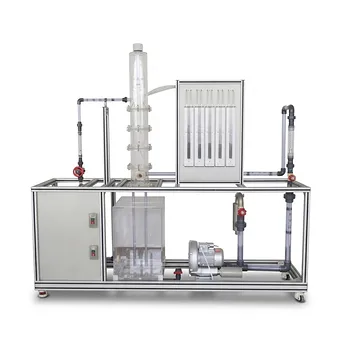
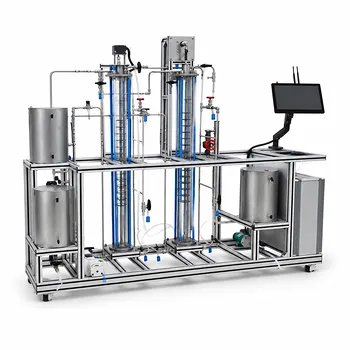
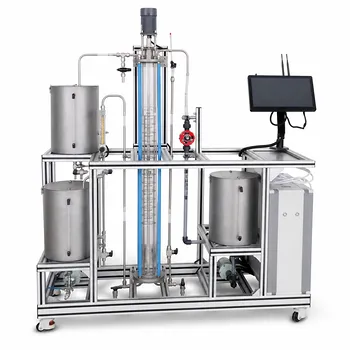
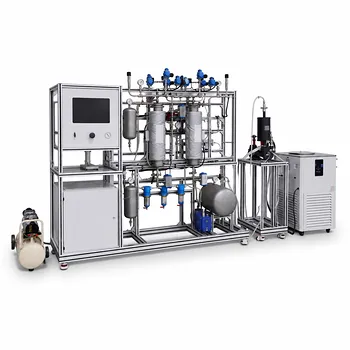
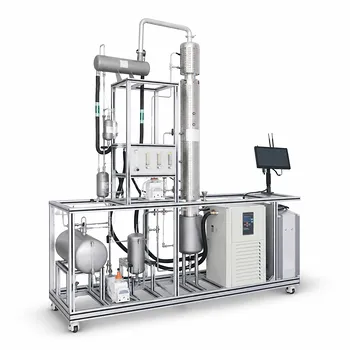
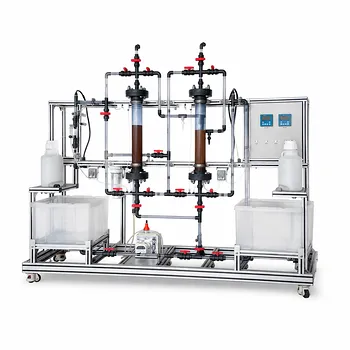
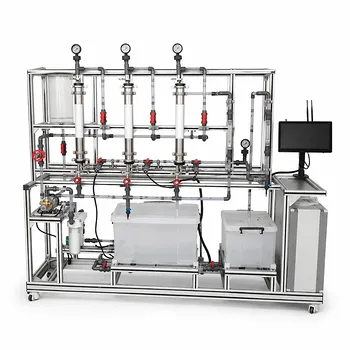
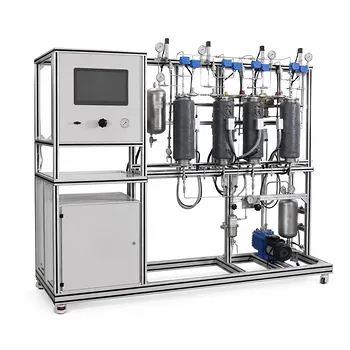
Scaling up column chromatography is not a simple magnification of a lab procedure. It is a fundamental shift from managing a glass column to controlling a dynamic process unit. The core operational considerations involve maintaining uniform fluid dynamics in a much larger bed, which requires mastering automated packing procedures, pressure drop management, and specialized flow distribution systems to prevent the channeling and band broadening that destroy separation efficiency.
The central challenge in pilot-plant scale-up is overcoming the amplified effects of non-uniform flow. While a student can visually correct a crack in a lab column, a pilot plant demands the engineering foresight to prevent such inefficiencies from ever forming—a lesson taught through automated systems and the disciplined control of pressure, flow, and column geometry.
Mastering Column Packing at Scale
At laboratory scale, you visually confirm the slurry is free of bubbles and the bed is level. In a pilot plant, this manual inspection is impossible. The process must be engineered to be repeatable and predictable.
The Shift to Automated Slurry Packing
The primary operational difference is the use of automated slurry packing systems. Instead of pouring a slurry by hand, operators learn to use pumps and pressurized reservoirs to transfer the stationary phase into the column in one continuous, controlled motion. This method ensures a consistently high packing density from the bottom to the top, eliminating the air bubbles and stratified layers that cause band broadening.
Uniformity is the Performance Metric
A pilot plant's success hinges on packing uniformity, not just the absence of visible gaps. The goal is to minimize the Height Equivalent to a Theoretical Plate (HETP) , the key measure of column efficiency. Trainees learn that an unevenly packed bed introduces eddy diffusion—different flow paths for molecules—which directly widens peaks and reduces purity. Achieving a low HETP requires a meticulously uniform bed, a concept measured and proven through the plant's performance, not by visual checks.
The Critical Role of Hardware Design
Pilot plants teach that the column's internal hardware is as important as the packing media. Specialized distributor plates and screens are positioned at the fluid inlet and outlet. These components create a high resistance to flow at the column's entry point, spreading the incoming mobile phase over the entire cross-section. Trainees see that without these, fluid naturally channels through the center of the bed, making a large portion of the stationary phase useless.
Managing Fluid Dynamics and Process Limitations
The fluid behavior in a large column is governed by different forces than a lab setup. Trainees must learn to monitor and control a system where gravity is replaced by pump-driven pressure and surface tension effects are magnified.
The Criticality of Pressure Drop Control
A direct consequence of scaling up is a significant rise in pressure drop across the column. The fluid must travel through a deeper bed and a wider diameter, requiring high-pressure pumps. Operators must constantly monitor pressure sensors to stay within the resin's mechanical limits and to diagnose problems. A sudden pressure spike is a key indicator of a clogged frit or a collapsed bed, while a low pressure drop can signal channeling or insufficient packing.
Understanding Column Loading Limits
Pilot-plant operation requires a precise understanding of column loading capacity. Trainees learn to work with modern resins that can often bind over 30 g/L of target product. The operating procedure shifts from applying a sample band to managing a breakthrough curve. Overloading the column, either beyond its mass or volume capacity, leads directly to lost product in the flow-through and a failed purification run, a crucial operational lesson for cost-sensitive processes.
The Perils of De-Wetting and Minimum Flow
A non-negotiable safety protocol in pilot plants is to never let the solvent level drop below the top of the stationary phase bed. If a packed column runs dry, a crack forms, breaking the capillary flow and creating a channel. Restoring performance requires a complete repack. Similarly, for some column types, the liquid loading rate must stay above a minimum threshold to ensure the packing surface is fully wetted; falling below this causes an abrupt loss in mass transfer efficiency.
Inherent Column Limitations and Selection
A critical operational lesson is learning when not to use a packed chromatography column. Because they are highly susceptible to clogging, these systems must never be used with feeds containing suspended solids or compounds prone to polymerization. Trainees learn to perform a proper fluid assessment and consider a guard column or alternative separation before the main pilot unit, framing column selection as a risk-based decision.
Designing Training Experiments for Real-World Insight
An educational pilot plant must be sized to fit a lab yet operate with true industrial fluid dynamics. This requires deliberate design choices in column geometry and the training of disciplined operating habits.
Navigating Column Geometry and Wall Effects
Pilot-scale columns must be designed to minimize wall effects, where fluid flows faster along the smooth column wall than through the packed bed. This is achieved by maintaining a ratio of column diameter to packing particle size greater than 8-10. In a typical 50-150mm diameter educational column, this necessitates using smaller packing elements (e.g., 10-15mm). Trainees learn to calculate this ratio and select appropriate media, directly linking a simple geometric rule to the prevention of a major efficiency loss.
Developing a Disciplined Operating Rhythm
The automated nature of a pilot plant does not eliminate the need for operator discipline; it shifts its focus. Trainees must learn to program and verify a precise elution flow rate, understanding that deviations cause sample diffusion and blurry band separation. They monitor elution profiles using integrated sensors, learning that an asymmetric peak is not just data but a diagnostic tool pointing to packing defects or flow maldistribution. Continuous, uninterrupted operation becomes the standard they must uphold.
Exploring the Scale-Up Parameters
Students use the pilot plant to validate the fundamental rule of scale-up: maintaining constant bed height and linear flow velocity while increasing column diameter and volumetric flow. They can directly compare the performance of a long, narrow column (ideal for difficult separations with a selectivity factor, alpha < 1.15) against a wider column (for maximizing throughput when alpha > 1.15). This hands-on comparison of column form for different separation functions is a core takeaway.
Understanding the Trade-offs
Scaling up is a series of compromises, and an educational pilot plant makes these explicit. No single column configuration is perfect for every task.
Trainees see the direct conflict between resolution and throughput. A long, narrow column yields peak separation but operates at a low flow rate and high back pressure. Switching to a short, wide column dramatically increases productivity but risks losing resolution if not carefully managed. The choice of packing material presents another trade-off: smaller particles give higher efficiency but at the cost of a much higher pressure drop, requiring a more complex and expensive system. The key lesson is that the operator, by changing a controllable parameter like particle size or bed height, actively manages a dynamic tension between quality, productivity, and system cost.
Making the Right Choice for Your Training Goal
The design of your chromatography training program should match the core engineering concept you want to teach. Use the pilot plant to challenge students with specific, real-world scenarios.
- If your primary focus is teaching the impact of packing quality: Structure an experiment where students must pack a column, measure its HETP, then deliberately introduce an error (like an air bubble or low-pressure slurry) and measure the drop in performance.
- If your primary focus is exploring process economics: Assign a design problem where students must achieve a specific product purity and throughput target, forcing them to choose between a high-resolution, low-throughput column and a high-throughput column with marginal separation.
- If your primary focus is equipment validation and safety: Have students perform a pre-run checklist that includes pressure-drop calculations, compatibility checks for all wetted parts, and a plan for managing a pressure spike before they are allowed to start the pump.
The true value of a chromatography pilot plant isn't just in purifying a sample—it's in teaching that performance is engineered from the start through an understanding of fluid dynamics, material limits, and disciplined operation.
Summary Table:
| Key Parameter | Lab Scale (Glass Column) | Pilot Plant Scale | Educational Focus |
|---|---|---|---|
| Packing Method | Manual pouring & visual check | Automated slurry packing systems | Achieving low HETP & bed uniformity |
| Fluid Dynamics | Gravity-fed or low-pressure flow | High pressure & distributor plates | Managing pressure drop & channeling |
| Process Limits | Visual band separation | Breakthrough curve management | Balancing resolution vs. throughput |
Bring Industrial Scale-Up to Your Lab with LABPARK
Transitioning from benchtop concepts to industrial reality requires hands-on experience with professional systems. LABPARK designs and manufactures premium Educational and Vocational Unit Operations Pilot Plants in chemical engineering, bioprocess & biotech, and environmental & water treatment.
Specially built for universities, research institutes, and enterprises, our pilot plants empower students and trainees to master automated packing, fluid dynamics, and process control.
Ready to upgrade your training facility? Contact LABPARK today to discuss your custom pilot plant requirements.
Related Products
- Absorption and Desorption Educational Unit Operations Pilot Plant
- Plate Column Hydrodynamics Tray Demonstration Educational Pilot Plant
- Multimodal Absorption and Desorption Pilot Plant for Unit Operations Training
- Dual-Mode Rectification Pilot Plant for Practical Training Unit Operations
- Comprehensive Liquid-Liquid Extraction Pilot Plant for Engineering Education
People Also Ask
- How to demonstrate physical vs chemical absorption using a pilot plant? A practical lab guide.
- Why are liquid-phase mass transfer rates in pilot plants comparable to gas-phase rates? Key Insights
- Why is interface composition critical in absorption pilot plants? Bridging Theory & Practice
- How do absorption pilot plants assist students in calculating mass transfer coefficients and sizing column parameters?
- How to Calculate HTU & NTU for Pilot Plant Packing Height: A Complete Guide