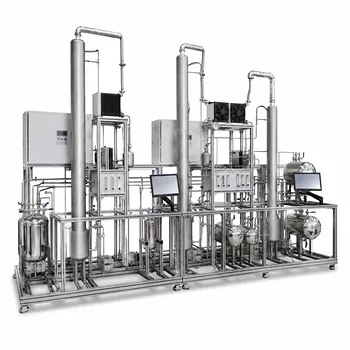
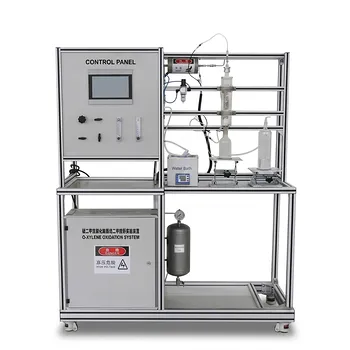
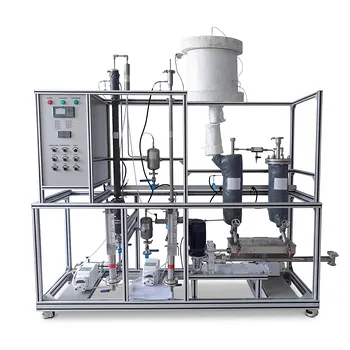
Isothermal reactors for an ethylbenzene dehydrogenation pilot plant cut steam demand by about 50% thanks to continuous external heating, but they require expensive multi‑tubular construction. An adiabatic reactor is mechanically far simpler and cheaper, yet it demands multiple catalyst beds with interstage reheating just to reach a moderate 65–70% conversion. The choice ultimately hinges on whether you prioritize thermal efficiency and kinetic precision, or construction simplicity and industrial realism.
The fundamental difference lies in heat management. Isothermal designs supply heat uniformly along the catalyst bed, keeping temperature critical for selectivity constant. Adiabatic designs let the bed cool down as the endothermic reaction proceeds, which forces the process to use multiple stages and copious amounts of superheated steam to maintain acceptable kinetics.
Why the Reactor Choice Determines Your Pilot Plant’s Soul
Ethylbenzene dehydrogenation is strongly endothermic. Without a smart thermal strategy, the bed temperature plummets, conversion suffers, and the catalyst deactivates under the high steam loads needed to compensate. Your reactor choice is the primary lever you pull to manage this heat‑hungry chemistry.
The Isothermal Solution – Continuous Heat Supply
An isothermal multitubular reactor surrounds catalyst‑filled tubes with a hot heat‑transfer medium—often flue gas or a circulating molten salt. This delivers heat through the tube wall at every point along the reactor, maintaining a flat, near‑constant temperature profile. The result is a highly controlled environment that requires far less co‑fed steam to provide sensible heat, because the external jacket does the heavy lifting. This configuration is ideal for studying true reaction kinetics and heat transfer phenomena without a moving temperature baseline.
The Adiabatic Approach – Staged Temperature Profile
An adiabatic reactor has no external heating during the reaction; the only heat available comes from the incoming feed. As the endothermic reaction sucks energy from the stream, the temperature drops continuously along the catalyst bed. To prevent the outlet temperature from falling so low that kinetics grind to a halt, the process uses multiple adiabatic stages (commonly two or three beds), with interstage heaters that bring the stream back to the optimal inlet range of 580–600 °C. This design is rugged and inexpensive but inherently less efficient per pass, pushing conversion to around 65–70% in multi‑stage configurations.
Design Differences That Dictate Cost and Complexity
When you walk into a pilot plant bay, the physical footprint, steam piping, and wall of heaters tell you immediately which philosophy the designers chose.
Reactor Construction and Capital Cost
Isothermal reactors are engineering marvels with a price tag to match. They require precision‑fabricated tube bundles, a high‑temperature shell, and a robust circulation system for the heating fluid. This complexity drives up manufacturing costs and makes the reactor much harder to modify or scale. Adiabatic reactors are essentially simple insulated vessels filled with catalyst. Each stage is a low‑cost fixed bed, and the interstage heaters are often straightforward electric or fired units. For a pilot plant on a tight budget, adiabatic simplicity is extremely attractive.
Steam Management and Utility Consumption
The primary reference states that isothermal designs need roughly 50% less steam than an adiabatic train. This is because steam’s role shifts from being the primary heat carrier to primarily a diluent that keeps the reaction equilibrium favorable and suppresses carbon formation. In an adiabatic pilot plant, you will feed steam at a much higher ratio—often above the 1–1.5:1 mass ratio typical of isothermal operation—and you will also need to superheat it to high temperatures before injecting it at each interstage point. The steam header and utility cost are substantially larger.
Temperature Control and Conversion Profiles
Isothermal operation delivers a razor‑sharp temperature window. The entire catalyst bed can be held at the sweet spot of 580–600 °C, avoiding both the low conversion tail at the reactor exit and the high‑temperature coking zone above 600 °C that kills selectivity. Adiabatic operation sees a saw‑tooth temperature profile. Each stage begins hot, then cools by 50–100 °C or more before reheating. This variation means you can never keep the whole catalyst inventory at one ideal temperature; the per‑pass conversion is lower, and you need more total catalyst volume to achieve the same plant yield.
Operational Realities in a Pilot Plant Environment
Day‑to‑day running of the unit exposes striking practical differences that often sway the decision more than textbook theory.
Catalyst Performance and Regeneration
In an isothermal bed, the temperature uniformity minimizes hot spots that accelerate carbon laydown. Consequently, catalyst deactivation from coking is often slower, although regeneration can be more difficult because the entire tube bundle must be cleaned uniformly. Adiabatic beds, with their varying temperature profile, may experience slightly more selective poisoning zones, but the simple straight‑vessel design makes it easier to remove and replace catalyst or to conduct in‑situ regeneration.
Research and Educational Goals
Isothermal pilot plants are superb for kinetic experiments. Because you eliminate the temperature gradient as a confounding variable, you can measure intrinsic rate constants and diffusion limitations with high confidence. Adiabatic units excel at teaching industrial process dynamics. The need to manage interstage reheat, the impact of feed temperature on conversion fall‑off, and the interplay of steam ratio with bed temperature all mimic real‑world operations faithfully. If your pilot plant’s mission is to screen catalysts under plant‑like temperature gradients, an adiabatic setup delivers more relevant data.
Scale‑Up Representation
Commercial ethylbenzene dehydrogenation plants overwhelmingly use multi‑stage adiabatic reactors with interstage reheating. Data generated from an adiabatic pilot plant therefore translate more directly to full‑scale design, especially for pressure drop and catalyst deactivation patterns. Isothermal pilot data are invaluable for separating heat and kinetic effects, but scaling them up to an industrial adiabatic train requires extra modeling steps that introduce error.
Understanding the Trade‑offs
No single design is universally superior; each forces you to accept a set of hard constraints.
Isothermal reactors force you to pay more for hardware upfront and accept higher maintenance complexity (tube fouling, hot fluid leaks, more complex startup procedures). Their thermal elegance comes at a capital premium and makes them less flexible if you want to test radically different catalyst shapes or bed heights later.
Adiabatic reactors force you to accept higher steam consumption, larger catalyst inventories, and a more elaborate sequence of interstage heaters. The temperature gradients also complicate basic kinetic analysis. Yet their mechanical simplicity and lower construction cost often make them the only viable choice for a pilot plant that must be built quickly or operated by students without risking expensive equipment damage.
Making the Right Choice for Your Pilot Plant’s Mission
Your decision must mirror what you need the pilot plant to teach or prove.
- If your primary focus is fundamental kinetic research and precise temperature control: Choose an isothermal multitubular reactor. It eliminates the temperature variable and lets you dissect rate phenomena with the cleanest possible data.
- If your primary focus is demonstrating industrial‑style multistage operation and process dynamics: Choose an adiabatic staged‑bed system. It mirrors commercial reality and gives you true experience with interstage reheating and steam ratio optimization.
- If your primary focus is minimizing utility costs and steam usage: The isothermal reactor’s 50% lower steam demand will pay dividends, assuming you can accept the higher initial investment.
- If your primary focus is budget and construction simplicity: The adiabatic train’s low‑cost, straightforward vessel design will get you to meaningful operation faster and with less infrastructure.
Your pilot plant’s reactor selection is never about which technology is “better” in a vacuum—it’s about the specific problem you are solving. Spell out your thermal management goals and mechanical constraints first, and the right reactor type becomes obvious.
Summary Table:
| Feature | Isothermal Reactor | Adiabatic Reactor |
|---|---|---|
| Heat Supply | Continuous external heating (jacket/bath) | No external heating during reaction (uses interstage heaters) |
| Steam Consumption | ~50% lower (used primarily as diluent) | Significantly higher (used as heat carrier and diluent) |
| Design Complexity & CAPEX | High (expensive multi-tubular construction) | Low (simple, cost-effective insulated vessels) |
| Temperature Profile | Uniform and flat (optimal selectivity) | Saw-tooth profile (cools across beds, then reheats) |
| Ideal Application | Precise kinetic research & fundamental studies | Industrial scale-up simulation & educational training |
Build Your Next Pilot Plant with LABPARK
Selecting the right reactor configuration is critical for achieving your research and training objectives. LABPARK provides state-of-the-art Educational and Vocational Unit Operations Pilot Plants in chemical engineering, bioprocess & biotech, and environmental & water treatment. Tailored for universities, research institutes, and enterprises, our systems deliver the operational flexibility and industrial realism you need to succeed.
Ready to design your custom pilot plant? Contact our engineering experts today to discuss your project requirements!
Related Products
- Ethylbenzene Dehydrogenation Educational Unit Operations Pilot Plant
- Crude Benzene Hydrogenation Educational Unit Operations Pilot Plant
- Methane Cracking Educational Unit Operations Pilot Plant
- Green Anhydrous Ethanol Purification Extractive Distillation Unit Operations Training Pilot Plant
- Carbon Dioxide Hydrogenation Methanol Synthesis Educational Unit Operations Pilot Plant
People Also Ask
- What parameters & reactor configurations are needed for ethylbenzene dehydrogenation pilot plants?
- Why is steam dilution critical in dehydrogenation? Pilot Plant Control Guide
- How do pilot plants help students verify material balances? Bridge Theory with Real-world Data
- Why is the steam-to-feedstock ratio critical in catalytic dehydrogenation? Learn the 3 key roles of steam.
- How do collocation methods assist in pilot plant scaling? Simplify complex chemical engineering models.