Steam dilution isn’t an optional add‑on—it’s the thermodynamic lever that makes endothermic dehydrogenation feasible.
Steam performs three indispensable jobs simultaneously: it lowers reactant partial pressure to drive equilibrium conversion, supplies the massive sensible heat the reaction absorbs, and continuously removes coke from the catalyst surface. In a chemical engineering pilot plant, precise metering of steam and hydrocarbon—using mass flow controllers, vaporizers, and online analytics—allows students and researchers to replicate industrial performance, quantify the impact of the steam‑to‑feed ratio, and bridge textbook theory with real‑world optimisation.
Dehydrogenation reactions are equilibrium‑limited and strongly endothermic. Steam dilution solves both dilemmas at once by shifting the equilibrium toward higher conversion, carrying the thermal energy that sustains the reaction, and gasifying the carbon that would otherwise deactivate the catalyst. Managing this ratio precisely in a pilot plant is the key that unlocks both fundamental understanding and practical scale‑up.
Why Steam Dilution is Non‑Negotiable in Dehydrogenation
The Thermodynamic Lever: Shifting Equilibrium by Lowering Partial Pressure
Dehydrogenation is a molecule‑increasing reaction—one mole of alkane splits into two moles of products (e.g., ethane → ethylene + H₂).
According to Le Chatelier’s principle, lowering the pressure favours the side with more moles of gas.
Instead of using costly and mechanically complex vacuum systems, steam is injected as an inert diluent.
Its low molecular weight (18 g/mol) maximises the partial‑pressure reduction of the hydrocarbon feed.
At a constant total pressure, adding steam pushes the equilibrium to significantly higher conversion without changing the reactor temperature or catalyst.
In a pilot plant, students can watch this effect in real time—doubling the steam rate can raise the equilibrium yield by 15–25 percentage points.
The Heat Carrier: Delivering Thermal Energy Without Temperature Collapse
The dehydrogenation of light alkanes consumes roughly 130–140 kJ of energy per mole reacted.
Without a continuous supply of heat, the catalyst bed would quench and the reaction would stall within seconds.
Superheated steam (typically entering at 700–800 °C) acts as a high‑heat‑capacity thermal flywheel.
Its specific heat capacity (~2 kJ/kg·K) means it can deliver a large amount of sensible heat while dropping only a few tens of degrees across the bed.
This minimises the adiabatic temperature drop and keeps the reaction rate high throughout the reactor length—a behaviour that pilot‑plant thermocouple arrays reveal with striking clarity.
The Catalyst Guardian: Suppressing Coke via the Water‑Gas Shift
Carbon deposition (coking) is the primary deactivation pathway in dehydrogenation.
Coke blocks active sites, increases pressure drop, and can create hot spots that locally damage reactor tubes.
Steam reacts with surface carbon through the water‑gas shift reaction (C + H₂O ⇌ CO + H₂), continuously gasifying the coke precursors before they consolidate.
This shifts the net carbon balance and extends catalyst lifetime by orders of magnitude.
In a pilot plant, monitoring the CO/CO₂ content in the effluent provides a direct, real‑time indicator of how effectively the steam is performing its decoking duty.
Managing Steam Dilution in Chemical Engineering Pilot Plants
Precision Metering and Feed Control
Educational and research pilot plants rely on mass flow controllers (MFCs) for gaseous feeds and precision syringe pumps or controlled evaporators for liquid organics and water.
The water is turned into stable, superheated steam in a dedicated preheater, guaranteeing a pulse‑free, well‑characterised flow.
The steam‑to‑hydrocarbon mass ratio (or its molar equivalent, the steam‑to‑carbon ratio) becomes the master control variable.
Typical design ranges are 1.0–2.0 kg/kg for isothermal lab rigs and 1.3–1.8 kg/kg for adiabatic reactors.
Students learn to calibrate these devices and verify the actual ratio using online mass spectrometry or frequent gas‑chromatograph sampling, transforming a conceptual variable into a tangible operational setpoint.
Selecting the Right Ratio: A Balancing Act
The chosen ratio is not a one‑size‑fits‑all number—it reflects the coking tendency of the feedstock.
Light feeds like ethane or propane require only moderate dilution (0.3–0.5 kg steam per kg feed), while heavier naphtha or diesel cuts demand ratios above 1.0, and crude oil can require up to 5.0 kg/kg.
In a pilot plant, a typical experiment involves a parametric sweep over the steam ratio while measuring conversion, selectivity to the desired olefin, and the pressure drop across the catalyst bed.
The optimum is the minimum ratio that suppresses coke without wasting energy on excess steam.
Students also use axial temperature profiles to detect flow maldistribution or the early signs of coking—teachable moments that connect operational discipline to catalyst health.
Operational Integration: Preheating, Mixing, and Separation
Before entering the reactor, the organic feed and steam must be perfectly homogenised.
Pilot plants use static mixers or packed preheat zones to eliminate cold spots that would otherwise trigger rapid coking.
Downstream, the large water load must be removed cleanly.
A knock‑out pot and condenser separate the aqueous phase, leaving dry product gases for analysis.
Heated sample lines prevent premature condensation, and proper drains prevent water slugs from damaging instruments.
This integrated loop teaches the full process‑engineering picture, from feed preparation to safe effluent handling.
Understanding the Trade‑offs and Pitfalls
The Energy and Cost Penalty of Excess Steam
While a higher steam ratio always helps equilibrium and decoking, it comes at a steep price.
Generating superheated steam requires significant utility heat, and condensing it downstream consumes cooling energy.
In an industrial context, excessive dilution dilutes the product stream and raises separation costs.
Pilot plant studies that close the energy balance around the reactor and steam generator make this trade‑off quantifiable.
Students quickly learn that the “best” ratio is an economic optimum, not a thermodynamic maximum.
Material and Corrosion Challenges
High‑temperature steam can cause metal dusting, carburisation, and hydrogen embrittlement in reactor tubes.
The alloy selection (e.g., 9Cr‑1Mo or higher‑alloy steels) becomes critical, and the pilot plant provides a safe environment to observe the consequences of inadequate materials or steam interruptions.
In some processes, trace sulfur in the feed can be managed by the steam atmosphere to inhibit corrosion on the tube surface, a nuance often explored in pilot experiments.
Common Operational Pitfalls in the Lab
- Inadequate preheating introduces liquid droplets that cause thermal shock and instant coking.
- Poor mixing creates local zones with low steam‑to‑carbon ratios, triggering runaway deactivation.
- Condensation in unheated sample lines skews analytical results and can plug delicate capillaries.
- Relying on a single ratio without understanding its dynamic impact on pressure drop and temperature profile masks the true state of the catalyst.
A well‑designed pilot plant includes alarms and interlocks that stop the hydrocarbon feed if steam flow drops, transforming these pitfalls into powerful lessons in process safety.
Making the Right Choice for Your Pilot Plant Goals
The way you manage steam dilution should directly reflect what you want to learn or demonstrate.
- If your primary focus is demonstrating thermodynamic fundamentals: Use a fixed, generous ratio (e.g., 1.5 kg steam/kg ethane) and show the equilibrium conversion shift. Calculate the partial‑pressure effect from first principles.
- If your primary focus is catalyst optimisation: Run a parametric study of steam‑to‑carbon ratios, tracking activity and pressure drop over time, to identify the lowest ratio that still prevents measurable coke accumulation.
- If your primary focus is industrial‑scale reactor design: Operate the pilot rig adiabatically with a realistic ratio (1.3–1.8 kg/kg) and record the axial temperature and composition profiles to validate a kinetic model for scale‑up.
- If your primary focus is safety and operational robustness: Implement a low‑steam‑flow interlock that immediately stops organic feed—a practical exercise in hazard prevention that mirrors plant‑wide protection systems.
Mastering steam dilution in a pilot plant transforms an abstract thermodynamic principle into a tangible, multivariable optimisation problem—one that sits at the very heart of dehydrogenation economics and safe reactor design.
Summary Table:
| Role of Steam | Mechanism | Pilot Plant Control & Monitoring |
|---|---|---|
| Shift Equilibrium | Lowers hydrocarbon partial pressure for higher conversion | Mass flow controllers & online gas chromatography |
| Deliver Heat | High-heat-capacity carrier to sustain endothermic reaction | Superheaters, preheat zones & thermocouple arrays |
| Suppress Coking | Gasifies surface carbon via water-gas shift reaction | Monitoring CO/CO₂ effluent ratio in real-time |
Elevate Your Chemical Engineering Lab with LABPARK
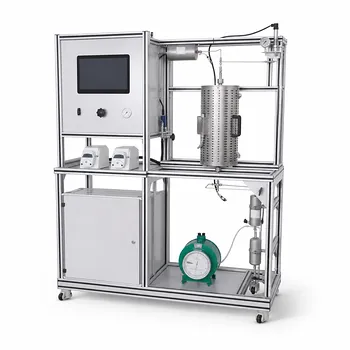
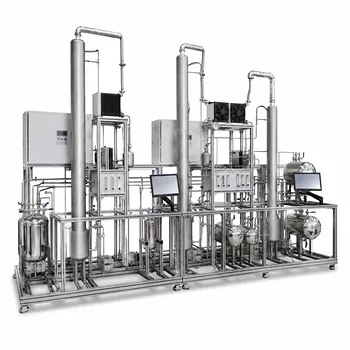
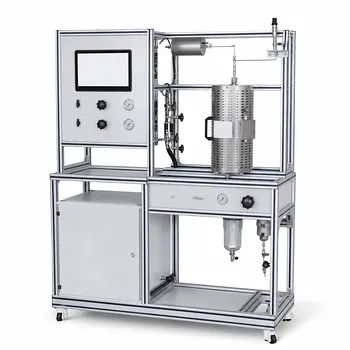
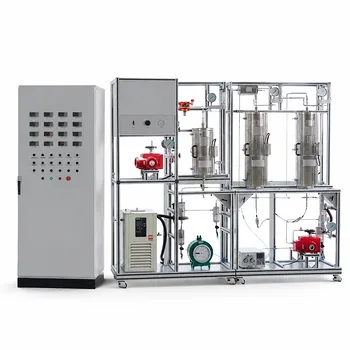
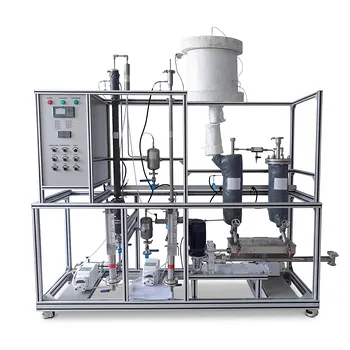
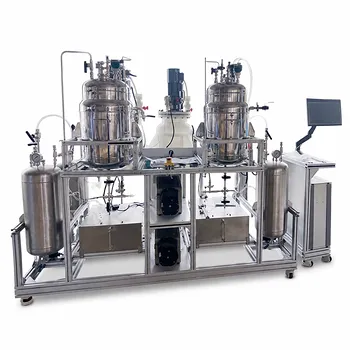
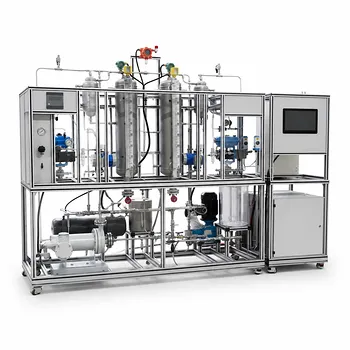
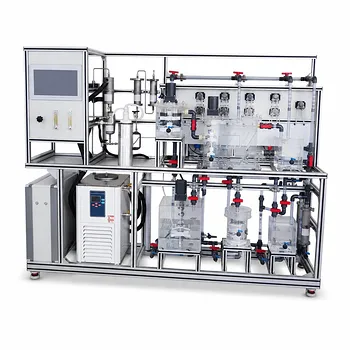
To bridge the gap between thermodynamic theory and industrial practice, universities, research institutes, and enterprises need precise, reliable equipment. LABPARK provides premium Educational and Vocational Unit Operations Pilot Plants in chemical engineering, bioprocess & biotech, and environmental & water treatment.
Our pilot plants feature advanced metering, preheating, and analytics, allowing students and researchers to master critical concepts like steam-to-carbon ratio optimization and process safety.
Ready to enhance your hands-on training and research capabilities? Contact LABPARK today to find the perfect pilot plant solution for your institution!
Related Products
- Ethylbenzene Dehydrogenation Educational Unit Operations Pilot Plant
- Green Anhydrous Ethanol Purification Extractive Distillation Unit Operations Training Pilot Plant
- Carbon Dioxide Hydrogenation Methanol Synthesis Educational Unit Operations Pilot Plant
- 100L Continuous Loop Hydrogenation Educational Unit Operations Pilot Plant
- Crude Benzene Hydrogenation Educational Unit Operations Pilot Plant
People Also Ask
- What parameters & reactor configurations are needed for ethylbenzene dehydrogenation pilot plants?
- Isothermal vs Adiabatic Reactors: Key Differences in Ethylbenzene Dehydrogenation Pilot Plants
- How do pilot plants help students verify material balances? Bridge Theory with Real-world Data
- Why is the steam-to-feedstock ratio critical in catalytic dehydrogenation? Learn the 3 key roles of steam.
- How do collocation methods assist in pilot plant scaling? Simplify complex chemical engineering models.