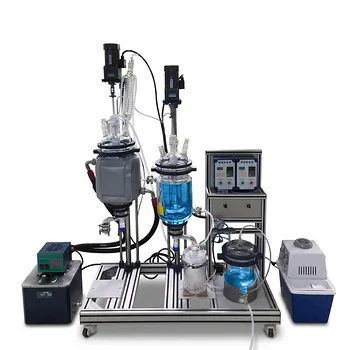
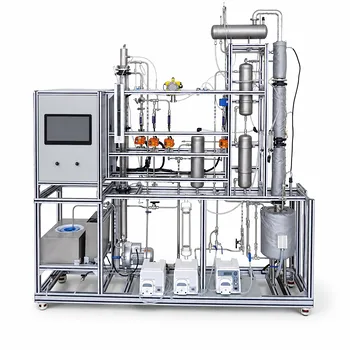
The core advantage of vacuum evaporation is protecting product quality, but the hidden cost is a fight against physics. By lowering the operating pressure, you lower the boiling point of the solvent, which allows you to remove water or solvents with gentle heat. This prevents thermal degradation of the product. However, operating in a vacuum introduces a significant physical trade-off: the same low temperatures that save your product also increase liquid viscosity and vapor volume, which directly attacks your heat transfer efficiency and increases equipment size.
Successfully processing heat-sensitive materials in a pilot plant isn't just about pulling a vacuum. It is a balancing act between preventing chemical damage from heat and managing the physical constraints of increased viscosity and vapor handling that come with low-temperature operation.
The Core Advantage: Preserving Product Integrity at Low Temperatures
The primary reason to use a vacuum is to prevent thermal damage. Many high-value products—like pharmaceuticals, certain foods, and biological extracts—will degrade, react, or change flavor if exposed to high heat.
How Vacuum Protects Sensitive Molecules
When you reduce the pressure in an evaporator vessel, you lower the boiling point of the liquid. This allows vigorous evaporation to occur at temperatures far below normal atmospheric boiling.
This is critical for two reasons. First, it simply avoids the temperature threshold that triggers a chemical reaction in the product. Second, it can create a larger temperature difference between your heating medium (steam) and the boiling liquid, which is the fundamental driving force for heat transfer.
The Benefit is Also a Design Constraint
This low-temperature environment makes vacuum evaporation the only viable option for many biological and pharmaceutical applications. The goal is to concentrate the product without destroying the active ingredient.
The necessity of a low temperature is not just an operational choice; it becomes the non-negotiable starting point for all other engineering decisions in the pilot plant.
The Fundamental Trade-off: The Viscosity Barrier
The very condition that protects your product—low temperature—creates the biggest process challenge. A lower operating temperature almost always results in a significant increase in the solution’s viscosity.
The Domino Effect on Heat Transfer
This increase in viscosity has a direct and negative impact on fluid dynamics. It thickens the liquid film on the heat exchanger surface and dampens turbulent flow.
This change directly lowers the overall heat transfer coefficient. You are effectively trading thermal protection for heat transfer resistance. The efficiency you gained with a larger temperature driving force is now being eaten away by a sluggish, viscous liquid film.
A Special Challenge for Falling Film Evaporators
This is particularly problematic for certain evaporator types. A standard falling film evaporator relies on gravity to create a thin, uniform film on the tube walls for efficient heat transfer.
With a highly viscous feed, the liquid cannot flow properly. It fails to create a uniform film, leading to dry spots, rapid fouling, and a complete breakdown of performance. This is why standard falling film units are often unsuitable for highly viscous or scaling-prone solutions, even though they are excellent for thin, heat-sensitive ones.
Design as a Resolution: Matching Evaporator Type to Feedstock Properties
You cannot overcome the viscosity trade-off with brute force. The solution is a proactive design choice based on your specific feedstock properties. The type of evaporator you select is what ultimately resolves the tension between thermal sensitivity and fluid dynamics.
When Heat Sensitivity is the Paramount Concern
For products where thermal degradation is the single largest risk and viscosity remains moderate, falling film evaporators are often the gold standard. They are specifically designed for minimal residence time and low liquid holdup.
This means the product only contacts heat for seconds. However, a critical design rule applies: if the evaporation rate is high (typically over 30%), you must incorporate a recirculation loop to mix concentrate back into the feed. This keeps the flow rate high enough to maintain a complete wetting film on the tubes, preventing dry spots.
When Viscosity and Fouling are the Greater Threats
For feedstocks that become highly viscous, tend to crystallize, or form scale during concentration, a more aggressive mechanical solution is needed. A scraped thin film evaporator is the ideal choice here.
This design uses mechanical rotating blades to physically spread the liquid into a thin film. The blades also continuously wipe the heat transfer surface, preventing fouling and ensuring the film remains uniform regardless of the liquid's viscosity. This is the hard engineering solution to the viscosity problem.
Designing the Vacuum System for Reality
The mechanical design of the vacuum system must account for the vapor's physical properties. At low pressures, vapor density drops dramatically, creating a massive volumetric flow.
This means packed columns are strongly preferred over tray columns in vacuum service for their much lower pressure drop. Furthermore, the entire vessel must be mechanically designed as a pressure vessel in reverse, with walls thick enough to withstand external atmospheric pressure and prevent implosion. This is a safety and cost factor that is often underestimated.
Making the Right Choice for Your Goal
The correct pilot plant configuration is not universal; it is a direct function of your specific objectives and material constraints.
- If your primary focus is maximum product purity with a non-scaling feed: Select a falling film evaporator. Ensure your design includes the capability for a product recirculation loop to manage the wetting rate at high evaporation ratios.
- If your primary focus is processing a viscous, scaling, or crystallizing fluid without degradation: Invest in a scraped thin film evaporator. The mechanical complexity is a necessary trade-off to overcome the viscosity barrier and maintain long operational runs.
- If your primary focus is minimizing capital and operational complexity for a heat-sensitive material: Investigate steam distillation as a potential alternative, but only if your product is immiscible with water, as this avoids the high cost of the vacuum system entirely.
The art of pilot plant design for these materials isn't about finding an option without trade-offs; it’s about choosing the specific physical constraints you are best equipped to manage.
Summary Table:
| Evaporator Type | Best Used For | Key Advantage | Major Challenge |
|---|---|---|---|
| Falling Film | Low-viscosity, highly heat-sensitive liquids | Minimal residence time & low hold-up | High risk of dry spots & fouling |
| Scraped Thin Film | Viscous, scaling, or crystallizing fluids | Mechanical agitation maintains thin film | High mechanical complexity & cost |
Elevate Your Unit Operations with LABPARK
Are you looking to optimize process training or scale up research? LABPARK provides state-of-the-art Educational and Vocational Unit Operations Pilot Plants in chemical engineering, bioprocess & biotech, and environmental & water treatment.
Designed specifically for universities, research institutes, and enterprises, our systems offer hands-on training, reliable scaling, and robust performance to bridge the gap between theory and industry.
Contact LABPARK Today to find the perfect pilot plant configuration for your laboratory!
Related Products
- Circulating Wind Tunnel Drying and Convective Heat Transfer Coefficient Determination Educational Pilot Plant
- Rising and Falling Film Evaporation Educational Unit Operations Pilot Plant
- Supercritical High-Gravity Flash Evaporation Educational Unit Operations Pilot Plant
- Carbon Material Thermal Pretreatment Multiphase Separation Educational Pilot Plant
- Multi-Functional Special Distillation Educational Pilot Plant
People Also Ask
- Why transition from laminar to turbulent flow is critical in convective heat transfer pilot plants?
- How does a unit operations pilot plant demonstrate fluid velocity vs heat transfer coefficient?
- How do tube arrangement & orientation affect condensation heat transfer? Optimize pilot plant performance.
- Why Are Thermal Properties Critical in Pilot Plants? Key Material Selection Factors
- What characterizes the transition to the falling rate drying period? Key scale-up insights.