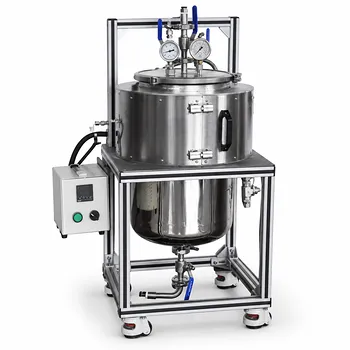
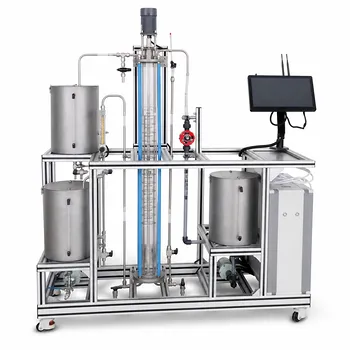
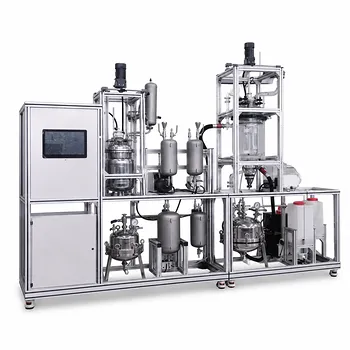
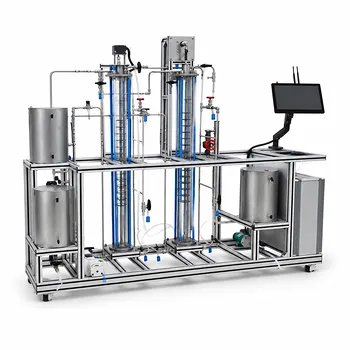
The fundamental steps of leaching are surprisingly simple, but their mastery defines an entire discipline.
At its core, leaching (solid-liquid extraction) consists of two operational steps: first, creating intimate contact between a solid matrix and a liquid solvent so the target solute can dissolve; second, separating the solute-rich liquid (the leachate) from the depleted solid residue. In chemical engineering pilot plants, these steps are systematically recreated to transform empirical art into quantifiable science—enabling researchers to optimize temperatures, particle sizes, flow rates, and contact times while studying the thermodynamics, mass transfer kinetics, and multi‑stage extraction calculations that drive industrial applications from hydrometallurgy to pharmaceuticals.
While the operational steps are straightforward, studying leaching inside a pilot plant turns it into a predictive tool. Engineers use these scaled-down systems to measure recovery kinetics, validate thermodynamic models, and determine stage efficiencies—bridging the gap between theoretical textbooks and full-scale production.
The Two Operational Steps of Leaching
The process, no matter the industry, always unfolds through the same sequence: contact, then separation. Understanding each step’s fundamentals is essential before adding the complexity of a pilot plant.
Step 1 – Establishing Intimate Solvent-Solid Contact
The solid matrix must be thoroughly wetted by the solvent so that the soluble constituent can migrate into the liquid phase. In a pilot plant, this contact is achieved through agitation, percolation, or heap‑like setups, each engineered to maximise interfacial area and minimise mass‑transfer resistance. The efficiency of this step depends heavily on particle size reduction, because a smaller solid exposes more solute-bearing surface to the solvent.
Step 2 – Separating the Phases
Once the solute has dissolved, the mixture must be split into a clear leachate and a solid residue. This phase separation is typically accomplished via sedimentation, filtration, or centrifugation directly on the pilot skid. In educational pilot plants, the separation stage is often deliberately designed to be visible and measurable, so students can quantify exactly how much solute was recovered and how much solvent remains trapped in the cake.
How Pilot Plants Bring the Process to Life
A well‑designed leaching pilot plant does more than just repeat the two steps; it turns them into a controllable experimental platform where chemical engineering principles are tested, measured, and challenged.
Manipulating Critical Process Variables
Pilot plants allow operators to isolate and vary the parameters that govern extraction efficiency. Students and researchers can adjust the solvent flow rate, contact time, temperature, and lixiviant concentration while monitoring the effect on solute recovery. For example, raising the temperature typically accelerates dissolution, but it may also increase unwanted side reactions or energy costs—a tension that becomes visible only when the variables can be controlled independently.
Quantifying Mass Transfer Kinetics
In an agitated batch reactor, the rate‑limiting step of the overall process can be identified by fitting experimental data to kinetic models. When ore particles are leached with acid, for instance, the shrinking core model is often applied: the reaction begins at the outer shell of the particle and propagates inward, leaving behind a porous product layer. By measuring leachate concentration over time, pilot-plant users can determine whether the rate is controlled by diffusion through the liquid film, diffusion through the solid product layer, or the chemical reaction itself—insights that are impossible to extract from a simple beaker experiment.
Applying Multi‑Stage Extraction Theory
Industrial leaching rarely happens in a single stage. Pilot plants equipped with multiple contactors teach the principles of counter‑current operation and stage efficiency. Users can calculate the number of theoretical stages using graphical methods, such as rectangular X‑Y diagrams for completely immiscible systems, and then compare that theoretical ideal with the actual performance of their physical stages. This direct comparison reveals how far reality deviates from equilibrium and helps students understand the concept of stage efficiency.
Validating Thermodynamic Feasibility
Every leaching reaction has an underlying thermodynamic signature. By measuring solute concentrations at equilibrium and calculating the standard Gibbs free energy change (ΔG⁰ = -RT ln K), researchers on a pilot plant can determine whether a reaction is thermodynamically favourable and how far it can proceed. This data guides the choice of operating temperatures and the decision to use excess leaching agent to shift the equilibrium toward complete recovery.
Understanding the Trade‑offs and Limitations
Pilot-scale studies are powerful, but they are not perfect mirrors of industrial reality. A responsible advisor must highlight the common pitfalls and compromises.
- Batch vs. continuous flow: Agitated batch reactors provide excellent kinetic data but often over‑simplify the fluid dynamics and channelling effects that plague large‑scale heap‑leaching operations.
- Model assumptions: The shrinking core model assumes spherical, monodisperse particles and a single rate‑limiting step; real solids have irregular shapes, broad size distributions, and multiple simultaneous resistances.
- Solvent consumption: Achieving high recovery often demands large excesses of solvent or reagent, which raises both operating costs and environmental load—a factor easily overlooked when the goal is simply maximising experimental yield.
- Stage efficiency complexity: Moving from theoretical diagrams to actual multi‑stage pilot rigs introduces mixing inefficiencies, bypassing, and entrainment, all of which reduce the effective number of stages and make scale‑up predictions uncertain without careful efficiency data.
Making the Right Choice for Your Study Goals
Your specific learning objective or research question should dictate how you configure and operate the leaching pilot plant. Use the bulleted guidance below to align your experimental design with your desired outcome.
- If your primary focus is understanding fundamental kinetics: Run carefully controlled single‑stage batch experiments where you vary only one parameter at a time (temperature, particle size, or lixiviant concentration) and fit the data to a shrinking core or empirical rate law.
- If your primary focus is optimising industrial recovery: Configure the pilot plant for continuous multi‑stage operation and systematically explore the trade‑off between recovery percentage and reagent consumption, using stage‑efficiency calculations to predict full‑scale performance.
- If your primary focus is comparing solvent systems: Operate under identical hydrodynamic conditions (fixed agitation speed and solid‑to‑solvent ratio) while swapping solvents, and measure both equilibrium concentrations and rates to rank solvents on both thermodynamic and kinetic grounds.
- If your primary focus is bridging theory and practice: Start with the simplest possible experiment (a single, well‑defined batch) to confirm the thermodynamic equilibrium, then layer on complexity step by step until the pilot plant behaviour begins to mirror the real‑world process you ultimately need to design.
A leaching pilot plant is far more than a scaled‑down production line—it is the clearest lens through which you can see the physical chemistry, kinetics, and economics of solid-liquid extraction working together.
Summary Table:
| Study Focus | Experimental Configuration | Key Variables / Models |
|---|---|---|
| Fundamental Kinetics | Single-stage batch experiments | Temperature, particle size, shrinking core model |
| Industrial Recovery | Continuous multi-stage operation | Stage-efficiency calculations, solvent consumption |
| Solvent Systems | Fixed hydrodynamic conditions | Equilibrium concentrations, thermodynamic ranking |
| Theory & Practice | Step-by-step scaling (batch to continuous) | Thermodynamic equilibrium, real-world deviation |
Bring Chemical Engineering Principles to Life with LABPARK
Are you looking to enhance your research capabilities or elevate student learning? LABPARK provides premium Educational and Vocational Unit Operations Pilot Plants in chemical engineering, bioprocess & biotech, and environmental & water treatment. Designed specifically for universities, research institutes, and enterprises, our advanced pilot plants help you seamlessly bridge the gap between theoretical extraction concepts and real-world industrial operations.
Contact LABPARK Today to find the perfect pilot plant configuration for your laboratory!
Related Products
- Hot Filtration Educational Unit Operations Pilot Plant Laboratory System
- Educational Rotary Disc Liquid-Liquid Extraction Pilot Plant
- Gallium and Indium Selective Extraction Educational Pilot Plant
- Comprehensive Liquid-Liquid Extraction Pilot Plant for Engineering Education
- Natural Product Extraction Unit Operations Training Pilot Plant
People Also Ask
- How to Determine Specific Cake (r) & Filter Medium (Rm) Resistance Using Filtration Pilot Plant Data
- How can researchers identify and resolve filter medium blinding? Optimize Your Pilot Plant Runs
- How to select solid-liquid separation equipment for pilot plants? A Step-by-Step Guide
- Why Demo Constant-Rate to Constant-Pressure Filtration on a Pilot Plant? Key Practical Insights
- How do Buchner funnels & leaf filters differ in filtration scale-up? Key Differences Explained