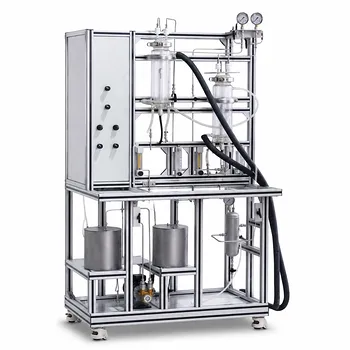
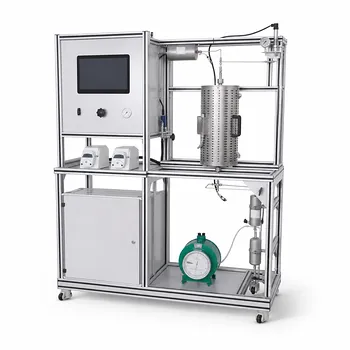
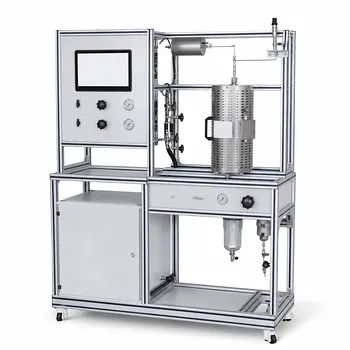
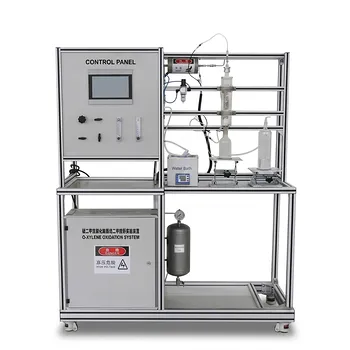
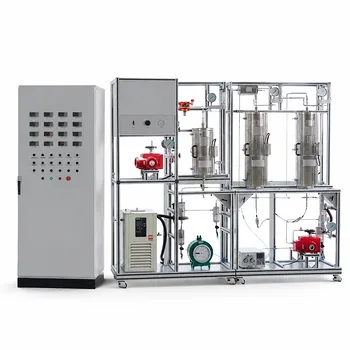
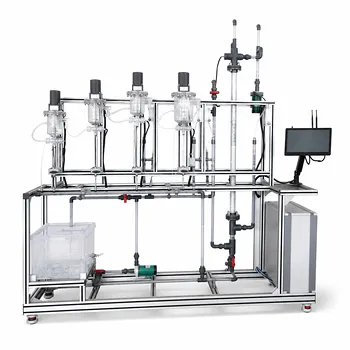
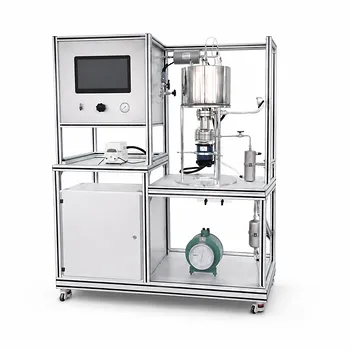
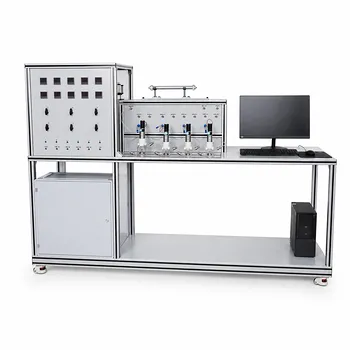
Polymerization reactors in a pilot plant push heat transfer and fluid rheology to their limits—both must be mastered simultaneously or the process fails.
The core physical challenge is that the reaction generates intense exothermic heat while the medium’s viscosity climbs by orders of magnitude, often turning non-Newtonian. As viscosity rises, heat removal plummets, mixing becomes harder, and the risk of thermal runaway or product non-uniformity skyrockets. A pilot-scale unit must therefore combine smooth heat transfer surfaces swept by high-torque agitation, capable of handling the full viscosity range, with responsive heating/cooling jackets and precise temperature control to maintain safety and reproducible polymer properties.
The defining tension in pilot-plant polymerization is that heat generation and viscosity increase in lockstep. Survival depends on selecting agitation and heat-exchange equipment that continuously wipe a smooth surface with a highly viscous fluid while removing heat fast enough to prevent runaway—all while maintaining uniform mixing to control molecular weight distribution.
The Exothermic Hammer: Heat Transfer as a Primary Constraint
Polymerizations release some of the highest heats of reaction in chemical engineering, turning temperature control into the single most critical design target. In a pilot plant, failing to contain this heat leads to spatial hot spots, runaway reactions, and broad molecular weight distributions.
Understanding the Heat Load: Why Runaway Is a Constant Threat
High heats of polymerization mean the reactor must dissipate energy at a rate that matches or exceeds the reaction kinetics.
As conversion increases, the reaction often accelerates—especially in bulk systems—creating a self-reinforcing heat spike.
Without rapid heat removal, the temperature can rise uncontrollably, degrading product quality and creating safety hazards.
The Dead-Zone Trap: Why Standard Internals Fail
Standard heat transfer enhancements like internal coils or corrugated surfaces are dangerous in polymerization service.
These features create stagnant zones where high-viscosity fluid accumulates, fouls, and forms an insulating layer.
The result is uneven cooling, poor heat transfer, and a wide molecular weight distribution. Pilot units must instead use smooth heat transfer surfaces that are continuously swept by the agitator.
The Gel Effect and Auto‑acceleration: The Hidden Accelerant
In bulk polymerization, the ‘gel effect’ (Trommsdorff effect) suppresses termination reactions, dramatically accelerating the rate and heat generation.
This auto‑acceleration can catch an operator off‑guard if the heat removal system isn’t oversized for this phase.
A pilot reactor must be designed to handle this non‑linear heat load with a cooling system that responds rapidly and has enough reserve capacity.
Responsive Jackets and Coils: Design for High-Viscosity Heat Transfer
As viscosity rises, the heat transfer coefficient can drop by an order of magnitude, making it much harder to move heat through the wall.
Heavy‑duty heating/cooling jackets (or specialized internal coils with smooth, swept surfaces) are necessary to maintain a meaningful overall heat transfer coefficient.
These systems must be highly responsive—pilot units benefit from split‑range control, rapid‑switching heating/cooling loops, and high‑flow tempered water or oil systems.
The Viscosity Wall: Fluid Rheology and Mixing Challenges
Viscosity isn’t a constant—it’s a moving target that redefines the fluid mechanics of the reactor. Ignoring the rheological evolution is the fastest way to a stalled agitator or an unblended product.
Non‑Newtonian Behavior: Why Simple Impellers Won’t Cut It
Polymer melts and concentrated solutions often exhibit shear‑thinning, viscoelastic, or even yield‑stress behavior.
An impeller designed for water-like fluids will either waste energy or create a cavern of motion surrounded by stagnant gel.
The pilot reactor must be equipped with agitators that maintain motion throughout the entire vessel volume, even when the fluid’s apparent viscosity varies wildly with shear.
High‑Torque Agitation: From Anchors to Helical Ribbons
Handling viscosities that can reach 600 Pa·s at 300°C (as in melt polycarbonate production) demands impellers like anchors, frames, or helical ribbons.
These close‑clearance designs continuously wipe the vessel wall, minimize dead zones, and impart the needed torque to mix uniformly.
Variable‑speed drives with high torque capability are essential, as the power draw can spike dramatically when the fluid transitions from liquid to paste-like consistency.
Pumping and Conveying: Moving Mountains
At high viscosities, conventional centrifugal pumps become useless; you must treat the material more like a solid.
In pilot plants, it’s common to use extruders as combined pumps and mixers, or positive‑displacement gear pumps, to transfer the reaction mass.
The post‑reaction equipment—such as wiped‑film evaporators for devolatilization or settling zones in loop reactors—must also be sized and configured to handle the same high‑viscosity stream.
The Reactor Architecture: How Configuration and Process Type Shape Design
The polymerization route itself dictates which heat and rheology challenges dominate, and therefore how the pilot plant should be laid out.
Bulk vs. Solution: Heat Transfer Trade‑offs at a Glance
Bulk polymerization gives the purest polymer but combines extreme viscosity with the gel effect, demanding high‑torque agitators and aggressive heat removal.
Solution polymerization uses a solvent to slash viscosity, making temperature control much easier—but it introduces the need for solvent recovery, distillation, and purification unit operations downstream.
A pilot plant must integrate these separation steps, not treat them as afterthoughts, because they directly affect the economic and environmental viability of the process.
Heterogeneous Polymerization: Mass and Heat Transfer in Particles
When the active center sits in a dispersed phase (droplets or particles), reactants must diffuse in and heat must diffuse out of the particles.
If heat builds up locally inside a particle, it can deactivate the catalyst or create off‑spec polymer; mass transfer limitations can starve the reaction.
Pilot reactors for this route need highly controllable, variable‑speed agitation to prevent particle agglomeration and ensure uniform dispersion, along with precise temperature and pressure monitoring to handle diffusion‑limited kinetics safely.
Melt Polymerization: Extreme Conditions Under Vacuum
Processes like transesterification routes to polycarbonate push temperatures to 300°C and viscosities to 600 Pa·s while requiring vacuum levels as low as 130 Pa to remove volatile byproducts.
This demands a reactor that can maintain a tight seal under high vacuum while simultaneously delivering high torque and uniform heating.
The pilot plant must therefore incorporate robust vacuum systems, high‑temperature heating jackets, and impellers engineered for these extremes—often helical ribbons or twin‑blade designs.
Batch versus Continuous: Product Distribution Is a Design Variable
The same chemistry run in a batch or continuous reactor can produce polymers with vastly different molecular weight distributions and copolymer sequences.
Mixing patterns, residence‑time distribution, and recycle streams all influence the final product distribution, which is often the key learning objective in a pilot‑scale research program.
Instrumenting the reactor to measure these variables and being able to switch between batch and continuous modes is critical for developing reproducible specialty polymers.
The Hidden Risks: Trade‑offs and Common Pitfalls
No single design covers every polymerization scenario, and chasing one goal often compromises another. Recognizing these trade‑offs upfront is what separates a reliable pilot plant from a constant troubleshooting nightmare.
Smooth Surfaces vs. Heat Transfer Area
Smooth heat transfer surfaces are mandatory to avoid fouling, but they often provide less surface area than corrugated or finned alternatives.
Compensating with higher jacket flow rates or larger vessel diameters increases cost and footprint. You trade compactness for reliability—and in a pilot plant, reliability usually wins.
Intense Agitation vs. Polymer Degradation
High‑torque, close‑clearance impellers keep the fluid moving, but they can also impart enough shear energy to mechanically degrade long polymer chains.
This is particularly problematic for shear‑sensitive materials like certain elastomers or high‑molecular‑weight thermoplastics.
Selecting impeller speed and geometry requires balancing mixing uniformity against the acceptable level of chain scission.
Solvent Simplicity vs. Separation Complexity
Solution polymerization makes heat and mixing dramatically easier, but it offloads the difficulty to downstream separation.
A pilot plant that doesn’t include a realistic solvent recovery and purification loop generates data that won’t scale, because the economics and energy balance are incomplete.
Integrating wiped‑film evaporators, distillation columns, or membrane systems adds complexity but is essential for meaningful scale‑up studies.
Thermal Expansion and Material Integrity
The thermal properties of the reactor materials themselves—thermal expansion coefficient, thermal conductivity, specific heat capacity—dictate how the vessel and seals respond to temperature swings.
Mismatched materials can lead to leaks, gasket failures, or structural warpage when cycling between ambient and 300°C.
Careful material selection and stress analysis are as important as the fluid dynamics in ensuring safe, long‑term pilot operation.
Ignoring Post‑Reaction Unit Operations
Stopping at the reactor outlet is a classic pilot‑plant pitfall.
Devolatilization, monomer recovery, and solid‑handling steps (like extrusion and pelletizing) must be designed to handle the same high‑viscosity, potentially sticky stream.
If these units aren’t integrated from the start, the pilot reactor may produce polymer that simply cannot be processed, defeating its purpose as a scale‑up tool.
Making the Right Choice for Your Pilot Plant
Every design decision in a polymerization pilot plant is a trade‑off between heat removal, mixing effectiveness, and product quality. Align your equipment with your specific research or production goals using these targeted recommendations:
- If your primary focus is producing high‑purity bulk polymers: Invest in a reactor with smooth‑jacketed walls, a heavy‑duty high‑torque agitator (anchor or helical ribbon), and a cooling system sized to handle the gel‑effect peak. Eliminate all internal dead‑zone‑creating features.
- If your primary focus is process flexibility and easy heat removal: Choose solution polymerization with a suitable solvent. Plan for significant ancillary equipment—solvent recovery distillation columns, wiped‑film evaporators, and purification units—to make your pilot data scalable.
- If your primary focus is heterogeneous or melt polymerization research: Equip the reactor with variable‑speed agitation capable of handling extreme viscosities (up to 600 Pa·s), high‑temperature heating jackets (300°C+), and a robust vacuum system. Integrate precise pressure and temperature sensors to track diffusion‑limited kinetics.
- If your primary focus is studying product distribution reproducibility: Design the pilot plant to operate in both batch and continuous modes, with instrumentation to measure residence‑time distribution, mixing patterns, and recycle effects. This reveals how operating conditions translate to molecular weight and copolymer composition.
In a pilot plant, every detail—impeller geometry, jacket surface finish, solvent selection—decides whether you create a reproducible, safe process or a block of gelled polymer. Match your heat transfer and rheology strategy to the specific polymerization chemistry and your research objectives, and you’ll build a platform that generates insight, not just heat.
Summary Table:
| Polymerization Type | Heat Transfer Challenge | Fluid Rheology Challenge | Equipment / Design Solution |
|---|---|---|---|
| Bulk | Extreme exothermic heat (gel effect) | Rapidly rising viscosity | Smooth-jacketed walls, high-torque agitators (anchor/helical) |
| Solution | Manageable (solvent reduces heat load) | Low to moderate viscosity | Solvent recovery, distillation & purification systems |
| Heterogeneous | Localized heat buildup in particles | Particle agglomeration risk | Variable-speed agitation, precise temp/pressure sensors |
| Melt | High temp (300°C+), vacuum required | Extreme viscosity (up to 600 Pa·s) | High-temp jackets, robust vacuum seals, helical ribbon |
Scale Up Safely and Efficiently with LABPARK
Overcoming heat transfer and high-viscosity mixing challenges requires precision-engineered equipment. LABPARK provides premium Educational and Vocational Unit Operations Pilot Plants in chemical engineering, bioprocess & biotech, and environmental & water treatment.
We empower universities, research institutes, and enterprises to transition seamlessly from lab-scale research to industrial reality. Ready to configure your custom polymerization reactor or pilot system?
Contact our engineering experts today to discuss your application requirements!
Related Products
- Polymerization Granulation and Pellet Processing Educational Unit Operations Pilot Plant
- Photocatalytic Membrane Separation and Degradation Unit Operations Pilot Plant
- Methanol Synthesis and Catalyst Performance Evaluation Educational Unit Operations Pilot Plant
- Methane Cracking Educational Unit Operations Pilot Plant
- Multi-Stage Stirred Tanks in Series Residence Time Distribution and Mixing Performance Determination Educational Pilot Plant
People Also Ask
- How do educational unit operations pilot plants bridge theory and design? Bridge the Engineering Gap
- How do educational unit operations pilot plants address safety and waste management when scaling up?
- Why Compare Predicted and Experimental Excess Enthalpy? Key to Accurate Pilot Plant Scale-up
- When to transition from PID to adaptive control in pilot plants? Key process indicators.
- How to study gasification in pilot plants? Compare exit gas composition & efficiency