Knowledge Chemical Engineering Education What are the advantages of testing ceramic vs polymer membranes in pilot plants? Key differences.
Author avatar

Tech Team · LABPARK

Updated 2 weeks ago

What are the advantages of testing ceramic vs polymer membranes in pilot plants? Key differences.


The core advantage of testing both ceramic and polymer composite membranes in a pilot plant isn’t just about observing different material properties—it’s about conducting a systematic risk analysis for your full-scale process. A ceramic membrane allows you to validate process viability under the harshest possible conditions (high temperature, corrosive solvents, extreme pH), proving the chemistry can work without the variable of material degradation. Conversely, testing a polymer composite membrane lets you establish a cost-optimized baseline for standard operations, quantifying the exact economic trade-off between capital expenditure and operational longevity. By testing both side-by-side, you generate the necessary data to balance process safety against profitability.

The true value of comparative pilot testing is benchmarking. Ceramic membranes set the “unbreakable” upper performance limit, revealing what is physically possible. Polymer composites define your lowest-cost operating window, showing what is economically practical. The gap between the two is where your final process design decision actually lives.

Evaluating the Ceramic Advantage for Extreme Environments

In pilot-scale chemical engineering, the feed stream is often a synthetic mixture designed to stress-test the system. Ceramic membranes excel in these brutal environments where polymers simply fail.

Uncompromising Chemical Resistance

The primary reference correctly identifies that membrane material dictates compatibility. Ceramic membranes are inherently inert to organic solvents like DMF, NMP, and DMSO. Unlike polymeric materials, ceramics do not swell or dissolve when exposed to aggressive neutral solvents. This allows a pilot plant to validate separation processes for refinery streams or pharmaceutical syntheses without contaminating the permeate with leached membrane components.

High-Temperature Process Validation

Many industrial reactions, such as partial oxidation or high-temperature esterifications, occur at temperatures exceeding 100°C. A standard polymeric membrane cannot handle this heat load. A ceramic membrane in a pilot setup allows you to emulate industrial-scale thermal conditions directly. You can integrate the separator immediately downstream of a reactor without needing a costly and potentially fouling inter-stage heat exchanger.

Mechanical Longevity in Abrasive Feeds

Processing streams with suspended catalysts or crystalline particles creates an abrasive environment. Polymer surfaces can erode, but the high mechanical strength of sintered ceramics resists this wear. This durability ensures that a long-duration pilot trial isn’t compromised by pin-holes or ruptures mid-experiment. It guarantees data consistency over weeks or months of continuous operation.c

Understanding the Trade-offs: Why Not Always Use Ceramic?

While ceramics define the performance ceiling, the surface-level stability data is insufficient for a complete economic evaluation. The limitations are critical and must be quantified in your pilot plant.

The Brittleness and Sealing Complexity

Ceramics are inherently brittle and difficult to seal within reactor housings. A thermal shock event or a pressure spike that a flexible polymer tube might survive can shatter a ceramic element. Pilot-scale testing with ceramics forces your engineering team to develop robust startup and shutdown procedures. This operational complexity is a real hidden cost that must be factored into scale-up.

The 10x Capital Expenditure Barrier

The supplementary references confirm that ceramic membranes are frequently more than ten times the cost of polymers, driven by complex multilayer coating procedures and sintered tube supports. Testing a polymer composite membrane in the same pilot skid provides the direct comparison point. You can measure exactly how much flux or lifetime you sacrifice for that 90% capital cost reduction.

The Role of Polymer Composites

A polymer composite membrane isn't just cheap; it represents a middle ground. Incorporating inorganic additives into a polymer matrix boosts fouling resistance. By testing these alongside pure polymers and ceramics, you can pinpoint whether the incremental resistance of a composite is sufficient for your process, potentially avoiding the extreme expense of a full ceramic installation.

The Pedagogical and R&D Value of Direct Comparison

The primary reference astutely notes the advantage of incorporating both modules into educational setups. This isn't just academic busywork—it defines the operating envelope for industrial innovation.

Accelerated Material Screening

A single pilot plant equipped with interchangeable ceramic and polymer modules becomes a screening tool. You can run identical feeds through both materials to isolate membrane fouling propensity from process fluid dynamics. This creates a library of chemical compatibility data, allowing a chemical engineer to instantly rule out polymers for a highly oxidizing stream or rule out ceramic if the process economics demand a disposable, lower-cost element.

Building Operational Intuition

For vocational training, failing a cheap polymer membrane through a chemical attack is a powerful lesson in material science. Successfully cleaning a heavily fouled ceramic membrane with aggressive acid backwashes demonstrates the extreme recovery options that polymers lack. This builds a critical safety mindset: the understanding that material choice governs not just performance, but the entire safe operating envelope of a unit operation.

Making the Right Choice for Your Testing Program

Your strategy for pilot plant testing must align the material selection with your specific risk tolerance and data objectives. The material is a variable, not a given.

  • If your primary focus is de-risking a harsh chemical synthesis: Lead with ceramic membranes. The cost premium is an insurance policy against trial failure caused by equipment degradation rather than process design flaws.
  • If your primary focus is maximizing commercial viability: Always baseline with a polymer composite or pure polymer element. You need to prove that a cheaper material cannot work before committing to the expensive ceramic alternative.
  • If your primary focus is fundamental research or teaching: Install both in series or parallel. The side-by-side dataset showing the trade-off between high stability and low cost is the most valuable deliverable the pilot plant can produce.

By treating your pilot plant as a device to quantify the gap between chemical extremes and economic reality, you move beyond simple filter testing and into true process engineering.

Summary Table:

Feature Ceramic Membranes Polymer Composite Membranes
Chemical Resistance High (inert to aggressive solvents like DMF, NMP) Moderate to low (susceptible to swelling/degradation)
Thermal Tolerance Excellent (withstands temperatures >100°C) Limited (often requires upstream cooling)
Mechanical Durability High (resists abrasive feeds and crystals) Lower (risk of erosion, pin-holes, or rupture)
Relative Cost High CAPEX (~10x polymer) Low CAPEX (economical baseline)
Best For Extreme chemical synthesis and process safety Commercial viability benchmarking and standard operations

Optimize Your Process Design with LABPARK

Are you looking to bridge the gap between chemical extremes and process economics? LABPARK provides premium Educational and Vocational Unit Operations Pilot Plants in chemical engineering, bioprocess & biotech, and environmental & water treatment.

We help universities, research institutes, and enterprises safely test membrane performance, accelerate material screening, and de-risk industrial scale-ups.

Contact LABPARK today to find the perfect pilot plant configuration for your research or training needs!

Related Products

People Also Ask

Related Products

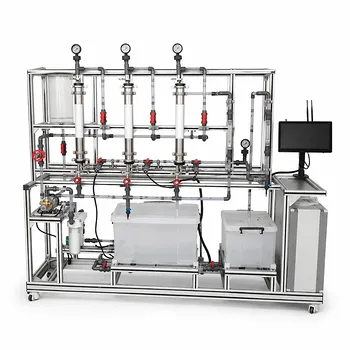
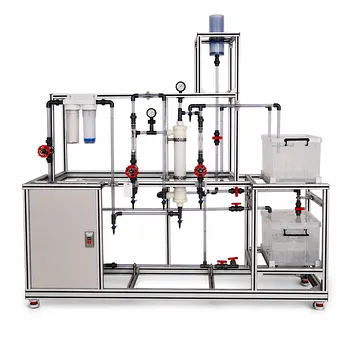
Multi-Functional Membrane Separation Educational Pilot Plant for Unit Operations Lab

Multi-Functional Membrane Separation Educational Pilot Plant for Unit Operations Lab

The Multi-functional Membrane Separation Educational Unit Operations Pilot Plant is an integrated bench-scale laboratory system designed for teaching undergraduate engineering education. It features Ultrafiltration, Nanofiltration, and Reverse Osmosis modules in a compact, mobile unit for practical hands-on learning.

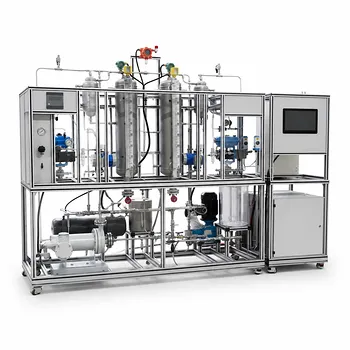
Multifunctional Membrane Separation Educational Pilot Plant with Ultrafiltration, Nanofiltration, Reverse Osmosis

Multifunctional Membrane Separation Educational Pilot Plant with Ultrafiltration, Nanofiltration, Reverse Osmosis

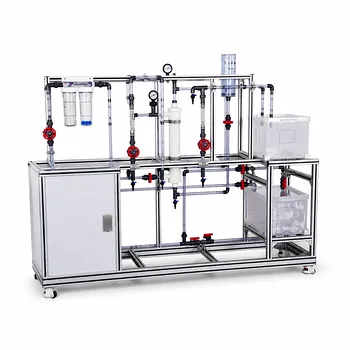
An integrated laboratory bench-scale membrane separation system for higher education engineering labs combining Ultrafiltration, Nanofiltration, and Reverse Osmosis processes. Features industrial PLC control with touch-screen HMI, transparent piping, and academic assessment software. Ideal for chemical and environmental engineering curricula.

Photocatalytic Membrane Separation and Degradation Unit Operations Pilot Plant

Photocatalytic Membrane Separation and Degradation Unit Operations Pilot Plant

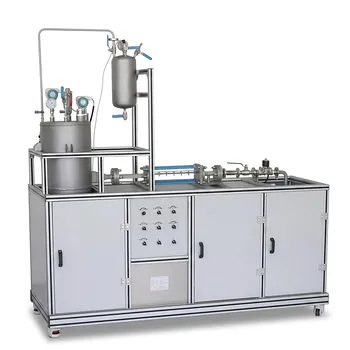
Bench-scale pilot plant integrating photocatalytic degradation with membrane separation for engineering education. Study advanced oxidation, microfiltration, and hybrid processes using industrial sensors. Features safety light-blocking curtain, low-noise compressor, and durable stainless-steel construction.

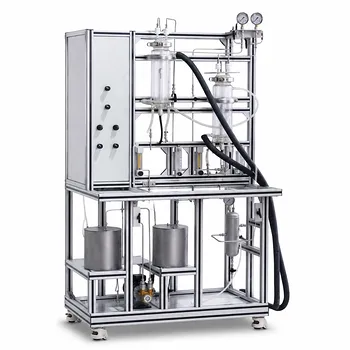
Multi Functional Membrane Crystallization Educational Unit Operations Pilot Plant

Multi Functional Membrane Crystallization Educational Unit Operations Pilot Plant

Integrated bench-scale membrane crystallization pilot plant for engineering education. Provides hands-on training in advanced separation technologies, combining membrane distillation crystallization and process intensification. Features variable scaling vessels, industrial-grade flow control, and interactive digital data acquisition. Customizable for university labs.

Constant Pressure Filtration Educational Unit Operations Pilot Plant

Constant Pressure Filtration Educational Unit Operations Pilot Plant

Hands-on educational pilot plant for constant pressure filtration. Classic plate and frame filter press allows students to study kinetics, determine specific cake resistance, perform cake washing and evaluate washing rates. Ideal for chemical engineering curriculum. Mobile, customizable, safety-compliant design.

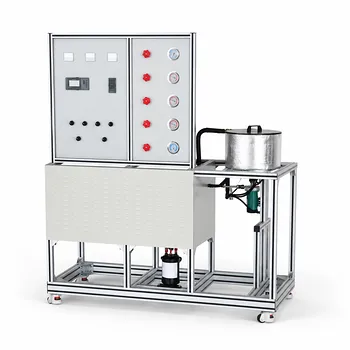
Rising and Falling Film Evaporation Educational Unit Operations Pilot Plant

Rising and Falling Film Evaporation Educational Unit Operations Pilot Plant

Hands-on educational pilot plant for studying rising and falling film evaporation, flow regimes, and heat transfer. Customizable for university labs with industrial instrumentation and data acquisition. Enables comparative evaluation of evaporation modes and energy efficiency.

Educational Compression Refrigeration Performance Determination Unit Operations Pilot Plant

Educational Compression Refrigeration Performance Determination Unit Operations Pilot Plant

This educational pilot plant for compression refrigeration performance determination offers dual COP evaluation, regenerative cycle comparison, and calorimeter calibration. Customizable for curriculum integration, it features environmentally conscious design. Supports thermodynamic mapping on pressure-enthalpy diagrams and synchronous monitoring with centralized instrumentation.

Alkaline Membrane Water Electrolysis Educational Pilot Plant Unit Operations Training System

Alkaline Membrane Water Electrolysis Educational Pilot Plant Unit Operations Training System

Hands-on educational pilot plant for alkaline membrane water electrolysis hydrogen production, integrating unit operations training with industrial PLC control, real-time data logging, customizable design, durable 316L stainless steel construction, explosion-proof safety, and modern 5G connectivity for university laboratories.

Ultrafiltration Membrane Separation Educational Pilot Plant

Ultrafiltration Membrane Separation Educational Pilot Plant

This ultrafiltration membrane separation educational pilot plant enables undergraduate students to process PVA solutions, study hollow fiber membrane dynamics, and perform quantitative analysis with spectrophotometry for hands-on learning of unit operations and industrial maintenance and membrane cleaning protocols.

Cavitation Phenomenon Demonstration and Analysis Educational Unit Operations Pilot Plant

Cavitation Phenomenon Demonstration and Analysis Educational Unit Operations Pilot Plant

Advanced educational pilot plant for demonstrating and analyzing cavitation phenomena in fluid systems. Features a transparent acrylic Venturi test section, high-precision pressure and flow sensors, digital data acquisition, and integrated safety relief valves for engineering curricula.

Hollow Fiber Ultrafiltration Membrane Separation Educational Pilot Plant

Hollow Fiber Ultrafiltration Membrane Separation Educational Pilot Plant

Explore our hollow fiber ultrafiltration membrane separation educational pilot plant for hands-on learning of industrial ultrafiltration processes, flux analysis, fouling mitigation, and process control. Compact, customizable, and built for engineering labs.

Multi Functional Catalytic Reaction and Reactor Evaluation Educational Unit Operations Pilot Plant

Multi Functional Catalytic Reaction and Reactor Evaluation Educational Unit Operations Pilot Plant

Bench-scale educational pilot plant for catalytic reaction and reactor evaluation, integrating fixed bed, fluidized bed, and stirred tank reactors. Students compare reactor designs, evaluate catalysts, and study reaction kinetics and hydrodynamics. Perfect for unit operations labs in chemical engineering curricula.

General Purpose Cosmetics Production Unit Operations Training Pilot Plant

General Purpose Cosmetics Production Unit Operations Training Pilot Plant

Integrated pilot-scale cosmetics production training plant for chemical engineering education featuring utility supply emulsification blending and filtration modules with dual touchscreen manual control customizable mobile design ideal for practical hands-on unit operations and advanced process control learning.

Bernoulli Equation Demonstration Unit Operations Pilot Plant

Bernoulli Equation Demonstration Unit Operations Pilot Plant

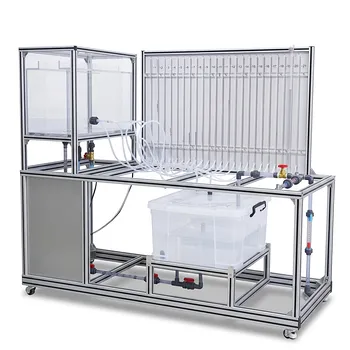
Laboratory pilot plant for Bernoulli's equation demonstration with transparent PVC pipes, 23 piezometer tubes for pressure measurement, and hands-on experiments. Designed for engineering education to study energy conservation, hydraulic grade line, and localized losses in fluid steady-flow systems.

Multi-Functional Special Distillation Educational Pilot Plant

Multi-Functional Special Distillation Educational Pilot Plant

Versatile multi-functional special distillation pilot plant for chemical engineering education. Supports continuous, vacuum, azeotropic, reactive, extractive distillation. Transparent glass columns enable real-time visual observation of hydrodynamics and separation processes.

Carbon Dioxide PVT Curve Determination Educational Unit Operations Pilot Plant

Carbon Dioxide PVT Curve Determination Educational Unit Operations Pilot Plant

Enable hands-on learning of thermodynamic principles with this carbon dioxide PVT curve determination pilot plant. Students visualize critical opalescence, phase transitions, and generate P-V isotherms across liquid, gas, and supercritical regions. Robust safety features, adaptable for university engineering labs.

Orifice and Venturi Flowmeter Calibration Educational Pilot Plant for Fluid Mechanics Laboratory

Orifice and Venturi Flowmeter Calibration Educational Pilot Plant for Fluid Mechanics Laboratory

Enhance fluid dynamics education with the Orifice and Venturi Flowmeter Calibration Educational Unit Operations Pilot Plant, featuring transparent orifice and Venturi meters, industrial sensors, touchscreen interface for real-time data analysis and automatic coefficient calculations in engineering student laboratories.

Solid Spherical Heat Transfer Coefficient Determination Educational Chemical Engineering Pilot Plant

Solid Spherical Heat Transfer Coefficient Determination Educational Chemical Engineering Pilot Plant

This educational chemical engineering pilot plant enables students to determine convective heat transfer coefficients and observe transient thermal behavior of solid spheres under natural convection, forced convection, fixed beds, and fluidized bed regimes.

Fluid Friction Resistance Determination Educational Unit Operations Pilot Plant

Fluid Friction Resistance Determination Educational Unit Operations Pilot Plant

Engineered bench-scale system for university engineering labs. Provides hands-on fluid mechanics experience: quantitative energy loss analysis, flow regime observation, friction coefficient determination. Features four-point pressure measurement, transparent sections, industrial touchscreen PLC, 3D virtual simulation. Ideal for chemical, mechanical, civil engineering.

Ion Exchange Water Purification Educational Pilot Plant for Engineering Unit Operations

Ion Exchange Water Purification Educational Pilot Plant for Engineering Unit Operations

This bench-scale ion exchange pilot plant trains engineering students in water purification. Dual transparent columns simulate industrial softening and demineralization. Students observe fluid dynamics, perform resin regeneration, and analyze breakthrough curves. The corrosion-resistant frame ensures durability in unit operations experiments.


Leave Your Message