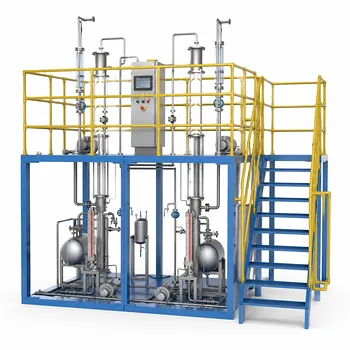
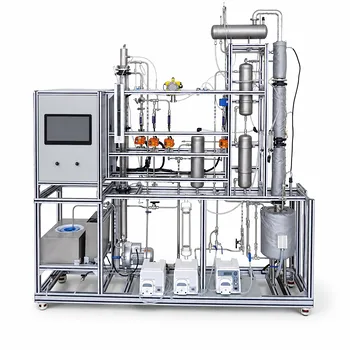
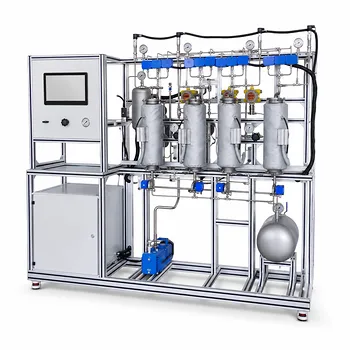
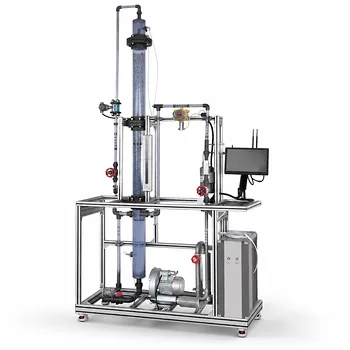
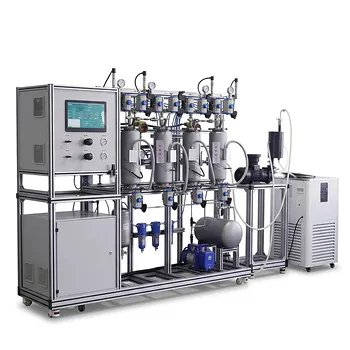
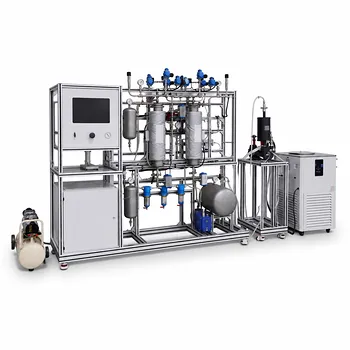
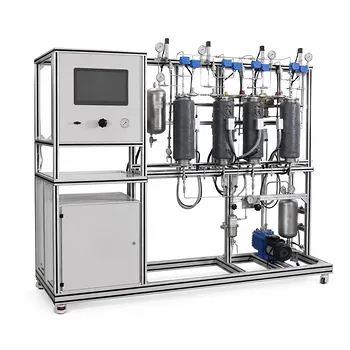
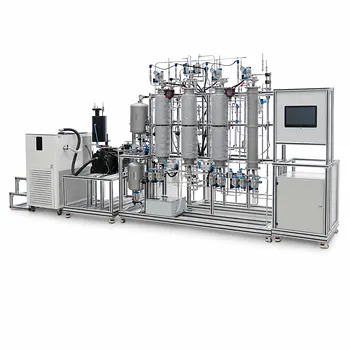
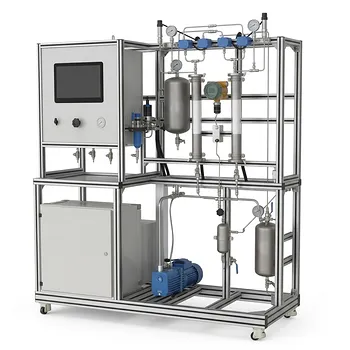
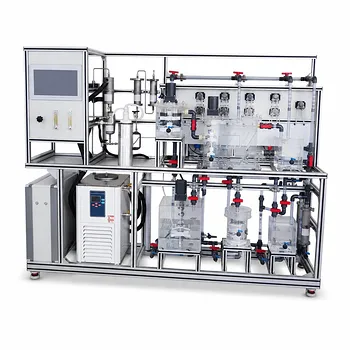
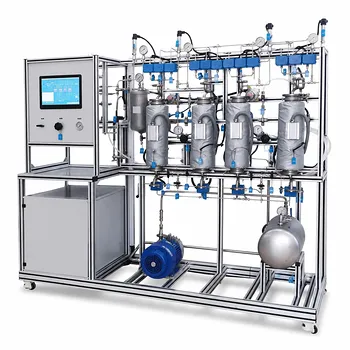
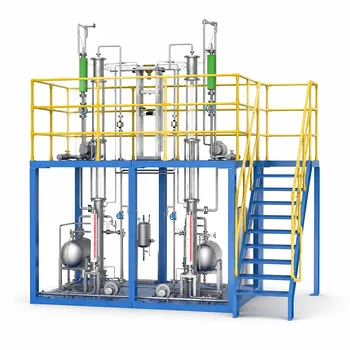
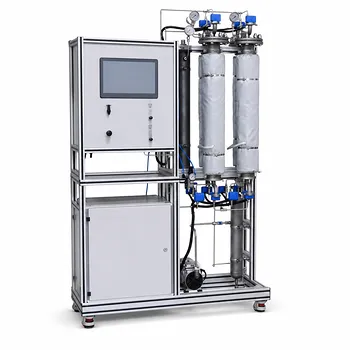
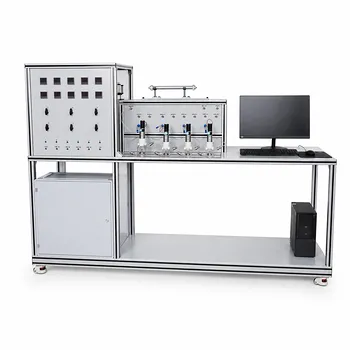
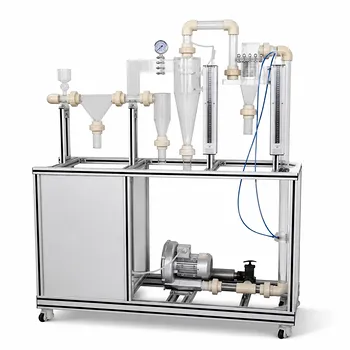
A gas absorption pilot plant brings the abstract concept of carbon capture down to a tangible, measurable process. By filling a packed column with an alkaline solvent like sodium hydroxide or monoethanolamine, you can directly scrub carbon dioxide (CO₂) from an air stream. This allows students to measure inlet and outlet gas concentrations, map temperature profiles from the exothermic reaction, and calculate solvent conversion rates—transforming environmental engineering principles from textbook theory into hand-operated, quantitative reality.
A gas absorption pilot plant serves as a miniature carbon capture laboratory. It teaches environmental engineering not by merely describing scrubbing, but by letting students manipulate the chemical reactions, mass transfer rates, and energy balances that define industrial greenhouse gas mitigation.
Simulating Carbon Capture at a Lab Scale
The Core Reaction: Chemical Absorption of CO₂
In a pilot plant, you introduce a CO₂-laden gas stream into the bottom of a packed column while a solvent flows counter-currently from the top. When the solvent is chemically reactive—for instance, an amine solution—the CO₂ does not simply dissolve. It undergoes a chemical reaction that locks it into the liquid phase.
This demonstrates the critical environmental engineering principle of chemical absorption. Unlike physical dissolution in water, the reaction with the solvent drastically accelerates the uptake of CO₂ and dramatically reduces its equilibrium back-pressure over the liquid. Students see firsthand why industrial carbon capture relies on reactive solvents rather than mere physical solubility.
Comparing Physical and Chemical Absorption
By running side‑by‑side experiments, the same pilot plant can teach the stark difference between physical and chemical absorption.
- Physical absorption: Using water, CO₂ is absorbed only according to Henry’s Law. The capacity is low and directly proportional to the partial pressure of CO₂.
- Chemical absorption: Using an alkaline solution, the reaction consumes the dissolved CO₂. The driving force for mass transfer stays high, increasing absorption efficiency manifold.
Switching solvents reveals why flue‑gas desulfurization and carbon capture systems prefer reactive liquors. It also uncovers how chemical enhancement factors multiply the liquid‑side mass transfer coefficient.
Quantifying the Key Engineering Concepts
Measuring Absorption Efficiency and Mass Transfer Coefficients
The pilot plant is instrumented to give numerical life to abstract parameters. Gas sensors at the inlet and outlet measure CO₂ concentration, allowing the direct calculation of absorption efficiency. By varying flow rates and sampling liquid‑phase compositions, students compute the overall mass transfer coefficient (K_Ga) and the height of a transfer unit (HTU).
This connects classroom models of two‑film theory to reality. Students learn how the liquid‑to‑gas ratio (L/G) influences separation performance and how to spot the onset of flooding, where liquid backs up and destroys the mass transfer interface.
Tracking the Exothermic Heat of Reaction
Reactive absorption of CO₂ into alkaline media is exothermic. The pilot plant’s temperature sensors along the column profile teach that heat release is a direct indicator of reaction kinetics. Students map the zone of maximum temperature rise—often near the gas inlet—and link it to the local rate of chemical reaction.
This thermal data grounds the discussion of energy management in full‑scale carbon capture plants. It shows that absorption is not just a mass balance problem, but an energy balance challenge that heavily influences solvent regeneration costs.
Understanding Chemical Enhancement Factors
Accompanying the heat is the powerful concept of the enhancement factor. The rapid reaction in the liquid film near the gas‑liquid interface steepens the concentration gradient. Students can isolate this effect by comparing a purely physical system with a chemically reactive one under identical hydrodynamic conditions.
This explains why a packed column for chemical absorption can be significantly shorter than one designed for physical absorption alone—a critical design insight for environmental engineers working on industrial emissions control.
Exploring Real-World Process Variables
Impact of Gas and Liquid Flow Rates
The pilot plant’s modular flow controllers let students simulate different operating scenarios. They can push a system toward flooding by over‑loading the column with gas, observing how pressure drop skyrockets and absorption plummets. Conversely, they can starve the column of solvent and witness the drop in efficiency.
This hands‑on troubleshooting instills an intuitive grasp of column hydraulics and the economic trade‑offs between pumping energy and capture performance.
The Challenge of Varying CO₂ Concentrations
Not all gas streams are equal. A pilot plant can be fed with a synthetic mixture that simulates different industrial sources.
- High‑concentration streams (e.g., from a purification tail gas, >70% CO₂) demonstrate that capture can be highly efficient and require less energy per kilogram of CO₂ captured.
- Low‑concentration streams (e.g., a coal boiler flue gas at 10‑20% CO₂) reveal the painful truth: dilute streams demand far greater solvent circulation rates and more regeneration energy per unit of CO₂.
This variability directly teaches the environmental engineering lesson that separation cost is tightly coupled to source concentration, a foundational principle for evaluating carbon capture economics.
Solvent Regeneration and the Energy Penalty
Though many educational plants focus on absorption, the full cycle is incomplete without regeneration. By coupling an absorption column to a stripping column, or by analyzing data from a plant that includes thermal regeneration, students learn about the energy penalty. They can see how operating conditions in the absorber dictate the heat demand in the stripper.
Processes like the reclamation of CO₂ using sodium carbonate solutions—where NaHCO₃ is heated to release pure CO₂—illustrate the integrated loop of absorption and regeneration. This closes the loop on carbon capture, showing that absorption is only one half of the environmental engineering equation; the other half is the energy‑intensive release and recycling of the solvent.
Understanding the Trade‑offs
Realism vs. Simplicity
A lab‑scale pilot plant cannot replicate the full complexity of a power plant’s flue gas stream. It typically uses clean, synthetic gas mixtures and idealized solvents. While this simplifies data analysis, students may not appreciate the impact of particulate matter, sulfur oxides, or water‑vapor content that can degrade real solvents.
This simplification trades pedagogical clarity for real‑world fidelity, and instructors must bridge that gap through careful data contextualization.
Solvent Selection and Safety
Many environmentally relevant solvents, like monoethanolamine, are effective but corrosive and potentially hazardous in a teaching laboratory. Safer alternatives (e.g., dilute sodium hydroxide) may be chosen, but they then limit the direct transfer of performance data to industrial amine systems.
Furthermore, the exothermic nature of the reaction requires careful thermal management even at pilot scale. A lab‑scale column must be transparent (often glass) for observation, but that imposes pressure and temperature limits that curtail certain types of kinetic studies.
Scale‑Up Limitations
The fluid dynamics in a small‑diameter column differ from those in an industrial column. Boundary effects, liquid distribution, and wall flow can skew mass transfer coefficients. Students learn that a K_Ga measured in a 5‑cm column cannot be directly plugged into a 5‑m column design without applying scale‑up correlations. This teaches the critical distinction between intrinsic reaction kinetics and apparent performance driven by macro‑scale mixing.
Making the Right Choice for Your Educational Goal
Selecting the experimental setup depends on what core lesson you want to instill.
- If your primary focus is fundamental mass transfer theory: Use a simple CO₂‑water system first to isolate physical absorption. Then introduce a reactive solvent to showcase the enhancement factor and link to reaction kinetics.
- If your primary focus is carbon capture economics and process design: Run parallel experiments with high‑ and low‑CO₂ feed streams. Emphasize the measurement of energy consumption and solvent regeneration, and discuss the implications for capture cost per tonne of CO₂.
- If your primary focus is advanced process control and instrumentation: Add a stripping column or automated sampling. Challenge students to design control loops for liquid-to-gas ratio based on real‑time outlet CO₂ readings, reflecting the dynamic demands of real‑time emissions compliance.
- If your primary focus is safety and environmental hazard mitigation: Demonstrate the rapid neutralization of an acidic gas (using a non‑toxic simulant) and quantify the liquid‑phase conversion, underscoring how wet scrubbers prevent toxic releases.
A gas absorption pilot plant is not just a teaching tool; it is a compressed version of an environmental engineering reality. It turns the invisible mass transfer of a gas into a visible, measurable, and optimizable process, giving students the indispensable intuition that only hands‑on operation can provide.
Summary Table:
| Concept | Lab Application | Student Takeaway |
|---|---|---|
| Chemical Absorption | Scrubbing CO₂ with NaOH/amines | Understand reaction-enhanced mass transfer |
| Mass Transfer | Measuring inlet/outlet CO₂ levels | Calculate transfer units & column efficiency |
| Thermal Effects | Monitoring exothermic heat in column | Connect temperature profiles to reaction kinetics |
| Hydraulics & Flow | Adjusting liquid-to-gas (L/G) ratios | Experience column flooding and pressure drops |
Bring textbook theory to life with LABPARK! We provide high-quality Educational and Vocational Unit Operations Pilot Plants in chemical engineering, bioprocess & biotech, and environmental & water treatment. Tailored for universities, research institutes, and enterprises, our systems empower students with essential hands-on training in carbon capture and mass transfer processes. Ready to upgrade your lab? Contact us today for detailed specifications and customized solutions!
Related Products
- Dual-Mode Gas Absorption and Desorption Unit Operations Training Pilot Plant
- Carbon Dioxide Absorption and Desorption Educational Pilot Plant for Carbon Capture Studies
- Carbon Dioxide Adsorption and Capture Educational Unit Operations Pilot Plant
- Absorption and Desorption Educational Unit Operations Pilot Plant
- Packed Bed Absorption Educational Unit Operations Pilot Plant
People Also Ask
- How do two-film & penetration theories apply to gas absorption pilot plant teaching? Key pedagogical insights.
- How is the direction and driving force of mass transfer determined in a gas absorption unit operations pilot plant?
- How does partial pressure behavior influence gas absorption pilot plants? Master Mass Transfer
- Why does increasing flow fail to enhance absorption in fast chemical reactions? Pilot Plant Insights
- How to model chemical absorption as physical absorption? The pilot plant simplification criterion.