In gel filtration chromatography, the mobile phase flow rate isn’t just a timer—it’s the primary dial controlling both resolution and column integrity. Setting it incorrectly directly undermines separation efficiency by starving or smearing your sample, and it can physically destroy the column bed. The key is balancing the time molecules need to diffuse into pores against the natural spreading that occurs when they move too slowly.
The core takeaway: Flow rate in GFC governs a trade-off between mass transfer and axial dispersion. Too fast, and solutes have no time to enter the gel pores, causing poor resolution and risking media compaction. Too slow, and longitudinal diffusion broadens the peaks, also harming resolution. Educational systems must make this narrow, safe operating window visible to teach proper method development.
Why Flow Rate Dictates Separation Quality
The Pore Diffusion Dilemma
Gel filtration separates molecules by size because smaller ones can access the internal pores of the beads, while larger ones are excluded. This pore access is not instantaneous—it requires a finite amount of time for a solute molecule to diffuse from the mobile phase into the stagnant liquid inside the pores.
When the mobile phase flow rate is too high, that critical residence time vanishes. Large molecules that should be excluded may slip through with the solvent front, and smaller molecules don’t have a chance to fully explore the pore volume. The result is poor peak resolution, with different-sized species eluting together. The sample’s true size distribution becomes masked by a kinetic bottleneck.
The Risk of Axial Diffusion at Low Speeds
A flow rate that is too low creates the opposite problem: excessive time for longitudinal diffusion. As solute bands travel slowly down the column, the concentration gradient within the peak drives molecules to spread out along the column axis. This band broadening increases peak width without enhancing separation, ultimately lowering resolution. It’s a classic van Deemter effect where the slow linear velocity pushes the separation into the B-term (longitudinal diffusion) region, negating any gains from extended pore access.
The Physical Limits of the Column Bed
Mechanical Pressure and Media Compaction
The gel bed has a maximum mechanical pressure limit that must never be exceeded. Soft gels, in particular, are delicate. A flow rate that is too high generates backpressure that can crush the beads, a process called media compaction. This permanently alters the pore structure, creates channels, and can render the column unusable. In educational settings, this is often the first real lesson in why pumps and pressure gauges are non-negotiable.
Signs of Column Overload in Educational Setups
An instructional pilot plant must feature precise flow and pressure monitoring to make these limits tangible. Tell-tale signs of impending compaction include a sudden, non-linear rise in backpressure, the appearance of cracks or voids at the column inlet, and a gradual loss of resolution that cannot be recovered by lowering the flow rate. Teaching students to recognize these symptoms protects expensive hardware and builds an instinct for operational safety.
Understanding the Trade-offs: The Optimal Operating Window
The Van Deemter Curve in Practice
Separation efficiency in GFC follows a classic U-shaped curve when plotted against linear velocity. At very low flow rates, efficiency is limited by axial diffusion. At very high flow rates, it’s limited by mass transfer resistance (pore diffusion). Between them lies a flat, optimal operating window where the highest separation efficiency is achieved without risking column compaction. For teaching, mapping this curve experimentally—by running the same sample at different flow rates—cements a foundational concept in chromatography.
How Pilot Plants Teach Critical Thinking
When students see high flow rates ruin a separation and low rates turn sharp peaks into broad humps, they internalize a core lesson: no single flow rate is “best” for every column or sample. Educational unit operations plants must allow students to identify this window for themselves by varying the flow and observing the direct impact on resolution and pressure. This transforms an abstract parameter into a primary process control lever.
Making the Right Choice for Your Teaching or Testing Goals
Tailor your approach to flow rate based on the learning objective:
- If your primary focus is demonstrating mass transfer fundamentals: Vary the flow rate in a structured experiment and have students plot resolution versus linear velocity. Highlight the point where peak asymmetry appears, marking the onset of mass transfer limitations.
- If your primary focus is preventing column compaction and teaching safe operation: Start every session by establishing the pressure-flow relationship with clean buffer. Set a hard upper pressure limit (e.g., 70% of the manufacturer’s maximum) and never exceed it, even if resolution seems less than ideal.
- If your primary focus is scaling up a method for pilot production: Conduct a “flow rate scouting” run where you prioritize throughput while maintaining the critical resolution required for the target product. Accept that some peak broadening is inevitable if the resin’s capacity or purity demands can still be met.
The true value of gel filtration isn’t just in separating molecules—it’s in understanding that the optimal flow rate is a system property, not a fixed number, and that respecting the column’s physical limits is the first law of a successful separation.
Summary Table:
| Flow Rate Level | Impact on Separation | Physical Column Risk | Dominant Phenomenon |
|---|---|---|---|
| Too High | Poor resolution; molecules bypass pores | Media compaction & high backpressure | Mass transfer resistance |
| Optimal | High resolution; sharp, well-separated peaks | None (Safe operating window) | Balanced kinetics |
| Too Low | Band broadening; wide, overlapping peaks | Low risk, but inefficient throughput | Axial (Longitudinal) diffusion |
Elevate Your Process Engineering & Biotech Training
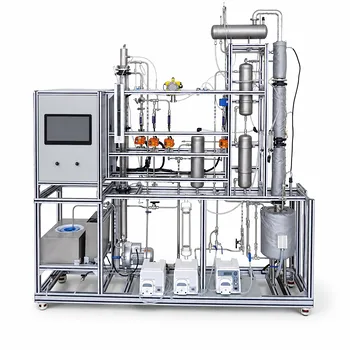
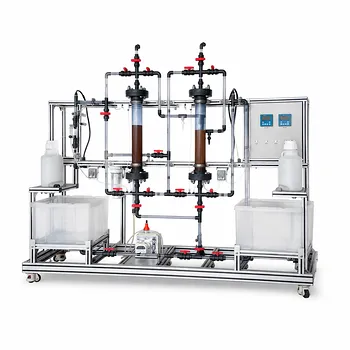
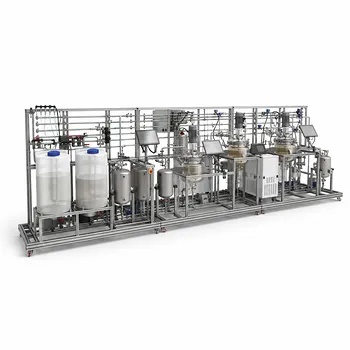
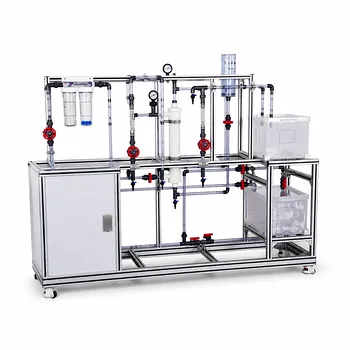
Teaching complex chromatographic principles like GFC requires reliable, hands-on systems that make process variables tangible. LABPARK provides state-of-the-art Educational and Vocational Unit Operations Pilot Plants in chemical engineering, bioprocess & biotech, and environmental & water treatment. Designed specifically for universities, research institutes, and enterprises, our pilot plants feature precise flow and pressure monitoring to help students master chromatography safely and effectively.
Ready to upgrade your laboratory capabilities? Contact LABPARK today to discuss your customized pilot plant needs!
Related Products
- Constant Pressure Filtration Educational Unit Operations Pilot Plant
- Hot Filtration Educational Unit Operations Pilot Plant Laboratory System
- Multifunctional Membrane Separation Educational Pilot Plant with Ultrafiltration, Nanofiltration, Reverse Osmosis
- Multi-Functional Membrane Separation Educational Pilot Plant for Unit Operations Lab
- Ultrafiltration Membrane Separation Educational Pilot Plant
People Also Ask
- How do educational unit operations pilot plants bridge theory and design? Bridge the Engineering Gap
- How do educational unit operations pilot plants address safety and waste management when scaling up?
- Why splitting a filtration batch doesn't always reduce cycle time? Pilot Plant Insights
- Why Demo Constant-Rate to Constant-Pressure Filtration on a Pilot Plant? Key Practical Insights
- How can researchers identify and resolve filter medium blinding? Optimize Your Pilot Plant Runs