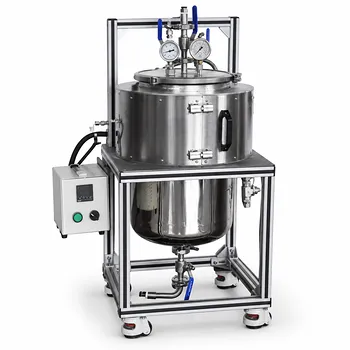
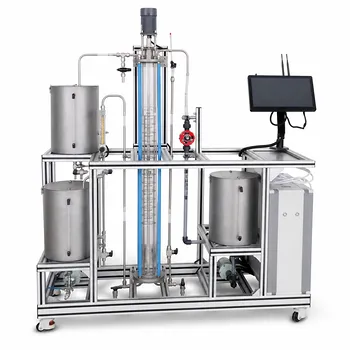
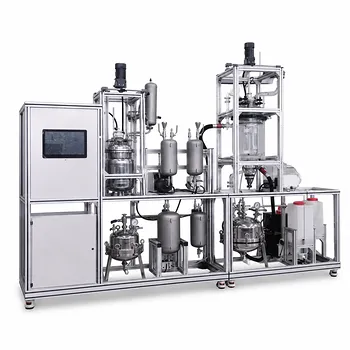
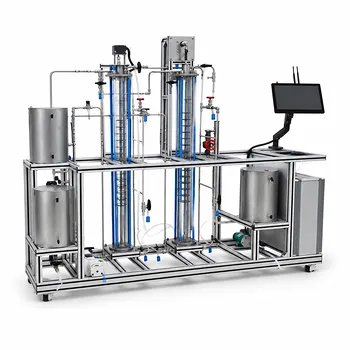
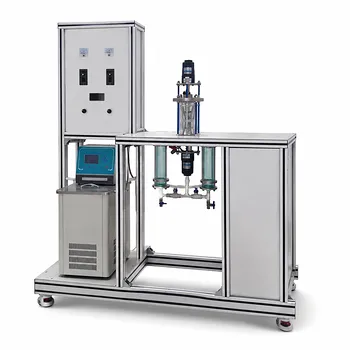
Solid-liquid extraction pilot plants transform the abstract chemistry of tin purification into a tangible, controllable experiment. They simulate the acid leaching of roasted cassiterite (SnO₂) concentrates by creating a small-scale version of the industrial process, where a dilute sulfuric acid solution contacts the solid concentrate under precisely controlled conditions. Students directly manipulate and measure the key process variables—liquid-to-solid ratio, leaching temperature, agitation rate, and residence time—to observe their impact on impurity dissolution and SnO₂ recovery.
Tin concentrate purification relies on a selective acid attack that dissolves impurity oxides while leaving the valuable SnO₂ intact. A solid-liquid extraction pilot plant simulates this entire operation, giving students a hands-on system to connect thermodynamic theory with real-world mass transfer and separation efficiency. It turns a complex hydrometallurgical circuit into a teachable, measurable unit operation.
The Selective Chemistry That Drives the Process
The starting material is roasted cassiterite. Roasting converts sulfide impurities to oxides, but elements like iron, copper, and zinc remain as oxide contaminants.
Why Impurities Dissolve While Tin Stays Solid
The core of the purification is a thermodynamic selection. Dilute sulfuric acid attacks the impurity oxides, converting them into soluble sulfates that enter the liquid phase. Cassiterite (SnO₂) is highly resistant to this acid under normal leaching conditions—it remains an insoluble solid. This difference in solubility forms the basis of the separation.
The Two Non-Negotiable Steps
Every pilot plant simulation must faithfully reproduce the two essential steps of a leaching unit operation, as identified in chemical engineering fundamentals.
- Step 1: Intimate contact. The solvent and solid must be brought together so the solute (impurity oxides) can transfer into the liquid phase.
- Step 2: Complete separation. The solute-rich liquid (leachate) must be cleanly separated from the insoluble solid residue (purified SnO₂).
How the Pilot Plant Recreates the Acid Attack
An educational pilot plant does not need tonnes of real cassiterite. It recreates the critical physical and chemical environment in a benchtop or small-floor-scale setup.
Material Surrogates and the Acid Environment
The “solid” can be actual roasted concentrate or a well-characterized substitute with known impurity loads. The “solvent” is a precisely prepared dilute sulfuric acid solution. Students prepare these materials to match a planned liquid-to-solid ratio, immediately connecting theory to practice.
The Control Panel for Learning
The pilot plant integrates instrumentation that lets students fix and vary the four key operating parameters identified in core hydrometallurgical training.
- Temperature is controlled via a heated, jacketed vessel or a thermostatic bath acting on the leaching tank.
- Agitation rate is set on a variable-speed impeller, dictating the turbulence and solid suspension.
- Residence time is the period the solid and acid remain in intimate contact before separation.
- Liquid-to-solid ratio is set by the amounts of acid and concentrate charged to the vessel.
The Variables Students Manipulate and What They Reveal
Each parameter is a lever that controls a specific aspect of the leaching performance. The pilot plant makes the effect of each lever visible.
Liquid-to-Solid Ratio and Solvent Concentration
Changing this ratio directly alters the availability of the acid. A higher ratio provides an excess of leaching agent, which shifts the reaction equilibrium toward more complete impurity dissolution—a direct demonstration of Le Châtelier’s principle in action. Too low a ratio, however, can lead to solvent saturation, halting the reaction prematurely.
Temperature: The Thermodynamic Driver
The feasibility of the leaching reaction is governed by the standard Gibbs free energy change (ΔG⁰ = -RT ln K). A negative ΔG⁰ indicates a favorable equilibrium. By raising the temperature, students can increase the kinetic rate and, in some cases, improve the equilibrium constant if the dissolution is endothermic. The pilot plant allows them to measure impurity concentration in the leachate at different temperatures and calculate the effect on extraction yield.
Agitation and Residence Time: Kinetics in Action
Even a thermodynamically favorable reaction can be painfully slow. Agitation enhances mass transfer by reducing the boundary layer thickness around solid particles, speeding the diffusion of dissolved impurities into the bulk liquid. Residence time determines how long the mass transfer process is allowed to proceed. Students can plot impurity removal versus time to find the optimal point beyond which further leaching yields minimal gain—teaching the critical concept of diminishing returns in reactor design.
From Data to a Separation Decision
Once the leaching step is complete, the simulation doesn’t end. The second fundamental step—separation—is tested.
Evaluating Solid-Fluid Separation Efficiency
The slurry formed in the tank must be separated into a clear leachate and a solid SnO₂ cake. Pilot plants typically include a filtration or sedimentation step. Students can analyze the solid residue to verify that SnO₂ was not lost and measure residual impurity levels. This closes the loop on solid-fluid separation efficiency, a key performance metric in any hydrometallurgical flowsheet.
Understanding the Trade-offs and Limitations
A pilot plant is a powerful teaching tool, but it is a model—not the plant floor. Trusting it blindly creates misconceptions.
- Simplified material chemistry. Real concentrates contain a complex matrix of minerals that can cause side reactions, localized passivation, or acid consumption beyond what the simple impurity oxides predict. A lab sample is often cleaner and more uniform.
- Idealized hydrodynamics. Small vessels with high-speed impellers create nearly perfect mixing. Industrial-scale tanks operate with dead zones, variable particle sizes, and imperfect solid suspension, which can drastically reduce effective liquid-solid contact.
- Batch vs. continuous reality. Most educational pilot plants operate in batch mode. Industrial circuits are often continuous counter-current decantation systems. The concept of residence time in a batch reactor does not directly translate to the residence time distribution in a continuous train.
- Thermodynamic purity. The thermodynamic calculations assume ideal solutions and pure phases. In practice, activity coefficients and co-dissolution of other elements can shift the effective ΔG⁰, making the ideal prediction an approximation.
These gaps do not diminish the educational value; they highlight why critical thinking and scale-up expertise remain essential.
Making the Most of a Teaching Pilot Plant
For educators and students aiming to get real insight from this simulation, the approach should be tailored to the learning objective. Focus the experiment on what the pilot plant reveals best.
- If your primary focus is grasping thermodynamic principles: Design experiments that vary temperature systematically while holding all other parameters constant. Calculate the apparent equilibrium constant from leachate assays and map it against the thermodynamic prediction.
- If your primary focus is process optimization: Run a factorial design on liquid-to-solid ratio, agitation, and time. Identify the point of maximum impurity removal for minimum energy and chemical consumption. This teaches practical trade-off analysis.
- If your primary focus is understanding solid-liquid separation: Do not stop at the leachate assay. Investigate the filter cake: measure its moisture, residual acid content, and fines loss. This connects the chemistry directly to downstream processing challenges.
A solid-liquid extraction pilot plant closes the gap between a hydrometallurgical equation and a running factory, giving future engineers the confidence that comes from having seen separation happen in their own hands.
Summary Table:
| Key Parameter | Control Method in Pilot Plant | Educational / Process Impact |
|---|---|---|
| Liquid-to-Solid Ratio | Charging precise acid & concentrate amounts | Demonstrates Le Châtelier’s principle & reaction equilibrium |
| Temperature | Heated jacketed vessel or thermostatic bath | Explores thermodynamic feasibility & Gibbs free energy |
| Agitation Rate | Variable-speed impeller setting | Shows kinetics & mass transfer boundary layer reduction |
| Residence Time | Duration of solid-acid contact | Plots impurity removal vs. time to find optimal yield |
| Separation Stage | Filtration or sedimentation unit | Evaluates solid-fluid separation efficiency & cake quality |
Bring Hydrometallurgical Theory to Life with LABPARK
Are you looking to bridge the gap between classroom theory and industrial reality? LABPARK provides premium Educational and Vocational Unit Operations Pilot Plants in chemical engineering, bioprocess & biotech, and environmental & water treatment.
Designed specifically for universities, research institutes, and enterprises, our pilot plants empower students and researchers to master key processes like solid-liquid extraction, filtration, and chemical synthesis with hands-on, high-fidelity equipment.
Ready to upgrade your lab's educational capabilities? Contact our experts today to find the perfect pilot plant system for your curriculum or research goals!
Related Products
- Hot Filtration Educational Unit Operations Pilot Plant Laboratory System
- Educational Rotary Disc Liquid-Liquid Extraction Pilot Plant
- Gallium and Indium Selective Extraction Educational Pilot Plant
- Comprehensive Liquid-Liquid Extraction Pilot Plant for Engineering Education
- Natural Product Extraction Unit Operations Training Pilot Plant
People Also Ask
- How to Determine Specific Cake (r) & Filter Medium (Rm) Resistance Using Filtration Pilot Plant Data
- How to select solid-liquid separation equipment for pilot plants? A Step-by-Step Guide
- How can researchers identify and resolve filter medium blinding? Optimize Your Pilot Plant Runs
- Why Demo Constant-Rate to Constant-Pressure Filtration on a Pilot Plant? Key Practical Insights
- How do Buchner funnels & leaf filters differ in filtration scale-up? Key Differences Explained