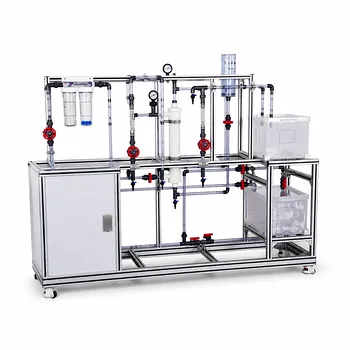
Scale-up in downstream purification is a geometry problem, not just a volume problem. Pilot-scale chromatography columns and tangential flow filtration (TFF) units allow you to analyze the physical parameters that govern separation performance at industrial scale. The critical parameters include bed height, linear flow rate, column diameter, packing density, pressure drop, and membrane flux. By studying these in a controlled pilot environment, you learn exactly how to maintain resolution and throughput when transitioning from bench to process scale.
Successful scale-up keeps the separation-determining parameters invariant—like bed height and linear velocity—while systematically increasing cross-sectional area. Pilot systems let you decouple these variables, probe packing quality, and identify pressure or flux limits long before you reach full manufacturing scale.
Why Scale-Up Demands Physical Parameter Control
Scaling a downstream process is not simply about making a bigger column or a larger membrane area. The deep need in teaching this discipline is to shift students’ thinking from chemistry to fluid dynamics and mass transfer. Pilot-scale tools give them the hands-on opportunity to see why certain parameters must remain constant, others must scale proportionally, and why ignoring these rules destroys resolution and yield.
The Surface Answer vs. the Underlying Principle
The surface need is a list of parameters. The deeper need is to understand the relationship between fluid residence time, dispersion, and separation efficiency. Pilot columns and TFF cassettes make these abstract concepts tangible by letting students vary one parameter at a time and measure the impact on purity, recovery, and backpressure.
How Pilot Systems Bridge the Gap Between Theory and Industrial Reality
In a teaching lab, full-scale manufacturing equipment is impractical. Pilot systems offer the same fluid path geometry and membrane configurations as production units but at a manageable scale. This enables students to develop a mechanical intuition for what happens inside a packed bed or along a membrane channel—knowledge that purely theoretical courses cannot deliver.
Chromatography: The Parameters That Dictate Column Performance
When you move from a small pre-packed column to a pilot-scale column, the separation quality hinges on preserving two parameters while scaling a third. Understanding this triad is the core of any scale-up curriculum.
Preserving Bed Height and Linear Flow Rate
Bed height directly determines the number of theoretical plates. If you keep the bed height constant, the residence time and separation quality remain the same. Linear flow rate (cm/h) governs the fluid velocity through the packed bed and, combined with bed height, defines the contact time. Pilot systems let you demonstrate that changing either one can dramatically alter peak resolution, a lesson far more memorable than any simulation.
Increasing Column Diameter and Volume
Once bed height and linear velocity are locked, the only way to increase throughput is to scale the column diameter. This increases the cross-sectional area and the total bed volume, boosting volumetric flow rate (L/h) without altering the fluid dynamics inside the bed. Students see that a 20 cm diameter pilot column behaves identically to a 5 cm column if the bed height and linear velocity are matched—and they witness the deviation when those parameters drift.
Quantifying Packing Density and Integrity
A column is only as good as its packing. Pilot-scale columns let you practice gravity settling, flow packing, and dynamic axial compression to achieve a stable bed. Students learn to measure packing density (grams of resin per liter) and evaluate bed integrity by pulse-injecting a tracer like acetone. A low HETP (height equivalent to a theoretical plate) and minimal asymmetry are the proof that the packing protocol works—critical know-how before tackling a GMP column.
Monitoring Pressure Drop Across Modern Resins
As you increase bed height or use smaller-particle resins, the pressure drop rises. Pilot systems with pressure sensors at the column inlet and outlet allow you to build a pressure-vs.-flow curve for each resin. This teaches the practical limits of compressible resins—exceeding the resin’s mechanical strength leads to bed collapse or channeling. Students learn to balance resolution (small particles) with operational pressure headroom.
Filtration: Unlocking Tangential Flow Scale-Up
For TFF processes like concentration and diafiltration, scaling often follows the constant wall concentration model. Pilot-scale membrane cassettes make it possible to map the flux behavior that will define the full-scale design.
The Central Role of Membrane Flux
Membrane flux (liters per square meter per hour, LMH) is the parameter that governs process time and membrane area. In a pilot TFF unit, students vary transmembrane pressure (TMP) and crossflow rate while recording flux. They quickly see the onset of limiting flux—the point where increasing TMP no longer improves throughput because concentration polarization or gel layer formation becomes dominant. This hands-on experience cements the concept that industrial TFF is operated at an optimal, sub-limiting flux.
Beyond Flux: Transmembrane Pressure and Crossflow Velocity
While flux is the primary output metric, understanding its drivers is the deeper lesson. Students use pilot systems to map TMP excursions and crossflow velocity effects. They see that higher crossflow can sweep away foulants and restore flux, but at the cost of greater pump energy and shear stress. This trade-off is the foundation of TFF process economics, and a pilot unit reveals it in minutes.
Pressure Drops in Filtration Channels
Just as in chromatography, pressure drop matters. TFF cassettes have narrow feed channels designed to create high shear. Pilot-scale units equipped with inlet, outlet, and permeate pressure gauges let students calculate the channel pressure drop and the average TMP. This reinforces that uniform TMP along the membrane path is an ideal rarely achieved, and that pressure losses influence cassette sizing and staging.
Understanding the Trade-offs
Pilot-scale studies are not just about confirming what works—they brilliantly expose what fails. Teaching these trade-offs prepares students for the compromises inherent in real-world process design.
Resolution vs. Throughput in Chromatography
A taller bed gives more plates but higher pressure. A higher linear velocity increases throughput but risks laminar dispersion. Small-particle resins improve resolution dramatically but generate steep pressure drops. Pilot columns let students navigate this tension by testing multiple combinations of bed height, resin type, and flow rate, finding the sweet spot for their specific separation.
Resin Stability and Lifetime
Pressure drop is not just a packing constraint; it’s a resin longevity concern. Repeated high-pressure cycles can crack rigid beads or compress soft resins. By cycling pilot columns under industrial conditions, students observe the degradation of plate count over multiple runs, learning that scale-up success also means designing for resin lifetime and cleaning-in-place (CIP) compatibility.
TFF Flux vs. Fouling and Product Stability
Pushing flux to the limit increases productivity but can cause irreversible fouling or, for sensitive biologics, protein aggregation from high shear. Pilot TFF experiments that run for several concentration-diafiltration cycles reveal the long-term flux decay and cleaning efficacy. Students see that a slightly conservative flux setpoint often yields more consistent batch-to-batch performance and longer membrane life.
Making the Right Choice for Your Teaching Lab or Process Development Goal
The specific parameters you choose to emphasize with your pilot systems should align with the learning or development objective. Use these guidelines to focus your experimental plans.
- If your primary focus is teaching the fundamentals of column scale-up: Prioritize experiments that keep bed height and linear velocity constant while scaling diameter. Have students measure HETP and asymmetry to prove the packing is reproducible, and log pressure to witness the resin’s stress limits.
- If your primary focus is optimizing membrane filtration steps: Center the work on flux-TMP curves and the impact of crossflow rate on limiting flux. Let students discover the optimal operating TMP where flux is high but fouling is minimal, and relate that to the number of membrane cassettes required at full scale.
- If your primary focus is process economics and risk mitigation: Design studies that compare different resins or membrane chemistries at pilot scale. Track pressure trends, cleaning cycles, and product recovery to calculate the true cost per gram and identify the most robust, scalable option.
By treating pilot-scale units as the physics laboratory of downstream processing, you equip yourself or your students with the diagnostic skills to troubleshoot any scale-up challenge—not just follow a recipe.
Summary Table:
| Operation | Key Parameters | Scale-Up Goal | Critical Trade-Offs |
|---|---|---|---|
| Chromatography | Bed height, Linear flow rate, Column diameter, Packing density, Pressure drop | Keep bed height & velocity constant; scale diameter | Resolution vs. throughput & backpressure |
| Filtration (TFF) | Membrane flux (LMH), Transmembrane pressure (TMP), Crossflow velocity | Map flux-TMP curve; operate at optimal sub-limiting flux | High flux vs. membrane fouling & shear stress |
Bring Industrial Scale-Up Insights into Your Laboratory with LABPARK
Bridge the gap between theoretical biochemistry and industrial fluid dynamics. LABPARK provides state-of-the-art Educational and Vocational Unit Operations Pilot Plants in chemical engineering, bioprocess & biotech, and environmental & water treatment for universities, research institutes, and enterprises.
Our pilot-scale chromatography and filtration systems allow hands-on mastery of critical scale-up parameters—giving your students and researchers the practical engineering intuition needed for real-world process design.
👉 Contact LABPARK today to find the perfect pilot plant solution for your lab
Related Products
- Hot Filtration Educational Unit Operations Pilot Plant Laboratory System
- Ultrafiltration Membrane Separation Educational Pilot Plant
- Constant Pressure Filtration Educational Unit Operations Pilot Plant
- Multifunctional Membrane Separation Educational Pilot Plant with Ultrafiltration, Nanofiltration, Reverse Osmosis
- Continuous Sieve-Plate Distillation Pilot Plant for Unit Operations Laboratory Education
People Also Ask
- How to Determine Specific Cake (r) & Filter Medium (Rm) Resistance Using Filtration Pilot Plant Data
- How to select solid-liquid separation equipment for pilot plants? A Step-by-Step Guide
- How can researchers identify and resolve filter medium blinding? Optimize Your Pilot Plant Runs
- Why Demo Constant-Rate to Constant-Pressure Filtration on a Pilot Plant? Key Practical Insights
- How do Buchner funnels & leaf filters differ in filtration scale-up? Key Differences Explained