Here’s the key insight: Deploying catalyst particles smaller than the liquid diffusion film thickness transforms the mass transfer mechanism from a conventional series pathway into a parallel reaction within the film itself. This dramatically steepens the dissolved gas concentration profile and boosts the specific absorption rate, enabling higher selectivity and more intense mass transfer in unit operations pilot plants.
The core takeaway: Catalyst particles smaller than ~20 µm lie inside the gas‑liquid mass transfer film. Instead of waiting for dissolved gas to diffuse through the liquid to the particle surface, the reaction happens directly where the gas enters the film. This parallel transport mechanism short‑circuits the usual diffusion barrier, producing a markedly higher specific absorption rate and giving pilot‑plant operators a powerful tool to demonstrate intensified, selective operation.
Why the Liquid Diffusion Film Limits Conventional Mass Transfer
In a slurry reactor, the gas must first dissolve in the liquid before reaching the solid catalyst. The liquid diffusion film—a thin boundary layer adjacent to the gas‑liquid interface—often controls how fast this happens.
The Traditional Series Transport Pathway
Normally, gas molecules traverse a sequential route:
Gas → gas‑liquid film → bulk liquid → solid‑liquid film → catalyst particle.
This series model is slow because each step adds resistance. The film thickness (typically 2 to 40 µm) acts as a barrier, limiting the flux of dissolved gas that can reach the catalyst per unit time.
What Happens When Catalyst Particles Are Smaller Than the Film
When catalyst particles are smaller than ~20 µm—well within the liquid film thickness—the entire reaction context changes.
The Parallel Transport Breakthrough
Tiny particles suspended inside the film intercept the diffusing gas before it ever reaches the bulk liquid.
The reaction now runs in parallel with diffusion inside the film. This parallel consumption steepens the dissolved gas concentration gradient across the film, which sharply increases the specific rate of absorption (the flux per unit interfacial area). The result is a much higher mass transfer rate than any series‑pathway design can deliver.
Enhanced Solid‑Liquid Mass Transfer
The solid‑liquid mass transfer coefficient for very small particles follows a Sherwood number of 2, meaning the coefficient is inversely proportional to particle size.
Making particles smaller directly raises the specific mass transfer rate at the particle surface. This effect compounds with the film‑parallel reaction to accelerate overall transport.
Dissolution Augmentation (When the Solid Is a Reactant)
If the catalyst itself is a solid reactant (e.g., calcium carbonate in acid gas scrubbing), fine particles dissolve simultaneously within the liquid film.
The release of reactive species augments the flux of the absorbed gas, further boosting the overall mass transfer rate—a demonstration that pilot plants readily compare by varying slurry particle size.
Practical Gains in Pilot Plant Operation
For unit operations pilot plants, sub‑film particles deliver several measurable benefits:
- Higher measured mass transfer coefficients – often doubling or tripling the apparent volumetric coefficient.
- Steeper concentration driving forces – the reaction inside the film maintains a low dissolved gas concentration at the interface, sustaining the gradient.
- Better selectivity – the compressed reaction zone can suppress unwanted side reactions that would otherwise occur in the bulk liquid.
These advantages make sub‑film catalysts especially valuable when pilot plants are used to demonstrate intensified gas‑liquid‑solid processes, such as absorption with slurry catalysts, or to teach the difference between series and parallel mass transfer resistances.
Understanding the Trade‑offs
Sub‑film particles are not a universal solution. You must weigh their drawbacks before adopting them in a pilot campaign.
Diminishing Returns When Kinetics Take Over
At very small sizes, mass transfer becomes so fast that the intrinsic reaction rate becomes the dominant resistance.
Further particle reduction then yields no additional mass transfer benefit, only added complexity. The pilot plant itself can reveal this shift by adjusting flow rate and monitoring the point where the overall rate becomes insensitive to particle size.
Handling and Separation Challenges
Ultra‑fine particles are difficult to filter, settle, or recover from the slurry.
They increase slurry viscosity, require more mixing power, and can lead to agglomeration or clogging in flow paths. In a pilot plant, these operational burdens can overshadow the mass transfer gains if not managed carefully.
Heat Management and Hotspots
A dramatic rise in reaction rate inside the film can cause local heat release that the surrounding liquid cannot carry away fast enough.
In exothermic reactions, this may create hotspots that damage the catalyst or compromise safety—a scenario that pilot plants must deliberately test before scaling up.
How to Apply This to Your Pilot Plant Study
When deciding whether to use particles smaller than the liquid diffusion film, align your choice with the primary goal of your experiment.
- If your primary focus is maximizing the apparent mass transfer rate: Use sub‑film particles and operate the pilot plant as a high‑intensity contacting device. You will see a sharp increase in the specific absorption rate.
- If your primary focus is isolating intrinsic kinetics: Avoid sub‑film particles. Keep the catalyst larger than the film thickness to suppress the parallel transport enhancement, so the measured rate reflects true chemical kinetics.
- If your primary focus is demonstrating selectivity improvements: Lean into the sub‑film regime. The compressed reaction zone inside the film can minimise side reactions and sharpen product distribution.
- If your primary focus is scaling up a commercial slurry reactor: Carefully run back‑to‑back tests with both sub‑film and film‑exceeding particles. Use the data to identify the transport‑to‑kinetic transition point, which defines the design‑space boundaries for full‑scale units.
The right particle size turns a pilot plant from a simple demonstration rig into a diagnostic tool that reveals the true mass transfer and kinetic picture—empowering you to design, optimise, and scale with confidence.
Summary Table:
| Parameter | Conventional Particles (>20 µm) | Sub-Film Particles (<20 µm) |
|---|---|---|
| Transport Pathway | Series (slow, high resistance) | Parallel (reaction inside film) |
| Mass Transfer Rate | Limited by film diffusion | Highly boosted / intensified |
| Selectivity | Lower (bulk reaction) | Higher (compressed reaction zone) |
| Main Challenges | Lower efficiency | Separation, viscosity, hotspots |
Optimize Your Chemical Engineering & Bioprocess Training
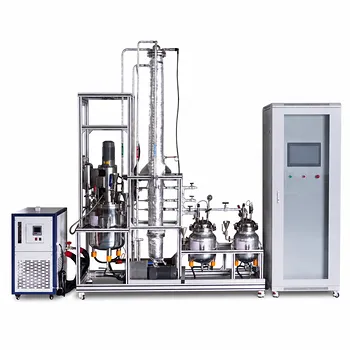
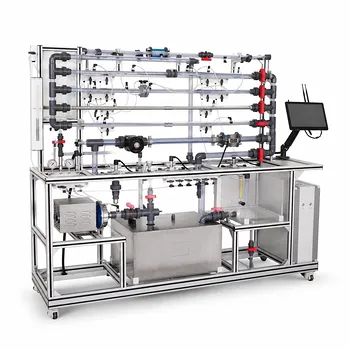
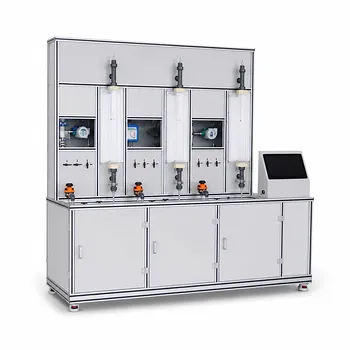
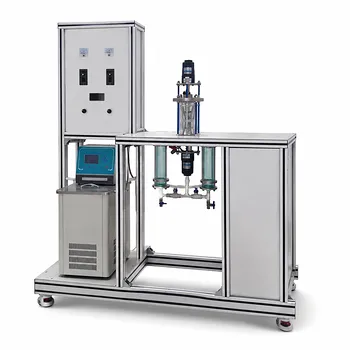
Whether you are demonstrating advanced mass transfer phenomena or scaling up complex multiphase reactions, LABPARK provides state-of-the-art Educational and Vocational Unit Operations Pilot Plants in chemical engineering, bioprocess & biotech, and environmental & water treatment. Designed specifically for universities, research institutes, and enterprises, our pilot plants empower students and researchers to master real-world process intensification.
Ready to elevate your laboratory capabilities? Contact LABPARK today to get a customized pilot plant solution for your institution!
Related Products
- Micro-Scale Gas-Solid Catalytic Reaction Educational Pilot Plant
- Fixed Bed Gas Solid Catalytic Reaction Educational Pilot Plant
- Fluidized Bed Gas Solid Catalytic Reaction Educational Pilot Plant
- Two-Dimensional Fluidization Hydrodynamics Educational Pilot Plant for Unit Operations Training
- Multi-Reactor Educational Pilot Plant for Reaction Engineering Unit Operations
People Also Ask
- Fluidized vs. Fixed Bed Reactors: Comparing Heat & Complexity in Pilot Plants
- Why is a multibed configuration necessary for exothermic reactions? Optimize your pilot plant trajectory.
- Why is thermal management a major challenge in methane oxidative coupling? Reactor Solutions for Pilot Plants
- How does the Mears criterion evaluate transport resistance? Key Guide to Intrinsic Kinetics
- How do reactor pilot plants safely study gas-solid reactions? Master kinetics with thermal & flow control.