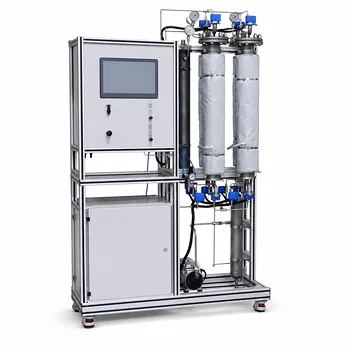
Induction and orientation forces are the invisible hands that determine how readily a gas dissolves in water. In a gas absorption pilot plant, water's polar nature interacts with gas molecules through two distinct mechanisms: it induces a temporary dipole in non-polar molecules like noble gases, and it aligns with the permanent dipoles of polar molecules like ammonia. The outcome is a clear solubility trend — larger, more polarizable non-polar gases dissolve better than smaller ones, while polar and hydrogen-bonding gases dissolve best of all. These molecular-level forces directly shape the base solubility that pilot plant operators observe, and they dictate the dominant mass transfer resistance in an absorption column.
Before a single flow rate is adjusted or a pressure setpoint changed, the inherent chemistry of the gas-water pair sets a solubility ceiling. Induction and orientation forces create that baseline, which then becomes the foundation for every temperature, pressure, and hydrodynamics decision in the plant. Mastering these forces lets you predict whether your absorption process will be gas-film or liquid-film controlled — and that prediction determines whether you invest your energy in increasing gas turbulence or optimizing liquid distribution.
The Two Key Intermolecular Forces at Play
When a gas molecule meets liquid water, the interaction is governed by electrostatic forces. Water’s permanent dipole moment distinguishes two critical scenarios.
Induction Force: When Water Creates a Dipole
Water is a polar molecule with a strong, permanent dipole. Even when a gas molecule has no net dipole — such as helium, argon, or methane — the water molecule’s electric field distorts the electron cloud of the non-polar gas. This distortion generates a temporary, induced dipole.
The strength of this induction force depends on the polarizability of the gas molecule. Polarizability increases with the number of electrons and the diffuseness of the electron cloud. For that reason, larger noble gases like xenon are much more polarizable than helium. The greater the polarizability, the stronger the attraction to water, and the higher the solubility. This is why, in any pilot plant lesson on dissolved gases, xenon shows measurably greater water solubility than helium even though both lack a permanent dipole.
Orientation Force: Aligning Permanent Dipoles
Polar gas molecules already possess a permanent dipole moment. When they encounter water, the positive end of one dipole aligns with the negative end of the other. This dipole-dipole (orientation) interaction is inherently stronger than an induced interaction.
Ammonia ((NH_3)) and carbon dioxide ((CO_2)) are classic examples. Ammonia can also form hydrogen bonds with water, which is an extreme case of the orientation force. The result is a solubility orders of magnitude higher than that of non-polar gases. Even gases like (CO_2), which have a modest quadrupole and can participate in acid-base chemistry, show dramatically enhanced solubility due to these specific molecular interactions.
From Molecular Forces to Pilot Plant Reality
Understanding these forces isn’t academic — it’s how you connect chemistry to column performance. In a unit operations pilot plant, the baseline solubility set by induction and orientation forces dictates everything from which rate-limiting regime you operate in to which process variable you must master.
Why Noble Gases Follow a Solubility Ladder
Take the sequence helium, neon, argon, krypton, xenon. As you move down the periodic table, atomic size and electron count rise. Polarizability climbs, the induction force with water intensifies, and solubility increases steadily.
In a pilot plant, this trend can be demonstrated by sparging these gases through water at fixed temperature and pressure. Helium shows almost negligible dissolution; xenon shows enough to meaningfully alter gas-phase composition. There is no permanent dipole involved — only induction. This simple ladder teaches operators that even “inert” gases have consistent, predictable solubility differences rooted in their electronic structure.
Why Ammonia Behaves Radically Differently from Carbon Dioxide
Ammonia’s permanent dipole and ability to hydrogen-bond with water mean that its solubility is extremely high. In column operation, that translates to a gas-film controlled process: the resistance to mass transfer is overwhelmingly located on the gas side. The moment ammonia molecules reach the gas-liquid interface, they are rapidly pulled into the liquid. To improve absorption, you must increase gas-phase turbulence and velocity rather than fiddle with liquid distribution.
Carbon dioxide, though often mistakenly grouped with “highly soluble” gases, is sparingly soluble in pure water compared to ammonia. Its induction and weak orientation interactions still leave it with a relatively large Henry’s law constant. This means the absorption of (CO_2) into water is a liquid-film controlled process. The resistance sits predominantly on the liquid side. Packing wetting, liquid flow rate, and distributor design become the levers you pull to boost mass transfer. Recognizing this distinction prevents an operator from wasting time boosting gas Reynolds numbers when the real bottleneck is on the liquid side.
Linking Solubility to Mass Transfer Regimes
The two-film theory directly connects solubility (Henry’s law constant (H)) to the location of mass transfer resistance. A gas with high solubility (strong orientation/hydrogen bonding) exhibits a small Henry’s law constant, making (1/k_l) negligible and rendering the process gas-film controlled. Conversely, a gas relying mainly on weak induction forces (large (H)) forces the process into liquid-film control.
In educational pilot plants, this translates to a deliberate choice of gas-liquid system. Choose ammonia-water to illustrate gas-film control; choose oxygen- or nitrogen-water to showcase liquid-film control. The induction and orientation forces you learned on the molecular level become the students’ roadmap for designing their experiment.
Trade-offs and Practical Limitations
Induction and orientation forces set the baseline, but they do not operate in isolation. Overlooking other variables leads to incorrect predictions and poor plant performance.
Temperature Overrides Molecular Attraction
Solubility is highly temperature-dependent. As solvent temperature rises, gas molecules have more kinetic energy to escape the liquid, and Henry’s law constants increase. Even a gas with strong orientation forces (like ammonia) becomes markedly less soluble in warm water. In pilot plants equipped with heat exchangers, students observe that heating the solvent stream can strip dissolved gases, completely reversing the absorption direction — regardless of how favorable the intermolecular forces are.
Pressure Multiplies the Driving Force
According to Henry’s law, the equilibrium dissolved concentration is proportional to partial pressure. A weak induction force can be offset by raising the operating pressure. In carbonation experiments, (CO_2) solubility at 8 atm is dramatically higher than at 1 atm, despite the same molecular interactions. This is why high-pressure absorption columns can process gases that would otherwise be considered “insoluble” — pressure compresses the gas, boosting the driving force for mass transfer.
Chemical Reactions Change the Game Entirely
The primary reference focuses on physical solubility. But in many environmental and carbon-capture pilot plants, chemical solvents like amines are used. Here, an entirely different mechanism — chemical reaction — dominates solubility, far surpassing anything induction or orientation forces alone could achieve. While this is beyond the scope of physical absorption, it’s a critical reminder that selecting the right solvent can completely eclipse the native water solubility dictated by dipoles.
Making the Right Choice for Your Pilot Plant Goal
When designing or operating a gas absorption experiment, let the molecular forces guide your system selection and operational strategy.
- If your primary focus is demonstrating physical solubility trends: Use a series of noble gases (helium through xenon) in water. The solubility ladder is a pure, clean demonstration of induction forces, free from chemical complications.
- If your primary focus is gas-film controlled absorption: Select ammonia-water or another highly soluble, polar gas system. Focus your optimization efforts on the gas phase — increase gas velocity, improve sparger design, and ensure turbulent gas flow.
- If your primary focus is liquid-film controlled absorption: Choose (CO_2)-water or oxygen-water. Here, the liquid side is the bottleneck. Invest your time in perfecting liquid distributor design, ensuring uniform wetting of packing, and adjusting liquid-to-gas flow ratios.
- If your primary focus is exploring temperature and pressure effects: Start with a gas of moderate solubility, like (CO_2), where you can clearly observe shifts in the equilibrium curve. Use a jacketed column with temperature control and a back-pressure regulator to move the system deliberately between absorption and stripping regimes.
Induction and orientation forces give you the map; temperature, pressure, and hydrodynamics give you the steering wheel. Mastering both is what turns a pilot plant from a black box into a precision instrument for chemical engineering education and process optimization.
Summary Table:
| Intermolecular Force | Gas Type | Solubility in Water | Mass Transfer Control |
|---|---|---|---|
| Induction (Temporary dipole) | Non-polar (e.g., He, Xe) | Low (increases with atomic size) | Liquid-film controlled (e.g., $O_2$, $CO_2$) |
| Orientation / H-Bonding | Polar (e.g., $NH_3$) | High to Extremely High | Gas-film controlled (e.g., $NH_3$) |
Ready to bring molecular chemistry and chemical engineering principles to life in your lab? LABPARK provides Educational and Vocational Unit Operations Pilot Plants in chemical engineering, bioprocess & biotech, and environmental & water treatment for universities, research institutes, and enterprises. Help your students master mass transfer regimes, absorption column hydrodynamics, and process control with our industry-grade training systems. Contact us today to discuss your laboratory setup and request a customized quotation!
Related Products
- Dual-Mode Gas Absorption and Desorption Unit Operations Training Pilot Plant
- Multi-Component Gas Pressure Swing Adsorption Pilot Plant for Unit Operations Education
- Carbon Dioxide Adsorption and Capture Educational Unit Operations Pilot Plant
- Packed Bed Absorption Educational Unit Operations Pilot Plant
- Absorption and Desorption Educational Unit Operations Pilot Plant
People Also Ask
- How do temperature and pressure affect gas absorption and desorption? Optimize Pilot Plant Performance
- How do two-film & penetration theories apply to gas absorption pilot plant teaching? Key pedagogical insights.
- How is the direction and driving force of mass transfer determined in a gas absorption unit operations pilot plant?
- How does partial pressure behavior influence gas absorption pilot plants? Master Mass Transfer
- How to model chemical absorption as physical absorption? The pilot plant simplification criterion.