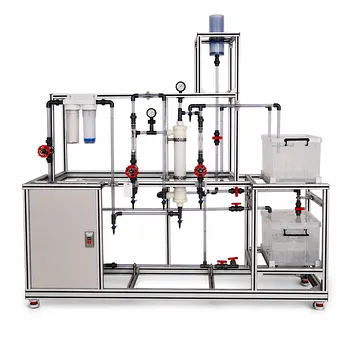
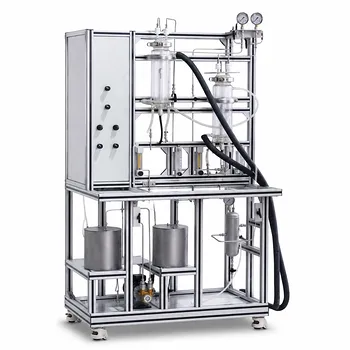
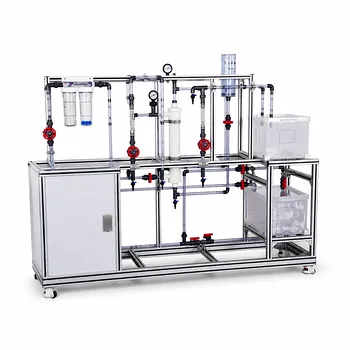
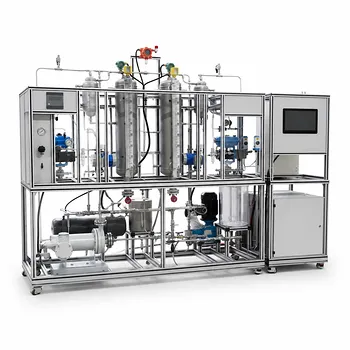
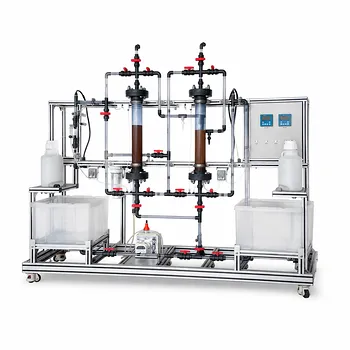
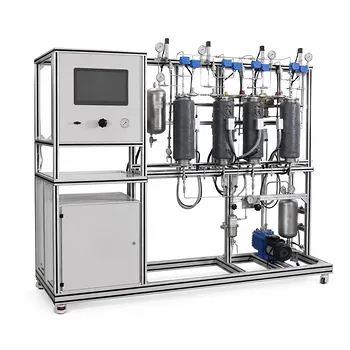
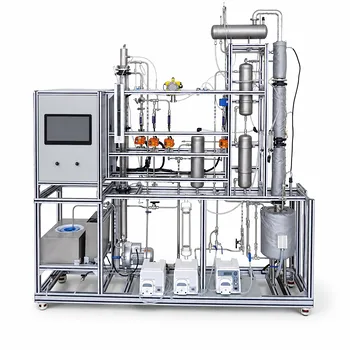
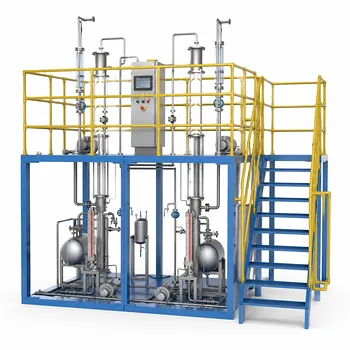
The core function is separation by preferential permeation. In an environmental and gas treatment pilot plant, organophilic membranes are used as a training tool to demonstrate the selective removal of Volatile Organic Compounds (VOCs) from air or nitrogen streams. The system compresses the feed gas, raises the VOC partial pressure, and uses a vacuum pump to draw an enriched permeate, leaving a purified gas retentate that meets emission standards. This directly simulates industrial solvent recovery and gasoline vapor capture.
The organophilic membrane pilot plant is a hands-on system designed not just to clean air, but to visually and operationally bridge the gap between fundamental mass transfer principles and an integrated industrial pollution control process. It solves the deep training need of understanding how membrane technology fits within a full-scale treatment train, including pre-treatment and post-polishing steps.
Deconstructing the Core Separation Principle
The pilot plant’s value lies in demonstrating a solution-driven separation, not just a theoretical one. It shows how the properties of the membrane material are exploited for a specific environmental goal—recovering value from waste.
The Fundamental Driving Force
The separation is based on a chemical potential gradient, practically managed as a partial pressure difference. The feed stream is compressed to bring the organic vapors near or above their saturation point.
This high-pressure, VOC-laden gas contacts the membrane’s active layer. The organophilic material selectively dissolves the VOC molecules on the feed side, they diffuse through the membrane, and are desorbed on the permeate side under vacuum. The result is a permeate stream that is highly concentrated with reusable solvents.
The Anatomy of the Working Membrane
The heart of the system is a thin-film composite (TFC) membrane. Its multi-layer construction is critical to surviving pilot plant conditions.
A rugged polyester nonwoven layer provides the mechanical backbone to withstand high feed pressures. This supports a microporous substrate, often made from polysulfone or polyimide, offering a smooth, strong foundation with minimal flow resistance. The separation magic happens in the final layer: a pore-free, rubbery polymer coating. This permselective skin determines the success of the recovery process.
Configuring the Pilot Plant for Training Goals
An effective training unit is not a black box; it’s a configurable system that teaches process integration. The placement of recovery and post-treatment units changes the entire process economics and efficiency.
Process Sequence and Multi-Stage Integration
The pilot plant’s layout is dictated by the feedstock's concentration and the user's compression strategy. This directly shows students how industrial plants are designed.
- Compression-First Setup: If a feed compressor is used, a condenser or absorption unit is placed upstream of the membrane stage. This handles the bulk of high-concentration organics before they reach the membrane, optimizing performance.
- Vacuum-First Setup: Without feed compression, the primary recovery unit sits in the permeate line. The vacuum pump’s discharge, rich in VOCs, is then sent to a condensation or recovery loop, demonstrating a different recovery strategy.
- Retentate Polishing: For compliance training, a post-treatment unit—such as an adsorption column or a catalytic oxidizer—is placed on the retentate exit. This demonstrates how to achieve final air purification targets that the membrane alone cannot meet, creating a complete environmental solution.
Membrane Contactor as an Alternative Bio-Configuration
The standard organophilic unit focuses on physical separation. An alternative training module uses a membrane contactor to showcase a destructive hybrid process.
In this setup, the gas flows on one side of a hydrophobic microporous membrane, while an aqueous nutrient solution with a specialized biofilm circulates on the other. The membrane acts as a fixed, non-clogging interface. VOCs like toluene diffuse from the gas into the liquid phase, where bacteria biodegrade them. This configuration directly teaches the avoidance of conventional scrubber problems like flooding and channeling.
Understanding the Trade-offs in Material and Process Selection
A high-quality training experience must teach economic and operational trade-offs. The choice of membrane material and process conditions dictates performance.
POMS vs. PDMS: A Selectivity-Flux Dilemma
The choice of the rubbery coating material is a central teaching point. The default standard is Polydimethylsiloxane (PDMS) .
PDMS offers very high flux, meaning more gas can be processed. However, its selectivity is moderate. For demonstrating specialized, high-purity separations, Polyoctylmethylsiloxane (POMS) is the superior choice. POMS provides significantly higher selectivity, which drastically reduces the required membrane area. This trade-off teaches a key engineering lesson: using POMS allows the pilot plant to run with smaller, cheaper vacuum pumps and compressors, swapping material cost for reduced ancillary equipment costs.
Pervaporation vs. Traditional Processes for Liquid Streams
While the primary reference focuses on gas streams, the system’s versatility extends to liquid-phase training via pervaporation. This comparison teaches broader economic logic.
The pilot plant can simulate the recovery of high-value aroma compounds or solvents from wastewater. Here, the organophilic membrane works by phase-change pervaporation. This is directly compared against the operating costs of traditional steam stripping or biological treatment, allowing users to calculate the break-even point where high product value justifies the membrane's selective but energy-intensive process.
Making the Right Choice for Your Pilot Plant Goal
The design of your training module and experiments should align with your specific educational or research objective. The "best" configuration is always relative to the learning outcome.
- If your primary focus is demonstrating high-value recovery economics: Configure the plant with POMS membranes and a vacuum-side recovery unit. This setup maximizes the concentration of valuable monomers like vinyl chloride and directly teaches the cost-benefit analysis of recycling versus emission control.
- If your primary focus is complete environmental compliance training: Use a PDMS membrane for bulk removal but heavily emphasize the integration and tuning of the post-treatment polishing unit, such as catalytic combustion, for the retentate stream.
- If your primary focus is process versatility and biological treatment: Incorporate the membrane contactor module. This allows parallel study of physical recovery (organophilic membrane) and destructive biological treatment (membrane biofilm reactor) for the same waste gas stream, with a focus on avoiding hydraulic issues like foaming.
The organophilic membrane pilot plant’s true training value is not just in a single separation, but in mastering the engineering decisions required to position it flawlessly within an industrial process chain.
Summary Table:
| Feature | PDMS Membrane | POMS Membrane | Membrane Contactor |
|---|---|---|---|
| Primary Function | Bulk VOC recovery & removal | High-purity separations | Biological VOC degradation |
| Key Advantage | High gas permeation flux | Superior selectivity (smaller footprint) | Eliminates flooding & channeling |
| Process Mechanism | Solution-diffusion | Solution-diffusion | Fixed biological interface |
Bring Industrial-Scale Environmental Tech to Your Lab with LABPARK
Bridge the gap between theoretical mass transfer and real-world pollution control. LABPARK provides state-of-the-art Educational and Vocational Unit Operations Pilot Plants in chemical engineering, bioprocess & biotech, and environmental & water treatment.
Tailored for universities, research institutes, and enterprises, our systems—including customizable organophilic membrane units—allow students and researchers to master VOC recovery, process configuration, and emissions compliance through hands-on learning.
Ready to elevate your engineering curriculum or research capabilities? Contact LABPARK today to discuss your pilot plant needs!
Related Products
- Ultrafiltration Membrane Separation Educational Pilot Plant
- Multifunctional Membrane Separation Educational Pilot Plant with Ultrafiltration, Nanofiltration, Reverse Osmosis
- Photocatalytic Membrane Separation and Degradation Unit Operations Pilot Plant
- Multi-Functional Membrane Separation Educational Pilot Plant for Unit Operations Lab
- Multi Functional Membrane Crystallization Educational Unit Operations Pilot Plant
People Also Ask
- Pervaporation vs. Vapor Permeation: Handling Suspended Solids in Membrane Pilot Plants
- How do PEI, PVDF, and PSU membranes compare in pilot plants? Find the best fit.
- How do membrane pilot plants demonstrate synthetic vs biological membrane advantages?
- Why Use a Membrane Separation Pilot Plant vs. Lab Testing? Avoid Costly Scale-Up Failures
- Isotropic vs. Anisotropic Membranes: How to Choose the Best Pilot Plant Modules