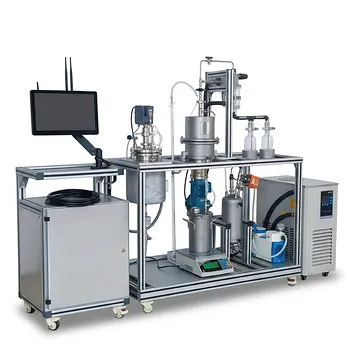
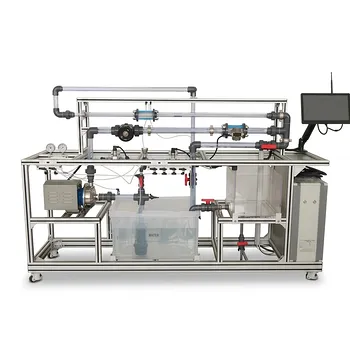
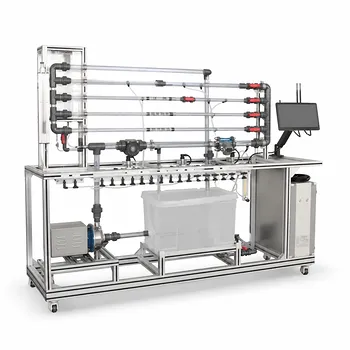
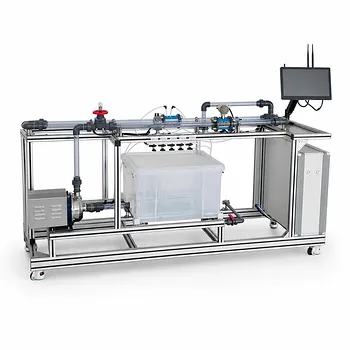
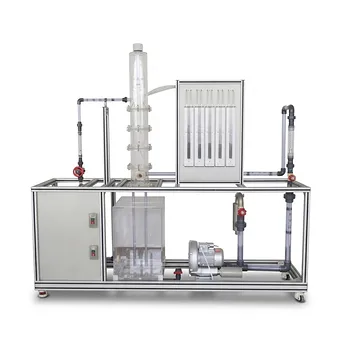
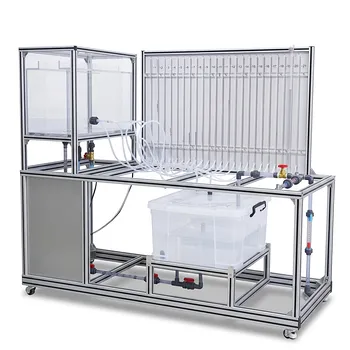
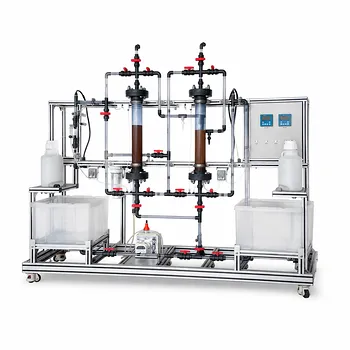
When you need to demonstrate water hammer mitigation in a lab setup, the core mechanical difference is stark. A surge chamber relies on an open water column that rises freely to absorb energy, while an air chamber compresses a trapped pocket of gas. This distinction directly shapes their maintenance, space requirements, and the hydraulic principles they illuminate for students.
The deepest insight emerges not from choosing one device, but from running both side-by-side. A surge chamber offers a low-maintenance, visually intuitive demonstration of hydraulic gradient control. An air chamber, though compact, forces students to confront the real-world maintenance headache of air dissolution—making the combination an exceptionally complete teaching tool.
How the Two Devices Absorb a Pressure Transient
Both components convert the kinetic energy of a suddenly stopped liquid column, but they follow different physical paths.
The Surge Chamber Alters the Hydraulic Gradient
An open-topped surge chamber allows a large quantity of water to rush upward when a valve slams shut.
This vertical rise changes the local hydraulic gradient, creating a decelerating force that safely dissipates the pressure wave.
Because the water surface is in contact with the atmosphere, the absorption mechanism is purely gravitational and fluid-mechanical.
The Air Chamber Relies on Gas Compression
An air chamber traps a cushion of air above the water line.
When a pressure spike hits, the water compresses this gas, storing the energy temporarily and releasing it as the system returns to equilibrium.
The trapped air acts as a nonlinear spring, but its effectiveness depends critically on the gas volume being maintained.
Operational Considerations That Shape Your Lab Schedule
These fundamental design choices translate into vastly different maintenance routines and spatial demands.
The Air Chamber’s Relentless Need for Replenishment
Pressurized water has a strong appetite—it slowly absorbs the trapped air over time.
If the air pocket shrinks, the chamber stiffens and can no longer cushion transients effectively.
This means periodic recharging with a small air compressor is not optional; it is a mandatory daily or weekly task, providing a perfect teachable moment about gas solubility under pressure.
Physical Size Limits and Lab Headroom
An air chamber faces a hard volume constraint: the maximum pressure surge it can handle is tied directly to the size of the compressible gas space.
For energetic transients, a purely air-chamber solution can become impractically large.
A surge chamber side-steps this by using vertical height rather than vessel diameter. However, it does demand generous overhead clearance for the water column to rise freely, which can be a deal-breaker in a low-ceiling laboratory.
The Surge Chamber’s Minimal Hands-On Upkeep
With no trapped gas to monitor and no compressor to run, a surge chamber erases the maintenance load associated with air dissolution.
Its open design means you never schedule a recharge cycle; the only practical concern might be periodic cleaning to avoid debris or biological growth.
This passive reliability makes it an excellent choice when the educational goal is to observe fundamental pressure wave physics without the distraction of component failure.
The Educational Advantage of Using Both
In a pilot plant built for teaching, the relative advantages are best understood through the lens of what students can directly compare.
Illustrating Two Distinct Transient Absorption Mechanisms
A surge chamber lets students visually trace the water level rise and calculate the decelerating force generated by an altered hydraulic gradient.
An air chamber lets them explore compression thermodynamics and measure how gas volume directly affects peak pressure attenuation.
Running the same shut-off scenario through both devices uncovers contrasting signatures in pressure-versus-time data, cementing the idea that “mitigation” is not one-size-fits-all.
Teaching Real-World Maintenance Trade-offs
The air chamber’s slow loss of effectiveness due to air absorption mirrors a genuine industrial headache.
By plotting the decaying performance over multiple tests without recharging, students internalize why field installations often favor bladder accumulators or surge tanks.
This joint setup turns an abstract maintenance note into a hands-on lesson about system reliability, making the air chamber’s operational weakness a powerful teaching strength.
Understanding the Trade-offs
No single device is perfect. A clear-eyed view of their drawbacks is essential for designing a meaningful experiment.
- Air chamber limitations: Its performance degrades silently as air dissolves, forcing you to log maintenance intervals faithfully. For large, fast transients, the required gas volume can quickly outgrow the lab bench.
- Surge chamber vulnerabilities: The open surface invites oxygen absorption, potentially causing corrosion downstream. It also requires a stable overflow path or drain, and the tall vertical standpipe must be structurally braced.
- Response time nuance: A surge chamber’s free water surface responds with a slight inertial lag compared to the near-instantaneous compliance of a pre-charged air cushion. This subtle delay is measurable and can spark classroom discussions about frequency-dependent behavior.
- Space-cost balance: If your lab has abundant vertical space but limited floor area, a slender surge chamber is a natural fit. If you are confined to a tabletop skid, you might lean toward an air chamber, accepting the compressor and recharge routine.
Making the Right Choice for Your Educational Goal
The ideal configuration depends on which lesson you want students to walk away with.
- If your primary focus is passive, maintenance-free operation: Select a surge chamber. It will run reliably semester after semester while revealing the direct link between hydraulic gradient and energy dissipation.
- If your primary focus is gas-fluid interaction and industrial realism: Install an air chamber. The mandatory air replenishment routine becomes a memorable lesson in why real pipelines require automated make-up air systems.
- If your primary focus is a comparative experiment that covers the full spectrum of mitigation physics: Incorporate both. A single pilot plant equipped with both devices lets students gather side-by-side data, analyze the trade-offs, and defend an engineering choice based on measured evidence.
By pairing these two fundamentally different mitigation strategies in your pilot plant, you give students a complete, unbiased laboratory course in transient fluid dynamics—one that no textbook graph alone can replicate.
Summary Table:
| Feature | Surge Chamber | Air Chamber |
|---|---|---|
| Mitigation Mechanism | Gravitational column rise | Gas compression cushion |
| Maintenance Level | Low (passive system) | High (periodic air recharging) |
| Space Requirement | High vertical headroom | Compact footprint |
| Educational Value | Visualizing hydraulic gradients | Studying thermodynamics & maintenance |
Upgrade your engineering lab with hands-on, industry-grade training systems. LABPARK provides premium Educational and Vocational Unit Operations Pilot Plants in chemical engineering, bioprocess & biotech, and environmental & water treatment designed specifically for universities, research institutes, and enterprises.
Whether you want to demonstrate water hammer mitigation side-by-side or build a custom process control system, we deliver the hardware and curriculum support you need. Contact LABPARK today to request a quote and customize your pilot plant!
Related Products
- Constant Pressure Filtration Educational Unit Operations Pilot Plant
- Rising and Falling Film Evaporation Educational Unit Operations Pilot Plant
- Three-Tube Heat Transfer Educational Pilot Plant for Unit Operations Training
- Carbon Dioxide PVT Curve Determination Educational Unit Operations Pilot Plant
- Cavitation Phenomenon Demonstration and Analysis Educational Unit Operations Pilot Plant
People Also Ask
- How do educational unit operations pilot plants bridge theory and design? Bridge the Engineering Gap
- How do educational unit operations pilot plants address safety and waste management when scaling up?
- Why splitting a filtration batch doesn't always reduce cycle time? Pilot Plant Insights
- Why Demo Constant-Rate to Constant-Pressure Filtration on a Pilot Plant? Key Practical Insights
- How to select solid-liquid separation equipment for pilot plants? A Step-by-Step Guide